


Vehicle Maintenance Honda Civic 3 and 4

Vehicle Identification Numbers
The vehicle number is stamped on the rear wall of the engine compartment and repeated on a plate under the windshield on the driver's side. The engine number on early models is stamped on the right rear side of the...
The vehicle number is stamped on the rear wall of the engine compartment and repeated on a plate under the windshield on the driver's side. The engine number on early models is stamped on the right rear side of the...

Fasteners
HONDA cars use metric and inch threads of fasteners: they are not interchangeable, be careful when working on the car. Bolts and nuts have a strength marking, it is applied to the part with dashes, dots or numbers: the...
HONDA cars use metric and inch threads of fasteners: they are not interchangeable, be careful when working on the car. Bolts and nuts have a strength marking, it is applied to the part with dashes, dots or numbers: the...

Emergency engine start
a) Before connecting the second battery, turn off the ignition; b) turn off all electrical loads; c) protect your eyes; d) Make sure that both batteries have the same operating voltage; d) two cars must not touch each...
a) Before connecting the second battery, turn off the ignition; b) turn off all electrical loads; c) protect your eyes; d) Make sure that both batteries have the same operating voltage; d) two cars must not touch each...

Jacking and towing a car
Jacking up Place the jack only under the amplifiers; never work on a vehicle raised on a jack; provide rigid supports. Jack installation locations Towing The best way to tow is with a special tractor in a semi-submerged...
Jacking up Place the jack only under the amplifiers; never work on a vehicle raised on a jack; provide rigid supports. Jack installation locations Towing The best way to tow is with a special tractor in a semi-submerged...
Car malfunctions and their causes
1. The engine does not turn over when trying to start The battery contacts are loose or corroded. The battery is discharged or damaged. The automatic transmission is not in the "P" or "N" positions or the clutch pedal...
1. The engine does not turn over when trying to start The battery contacts are loose or corroded. The battery is discharged or damaged. The automatic transmission is not in the "P" or "N" positions or the clutch pedal...
Maintenance Specifications
Recommended lubricants and fluids motor oil: type - SG/CC by API viscosity: -10°C to 50°0 - 20 W40 -20°C to 50°C -10 W40 -30°C to 30°C - 10 W30 automatic transmission - Dexron II Manual transmission type - SF/SG no API,...
Recommended lubricants and fluids motor oil: type - SG/CC by API viscosity: -10°C to 50°0 - 20 W40 -20°C to 50°C -10 W40 -30°C to 30°C - 10 W30 automatic transmission - Dexron II Manual transmission type - SF/SG no API,...
General information on servicing Honda Civic, CRX and Shuttle vehicles
Servicing your car at recommended mileage or operating time will extend the life of your car. When servicing one system, be sure to check the others, for example, if you lift the car to lubricate the chassis, inspect...
Servicing your car at recommended mileage or operating time will extend the life of your car. When servicing one system, be sure to check the others, for example, if you lift the car to lubricate the chassis, inspect...
Maintenance frequency
Weekly or every 400 km Control: engine oil level; coolant level; brake fluid level; tire pressure. Every 3 months or 5,000 km In addition to the above: control of the fluid level in the steering system; automatic...
Weekly or every 400 km Control: engine oil level; coolant level; brake fluid level; tire pressure. Every 3 months or 5,000 km In addition to the above: control of the fluid level in the steering system; automatic...
General information about adjustments
Sooner or later, it is time to make adjustments, especially if the frequency of maintenance was not observed. The first step in engine diagnostics is to measure the compression pressure ("compression"). Measurement of...
Sooner or later, it is time to make adjustments, especially if the frequency of maintenance was not observed. The first step in engine diagnostics is to measure the compression pressure ("compression"). Measurement of...
Control of operating fluid levels
1. Recommended fluids are listed in specifications . Level control should be carried out on a horizontal platform. Engine oil 2. The oil level dipstick is located on the left front side of the engine. 3. The level is...
1. Recommended fluids are listed in specifications . Level control should be carried out on a horizontal platform. Engine oil 2. The oil level dipstick is located on the left front side of the engine. 3. The level is...

Tire pressure and tire control
1. The condition of your tire tread can give you information about problems with your suspension or steering. 2. If the tread depth is less than the permissible value, replace the tires. 3. Carefully inspect the surface...
1. The condition of your tire tread can give you information about problems with your suspension or steering. 2. If the tread depth is less than the permissible value, replace the tires. 3. Carefully inspect the surface...
Checking the fluid level in the power steering
1. If you have a power steering system, you will need to periodically replenish the fluid. 2. The power steering reservoir on models from 1984 to 1987 is installed on the power steering pump, since 1988 it is installed...
1. If you have a power steering system, you will need to periodically replenish the fluid. 2. The power steering reservoir on models from 1984 to 1987 is installed on the power steering pump, since 1988 it is installed...
Checking the oil level in an automatic transmission
1. The fluid level in the automatic transmission is an important performance indicator. Both liquid and high oil levels are not allowed. 2. Check the level only when the engine is off. 3. Remove the dipstick and, at the...
1. The fluid level in the automatic transmission is an important performance indicator. Both liquid and high oil levels are not allowed. 2. Check the level only when the engine is off. 3. Remove the dipstick and, at the...
Replacing the oil filter and oil
1. Frequent oil changes are the key to a long engine life. 2. Before starting the oil change procedure, prepare all necessary tools and consumables. 3. It is more convenient to change the oil and filter from below, i.e....
1. Frequent oil changes are the key to a long engine life. 2. Before starting the oil change procedure, prepare all necessary tools and consumables. 3. It is more convenient to change the oil and filter from below, i.e....
Replacing windshield wiper blades
1. If the rubber of the wiper blade is worn out and/or does not clean the glass well enough, replace it. 2. At the same time, inspect the fastening elements of the brush leash.
1. If the rubber of the wiper blade is worn out and/or does not clean the glass well enough, replace it. 2. At the same time, inspect the fastening elements of the brush leash.
Battery maintenance
1. Regular battery maintenance will ensure easy and reliable engine starting. 2. Before servicing the battery, disconnect the cable from the negative terminal. 3. Hydrogen is formed in the battery: explosive! Charge the...
1. Regular battery maintenance will ensure easy and reliable engine starting. 2. Before servicing the battery, disconnect the cable from the negative terminal. 3. Hydrogen is formed in the battery: explosive! Charge the...
Drive belts — adjustment and replacement
1. The generator and air conditioning compressor drive belts are V-belts. 2. The number of belts depends on the design of the engine and attachments. 3. Check the condition of the belts: replace oily and damaged belts...
1. The generator and air conditioning compressor drive belts are V-belts. 2. The number of belts depends on the design of the engine and attachments. 3. Check the condition of the belts: replace oily and damaged belts...
Rubber Hoses — Inspection and Replacement
Caution: Never replace air conditioner hoses yourself. General information 1. Rubber hoses wear out over time. Inspect them periodically. 2. Cooling system hoses are highlighted separately in section 13 . 3. Check the...
Caution: Never replace air conditioner hoses yourself. General information 1. Rubber hoses wear out over time. Inspect them periodically. 2. Cooling system hoses are highlighted separately in section 13 . 3. Check the...
Cooling system control
1. Insufficient performance of the cooling system results in serious damage to the engine and automatic transmission. 2. Check the system only on a cold engine. 3. Remove the radiator cap: you should hear the sound of...
1. Insufficient performance of the cooling system results in serious damage to the engine and automatic transmission. 2. Check the system only on a cold engine. 3. Remove the radiator cap: you should hear the sound of...
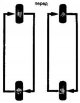
Wheel rotation
1. Tires should be rotated at regular intervals or when the tread on one of the tires is worn out. 2. The diagram of the movement of radial tires is shown in Fig. 14.2. Fig. 14.2 Wheel rotation diagram 3. Each time you...
1. Tires should be rotated at regular intervals or when the tread on one of the tires is worn out. 2. The diagram of the movement of radial tires is shown in Fig. 14.2. Fig. 14.2 Wheel rotation diagram 3. Each time you...
Brake control
1. Inspect the brakes at recommended intervals and whenever the wheels are removed. 2. Symptoms that indicate potential brake problems: the vehicle pulls to one side when braking, noise when braking, increased brake...
1. Inspect the brakes at recommended intervals and whenever the wheels are removed. 2. Symptoms that indicate potential brake problems: the vehicle pulls to one side when braking, noise when braking, increased brake...
Air filter and crankcase ventilation filter
1. Replace filters at recommended intervals. 2. The filter is located in the housing above the carburetor or next to the engine (carburetor models and models with injection respectively). 3. Remove the filter cover and...
1. Replace filters at recommended intervals. 2. The filter is located in the housing above the carburetor or next to the engine (carburetor models and models with injection respectively). 3. Remove the filter cover and...
Spark plugs — inspection and replacement
1. The spark plugs are replaced using a special head with a rubber washer that prevents damage to the insulator. 2. Before installing a new spark plug, adjust the spark gap between the side and central electrodes. The...
1. The spark plugs are replaced using a special head with a rubber washer that prevents damage to the insulator. 2. Before installing a new spark plug, adjust the spark gap between the side and central electrodes. The...
High voltage wires, distributor cap and rotor
1. Check high-voltage wires at night (not in the garage!) with the engine running. If you see the glow of the wires or a breakdown of the insulation on the housing, replace the wires and inspect the distributor cap and...
1. Check high-voltage wires at night (not in the garage!) with the engine running. If you see the glow of the wires or a breakdown of the insulation on the housing, replace the wires and inspect the distributor cap and...
Valve Drive Clearances — Checking and Adjusting
1. Checking and adjusting the clearance is carried out on a cold engine. 2. Remove the air filter assembly ( Chapter 4 ). 3. Remove the camshaft cover ( Chapter 2A ). 4. Set the piston of the first cylinder to TDC (...
1. Checking and adjusting the clearance is carried out on a cold engine. 2. Remove the air filter assembly ( Chapter 4 ). 3. Remove the camshaft cover ( Chapter 2A ). 4. Set the piston of the first cylinder to TDC (...
Fuel system control
1. If you smell fuel while driving or parked in the sun, inspect the fuel system immediately. 2. Inspect the filler neck, supply and return pipes. Make sure that the connections are securely tightened. 3. Inspect the...
1. If you smell fuel while driving or parked in the sun, inspect the fuel system immediately. 2. Inspect the filler neck, supply and return pipes. Make sure that the connections are securely tightened. 3. Inspect the...

Checking the oil level in a manual transmission
1. Work is carried out under the vehicle. 2. Unscrew the filler plug. The correct oil level is under the filler hole edge. Fig. 22.1 Drain (1) and filler (2) plugs of a manual gearbox 3. Add oil with a syringe until oil...
1. Work is carried out under the vehicle. 2. Unscrew the filler plug. The correct oil level is under the filler hole edge. Fig. 22.1 Drain (1) and filler (2) plugs of a manual gearbox 3. Add oil with a syringe until oil...

Checking the oil level in the rear differential (4WD models)
1. Work is carried out under the vehicle. 2. Unscrew the plug (it is both a control and a filler). The oil should be under the edge of the plug hole. Fig. 23.2. Location of rear differential plugs 3. Add oil and tighten...
1. Work is carried out under the vehicle. 2. Unscrew the plug (it is both a control and a filler). The oil should be under the edge of the plug hole. Fig. 23.2. Location of rear differential plugs 3. Add oil and tighten...
Steering and suspension control
Illustrations are given in Chapter 10 . The car is on the ground 1. Set the wheels to the straight-ahead position. Check the free play of the steering wheel. If it exceeds the permissible value, then there are problems...
Illustrations are given in Chapter 10 . The car is on the ground 1. Set the wheels to the straight-ahead position. Check the free play of the steering wheel. If it exceeds the permissible value, then there are problems...
Checking the drive shaft dust boots
1. The integrity of the dust boots guarantees the normal operation of the CV joints. Otherwise, the CV joints will wear out very quickly. 2. Replace torn anthers immediately ( see Chapter 8 ).
1. The integrity of the dust boots guarantees the normal operation of the CV joints. Otherwise, the CV joints will wear out very quickly. 2. Replace torn anthers immediately ( see Chapter 8 ).
Air damper position control
1. The air damper operates only when the engine is cold started. 2. Remove the air cleaner. Mark and disconnect the vacuum hoses. 3. The flap will be visible through the opening in the filter housing. 4. Press the gas...
1. The air damper operates only when the engine is cold started. 2. Remove the air cleaner. Mark and disconnect the vacuum hoses. 3. The flap will be visible through the opening in the filter housing. 4. Press the gas...
Checking and replacing crankcase ventilation
1. The ventilation valve in the crankcase breather chamber or the hoses connecting the crankcase breather to the intake manifold. Control 2. With the warm engine idling, disconnect the valve hose located at the top of...
1. The ventilation valve in the crankcase breather chamber or the hoses connecting the crankcase breather to the intake manifold. Control 2. With the warm engine idling, disconnect the valve hose located at the top of...
Cooling system maintenance
1. Maintenance and replacement of cooling system hoses must be carried out at the specified intervals. Draining liquid 2. Cool the engine, remove the radiator cap. 3. Place a container to collect the coolant under the...
1. Maintenance and replacement of cooling system hoses must be carried out at the specified intervals. Draining liquid 2. Cool the engine, remove the radiator cap. 3. Place a container to collect the coolant under the...
Exhaust system control
1. Perform work only on a cold engine, start checking from the engine. 2. Inspect pipes and connections for visible leaks, damage and corrosion. Make sure all brackets are intact and secure. 3. Move the pipes,...
1. Perform work only on a cold engine, start checking from the engine. 2. Inspect pipes and connections for visible leaks, damage and corrosion. Make sure all brackets are intact and secure. 3. Move the pipes,...
Replacing brake fluid
1. Brake fluid actively absorbs moisture, which can cause corrosion of brake system components. Replace the fluid at recommended intervals. 2. It is advisable to flush the brake system with alcohol. The procedure for...
1. Brake fluid actively absorbs moisture, which can cause corrosion of brake system components. Replace the fluid at recommended intervals. 2. It is advisable to flush the brake system with alcohol. The procedure for...
Automatic Transmission Oil Change
The fuel capacity of 4x2 and 4WD models is different, see specification. 1. Replace at recommended intervals. 2. Replace when the gearbox is warm. Warning: oil temperature exceeds 110°C! 3. Raise the vehicle, place a...
The fuel capacity of 4x2 and 4WD models is different, see specification. 1. Replace at recommended intervals. 2. Replace when the gearbox is warm. Warning: oil temperature exceeds 110°C! 3. Raise the vehicle, place a...
Changing oil in a manual transmission
1. Raise the car and place it on stands. Place a container to collect the oil and unscrew the drain plug. Drain the oil. The presence of metal inclusions indicates wear of the gearbox parts. 2. Replace the plug. 3. Fill...
1. Raise the car and place it on stands. Place a container to collect the oil and unscrew the drain plug. Drain the oil. The presence of metal inclusions indicates wear of the gearbox parts. 2. Replace the plug. 3. Fill...
Changing the Rear Differential Oil (4WD Models)
1. Warm up the differential (a trip of several kilometers). 2. Raise the car, unscrew the drain plug. 3. Carefully remove the drain plug and drain the oil, reinstall the plug. 4. The presence of metal inclusions...
1. Warm up the differential (a trip of several kilometers). 2. Raise the car, unscrew the drain plug. 3. Carefully remove the drain plug and drain the oil, reinstall the plug. 4. The presence of metal inclusions...

Adjusting the ignition timing angle
Note: Basic adjustment data is provided on the plate under the engine hood. 1. To adjust the ignition timing, you need a stroboscope. 2. On 1986, 1987 models, disconnect the hoses from the distributor and plug them. 3....
Note: Basic adjustment data is provided on the plate under the engine hood. 1. To adjust the ignition timing, you need a stroboscope. 2. On 1986, 1987 models, disconnect the hoses from the distributor and plug them. 3....

Intake Air Temperature Control Valve Control
1. Some engines are equipped with an intake air temperature control valve. Fig. 35.3 Typical intake air temperature control circuit 2. Control is carried out visually. In case of limited access, a mirror is used. 3. The...
1. Some engines are equipped with an intake air temperature control valve. Fig. 35.3 Typical intake air temperature control circuit 2. Control is carried out visually. In case of limited access, a mirror is used. 3. The...

Inspection of throttle control rods
1. If something prevents the accelerator pedal from moving, inspect the throttle linkage system. 2. Lubricate all lever axles with engine oil. 3. Press the throttle lever and check the cable deflection. It should be...
1. If something prevents the accelerator pedal from moving, inspect the throttle linkage system. 2. Lubricate all lever axles with engine oil. 3. Press the throttle lever and check the cable deflection. It should be...

Adjusting the idle speed
1. Engine idle speed is a critical value for the operation of the engine and individual vehicle systems. 2. Start the engine and warm it up to normal operating temperature (the fan should turn on twice). 3. Stop the...
1. Engine idle speed is a critical value for the operation of the engine and individual vehicle systems. 2. Start the engine and warm it up to normal operating temperature (the fan should turn on twice). 3. Stop the...
Fuel vapor recovery system control
1. The purpose of the system is to accumulate fuel vapors in an accumulator with activated carbon in order to maintain a clean environment. 2. The main sign of a system malfunction is a persistent smell of fuel in the...
1. The purpose of the system is to accumulate fuel vapors in an accumulator with activated carbon in order to maintain a clean environment. 2. The main sign of a system malfunction is a persistent smell of fuel in the...
Exhaust Gas Recirculation (EGR) System
1. The EGR system is usually located on the intake manifold (carburetor) or throttle body (injection). The biggest problems in the EGR system are sticking and corrosion of the bypass valve. 2. On a cold engine, press...
1. The EGR system is usually located on the intake manifold (carburetor) or throttle body (injection). The biggest problems in the EGR system are sticking and corrosion of the bypass valve. 2. On a cold engine, press...

Replacing the fuel filter
1. Perform work on a cold engine. Engines with carburetor 2. These engines are equipped with two filters: the main one is located immediately behind the fuel tank and an additional one in the engine compartment. Main...
1. Perform work on a cold engine. Engines with carburetor 2. These engines are equipped with two filters: the main one is located immediately behind the fuel tank and an additional one in the engine compartment. Main...
This section is available on: russian, bulgarian, belarusian, ukrainian, serbian, croatian, romanian, polish, slovak, hungarian
Link in different formats to this section
TEXTHTMLBB Code
- General information
- Technical data
- Governing bodies
- Driving and maintenance
- Power unit
- Gasoline engines (L13A)
- Gasoline engines (R18A)
- Diesel engines (N22A)
- Cooling and lubrication (L13A)
- Cooling and lubrication (R18A)
- Cooling and lubrication (N22A)
- Injection system (gasoline)
- Injection system (diesel)
- Toxicity reduction system
- Troubleshooting
- Transmission
- Clutch and drive shafts
- Mechanical gearbox
- Chassis and running gear
- Suspension and wheels
- Steering
- Brake system
- Body and interior
- Exterior (external elements)
- Doors, locks and windows
- Electrical equipment
- Equipment and devices
- Headlights and lighting
- Power devices
- Electrical circuits
- General information
- User manual
- Maintenance
- Power unit
- Engines D15B and D17A
- K20A Engines
- Overhaul engine
- Cooling system
- Lubrication system
- Fuel injection system
- Toxicity reduction system
- Engine electrical equipment
- Transmission
- Clutch
- Manual gearbox
- Automatic gearbox
- Variator (CVT)
- Drive shafts
- Chassis and running gear
- Car suspension
- Steering
- Brake system
- Body and interior
- Exterior (external elements)
- Interior (internal elements)
- Doors, locks and windows
- Heater and air conditioner
- Manual air conditioner
- Automatic air conditioner
- Security system
- Electrical equipment
- Equipment and devices
- Headlights and lighting
- Windscreen wipers
- Audio system
- Electrical diagrams
- General information
- Introduction to guide
- User manual
- Maintenance
- Power unit
- Engine in car (Civic)
- Engine in car (Integra)
- Engine overhaul
- Cooling and heating
- Power and exhaust systems
- Engine electrical equipment
- Engine management systems
- Transmission
- Manual gearbox
- Automatic transmission (AT/CVT)
- Clutch and drive shafts
- Chassis and running gear
- Brake system
- Car suspension
- Steering
- Body and interior
- Exterior (external elements)
- Interior (internal elements)
- Doors, locks and windows
- Electrical equipment
- Equipment and devices
- Electrical circuits
- Power unit
- SOHC engines
- DOHC engines
- Engine overhaul
- Cooling and lubrication system
- Intake and exhaust system
- Fuel injection system (SOHC)
- Fuel injection system (DOHC)
- Carburetor
- Transmission
- Clutch
- Manual gearbox S4C
- Manual gearbox S40
- Automatic gearbox
- Drive shafts
- Chassis and running gear
- Car suspension
- Steering
- Brake system
- Body and interior
- Body elements
- Heater and air conditioner
- Electrical equipment
- Power devices
- Equipment and instruments
- Electrical circuits
- General information
- Maintenance
- Power unit
- Engine in a car
- Engine overhaul
- Cooling system
- Power and exhaust system
- Engine electrical equipment
- Emission control system
- Transmission
- Mechanical gearbox
- Automatic gearbox
- Clutch and drive shafts
- Four-wheel drive
- Chassis and running gear
- Brake system
- Car suspension
- Steering
- Body and interior
- Body elements
- Electrical equipment
- Equipment and devices
- Electrical circuits