
Brake system of the car Honda Civic 8

Checking the brake system
Note. Do not reuse drained brake fluid. Use only clean, genuine Honda DOT 3 or DOT 4 Brake Fluid from a sealed container. The use of non-Honda approved brake fluid can cause corrosion and reduce the overall life of the...
Note. Do not reuse drained brake fluid. Use only clean, genuine Honda DOT 3 or DOT 4 Brake Fluid from a sealed container. The use of non-Honda approved brake fluid can cause corrosion and reduce the overall life of the...

Search for symptoms of brake system malfunctions
Rapid wear of brake pads, vehicle vibration (after a long drive), or high, «tough» brake pedal. 1. Make sure that the brake mechanisms are not fully released or the brake pedal becomes «tough». This may require 20 or...
Rapid wear of brake pads, vehicle vibration (after a long drive), or high, «tough» brake pedal. 1. Make sure that the brake mechanisms are not fully released or the brake pedal becomes «tough». This may require 20 or...

Inspection and testing of the brake system
Check the listed components of the brake system. Repair or replace any leaking or faulty parts. Brake pedal moves slowly down with constant pedal effort 1. Set the parking brake and start the engine, then turn off the...
Check the listed components of the brake system. Repair or replace any leaking or faulty parts. Brake pedal moves slowly down with constant pedal effort 1. Set the parking brake and start the engine, then turn off the...

Inspection of the front brake disc
Beat 1. Raise the front of the vehicle and install safety supports in the appropriate places. 2. Remove the front wheels. 3. Remove the brake lining. 4. Make sure that the surface of the brake disc is not cracked or...
Beat 1. Raise the front of the vehicle and install safety supports in the appropriate places. 2. Remove the front wheels. 3. Remove the brake lining. 4. Make sure that the surface of the brake disc is not cracked or...

Rear brake disc inspection
Beat 1. Raise the rear of the vehicle and place safety stands in appropriate locations. 2. Remove the rear wheel. 3. Remove the brake pads. 4. Make sure that the surface of the brake disc is not cracked or otherwise...
Beat 1. Raise the rear of the vehicle and place safety stands in appropriate locations. 2. Remove the rear wheel. 3. Remove the brake pads. 4. Make sure that the surface of the brake disc is not cracked or otherwise...

Inspection of the brake hose and pipeline
1. Inspect the brake hoses and make sure there are no mechanical damages, signs of wear, brake fluid leakage, and they should not touch other parts and should not be twisted. 2. Inspect the brake pipes and make sure...
1. Inspect the brake hoses and make sure there are no mechanical damages, signs of wear, brake fluid leakage, and they should not touch other parts and should not be twisted. 2. Inspect the brake pipes and make sure...

Adjusting the brake pedal and brake pedal position sensor
Pedal Height 1. Turn the brake light switch A counterclockwise and pull it out so that the switch shaft does not touch the brake pedal. 2. Move the mat back and locate the slot in the insulating material. Raise the...
Pedal Height 1. Turn the brake light switch A counterclockwise and pull it out so that the switch shaft does not touch the brake pedal. 2. Move the mat back and locate the slot in the insulating material. Raise the...

Checking the brake booster (L13A/R18A)
Leak test 1. Connect a vacuum gauge A between the vacuum booster and the non-return valve. 2. Start the engine, press the accelerator pedal to set the speed at which the discharge after the throttle valve is 66.7 kPa,...
Leak test 1. Connect a vacuum gauge A between the vacuum booster and the non-return valve. 2. Start the engine, press the accelerator pedal to set the speed at which the discharge after the throttle valve is 66.7 kPa,...
Checking the parking brake switch
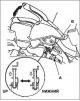
1. Remove the rear center console. 2. Disconnect connector A from the parking brake sensor B. 3. Measure the electrical resistance between the positive terminal C and «weight». When the parking brake lever is pulled,...
1. Remove the rear center console. 2. Disconnect connector A from the parking brake sensor B. 3. Measure the electrical resistance between the positive terminal C and «weight». When the parking brake lever is pulled,...

Checking the brake fluid level sensor
Check the quality of the terminals of connectors 1 and 2 in the upper and lower positions of the float. Note. Completely drain the brake fluid from the master cylinder reservoir. In the lower position of the float, the...
Check the quality of the terminals of connectors 1 and 2 in the upper and lower positions of the float. Note. Completely drain the brake fluid from the master cylinder reservoir. In the lower position of the float, the...

Brake Hose Replacement
Note. Before reassembly, check that all parts are free of dirt and other foreign particles. If required, replace parts with new ones. Do not spill brake fluid on the vehicle body as this may damage the paintwork. If...
Note. Before reassembly, check that all parts are free of dirt and other foreign particles. If required, replace parts with new ones. Do not spill brake fluid on the vehicle body as this may damage the paintwork. If...

Replacing the master brake cylinder
Note. Do not spill brake fluid on the vehicle body as this may damage the paintwork. If brake fluid comes into contact with the paintwork, wash it off immediately with water. 1. Remove the air purifier. 2. Make sure the...
Note. Do not spill brake fluid on the vehicle body as this may damage the paintwork. If brake fluid comes into contact with the paintwork, wash it off immediately with water. 1. Remove the air purifier. 2. Make sure the...

Disassembly of the master brake cylinder
1. Remove the rod seal from the master cylinder. 2. Disconnect the hose A of the expansion tank. 3. Remove retaining ring A by pushing secondary piston B inward. 4. Remove the block And and connecting plugs In a broad...
1. Remove the rod seal from the master cylinder. 2. Disconnect the hose A of the expansion tank. 3. Remove retaining ring A by pushing secondary piston B inward. 4. Remove the block And and connecting plugs In a broad...

Assembling the brake master cylinder
Note. Wash all parts in brake fluid and air dry; blow out all openings with compressed air. Before reassembly, check that all parts are free of dirt and other foreign particles. If required, replace parts with new ones....
Note. Wash all parts in brake fluid and air dry; blow out all openings with compressed air. Before reassembly, check that all parts are free of dirt and other foreign particles. If required, replace parts with new ones....
Inspection and replacement of the front brake pad
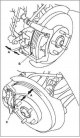
Warning! Frequent inhalation of the dust generated by worn brake linings, regardless of their material, can be hazardous to your health. Attention! Avoid inhalation of dust particles resulting from worn brake pads....
Warning! Frequent inhalation of the dust generated by worn brake linings, regardless of their material, can be hazardous to your health. Attention! Avoid inhalation of dust particles resulting from worn brake pads....

Brake Pedal Replacement
1. Disconnect an electric socket And the switch of a signal of braking. 2. Remove lock pin B and pin C. Note. Use a new locking pin with each installation. 3. Turn away a fixing bolt D and nuts E of a pedal of a brake....
1. Disconnect an electric socket And the switch of a signal of braking. 2. Remove lock pin B and pin C. Note. Use a new locking pin with each installation. 3. Turn away a fixing bolt D and nuts E of a pedal of a brake....

Brake Booster Replacement (L13A/R18A)
1. Remove the master cylinder. 2. Remove the engine harness clamp A. 3. Disconnect the brake booster vacuum hose A from the brake booster B. 4. Remove pin A and connecting pin B. 5. Turn away nuts of fastening of the...
1. Remove the master cylinder. 2. Remove the engine harness clamp A. 3. Disconnect the brake booster vacuum hose A from the brake booster B. 4. Remove pin A and connecting pin B. 5. Turn away nuts of fastening of the...

Checking and adjusting the parking brake
Examination 1. Pull the parking brake lever A with a force of 196 N. The parking brake lever should lock with a certain number of clicks. Number of clicks before lever stops: 8 to 9. 2. If the number of lever clicks is...
Examination 1. Pull the parking brake lever A with a force of 196 N. The parking brake lever should lock with a certain number of clicks. Number of clicks before lever stops: 8 to 9. 2. If the number of lever clicks is...

Replacing the parking brake cable
Note. The parking brake cables must not be bent or damaged. This will lead to tight work of the cables and their premature failure. If necessary, use the drawing of the hydraulic booster in disassembled state. 1. Fully...
Note. The parking brake cables must not be bent or damaged. This will lead to tight work of the cables and their premature failure. If necessary, use the drawing of the hydraulic booster in disassembled state. 1. Fully...
This section is available on: russian, bulgarian, belarusian, ukrainian, serbian, croatian, romanian, polish, slovak, hungarian
Link in different formats to this section
TEXTHTMLBB Code
- General information
- Technical data
- Governing bodies
- Driving and maintenance
- Power unit
- Gasoline engines (L13A)
- Gasoline engines (R18A)
- Diesel engines (N22A)
- Cooling and lubrication (L13A)
- Cooling and lubrication (R18A)
- Cooling and lubrication (N22A)
- Injection system (gasoline)
- Injection system (diesel)
- Toxicity reduction system
- Troubleshooting
- Transmission
- Clutch and drive shafts
- Mechanical gearbox
- Chassis and running gear
- Suspension and wheels
- Steering
- Brake system
- Body and interior
- Exterior (external elements)
- Doors, locks and windows
- Electrical equipment
- Equipment and devices
- Headlights and lighting
- Power devices
- Electrical circuits
- General information
- Introduction to guide
- User manual
- Maintenance
- Power unit
- Engine in car (Civic)
- Engine in car (Integra)
- Engine overhaul
- Cooling and heating
- Power and exhaust systems
- Engine electrical equipment
- Engine management systems
- Transmission
- Manual gearbox
- Automatic transmission (AT/CVT)
- Clutch and drive shafts
- Chassis and running gear
- Brake system
- Car suspension
- Steering
- Body and interior
- Exterior (external elements)
- Interior (internal elements)
- Doors, locks and windows
- Electrical equipment
- Equipment and devices
- Electrical circuits
- Power unit
- SOHC engines
- DOHC engines
- Engine overhaul
- Cooling and lubrication system
- Intake and exhaust system
- Fuel injection system (SOHC)
- Fuel injection system (DOHC)
- Carburetor
- Transmission
- Clutch
- Manual gearbox S4C
- Manual gearbox S40
- Automatic gearbox
- Drive shafts
- Chassis and running gear
- Car suspension
- Steering
- Brake system
- Body and interior
- Body elements
- Heater and air conditioner
- Electrical equipment
- Power devices
- Equipment and instruments
- Electrical circuits
- General information
- Maintenance
- Power unit
- Engine in a car
- Engine overhaul
- Cooling system
- Power and exhaust system
- Engine electrical equipment
- Emission control system
- Transmission
- Mechanical gearbox
- Automatic gearbox
- Clutch and drive shafts
- Four-wheel drive
- Chassis and running gear
- Brake system
- Car suspension
- Steering
- Body and interior
- Body elements
- Electrical equipment
- Equipment and devices
- Electrical circuits
HondaBook.ru © 2018–2024 • Mobile version • Sitemap: EN BG BY UA RS HR RO PL SK HU • Feedback • Driver Information • Search system • Bookmark
Accord 3 (1985-1989) • Accord 6 (1997-2002) • Civic 3 and 4 (1983-1991) • Civic 5 and 6 (1991-2000) • Civic 6 (1995-2000) • Civic 8 (2005-2011) • Fit 1 (2001-2008) • CR-V 1 (1995-2001) • HR-V 1 (1998-2006) • Avancier 1 (1999-2003) •
Accord 3 (1985-1989) • Accord 6 (1997-2002) • Civic 3 and 4 (1983-1991) • Civic 5 and 6 (1991-2000) • Civic 6 (1995-2000) • Civic 8 (2005-2011) • Fit 1 (2001-2008) • CR-V 1 (1995-2001) • HR-V 1 (1998-2006) • Avancier 1 (1999-2003) •