
Warning! Remember that the dust generated during operation of the brake mechanisms may contain asbestos, which is extremely harmful to human health. Never blow off dust with compressed air or inhale it – wear a protective mask or respirator when servicing the mechanisms. Never use gasoline or petroleum-based solvents to wipe brake system components – use only branded cleaning agents or methyl alcohol!
Removal
1. Loosen the wheel nuts. Jack up the front/rear of the car and place it on supports. Remove the wheels.
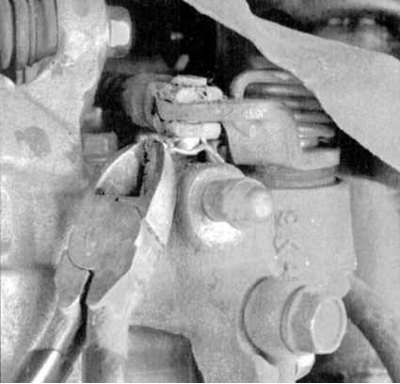
2. When removing the rear disc brake caliper, remove the cotter pin and disconnect the parking brake cable from the actuator lever (see accompanying illustration).
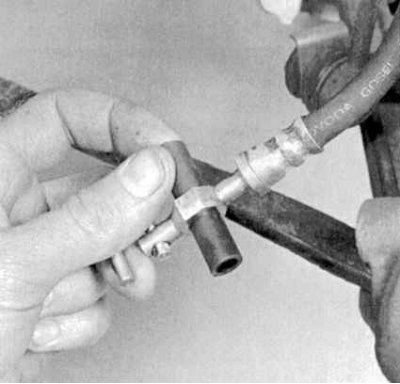
3. Disconnect the hydraulic line from the caliper to minimize the loss of brake fluid and to prevent dirt from getting inside the tract, seal the nipple connection (see accompanying illustration).
4. Remove the caliper (see Replacement of brake pads of disc brake mechanisms).
Repair
Front wheel brake caliper
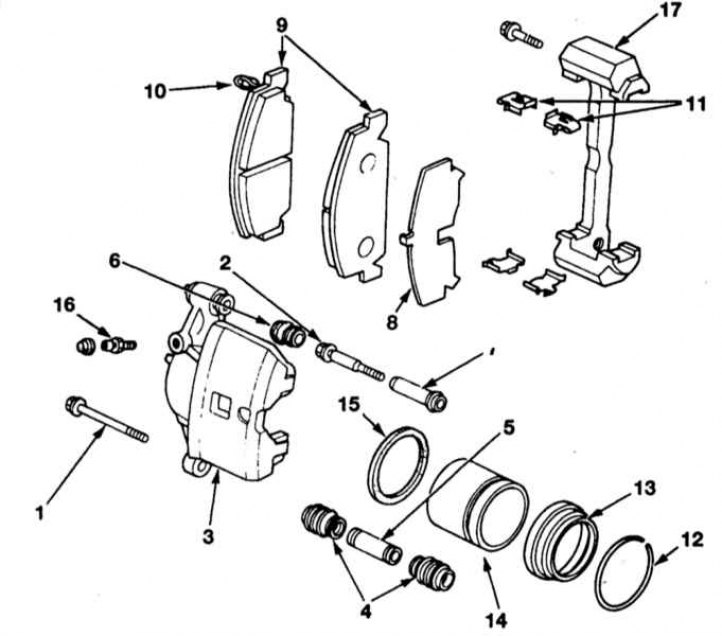
Akebono caliper
1 - Lower caliper bolt; 2 - Upper caliper bolt; 3 - Caliper housing (caliper); 4 - Protective covers; 5 - Bushing; 6 - Protective cover; 7 - Bushing; 8 - Brake shoe adjusting shim; 9 - Outer shoe; 10 - Inner shoe (with wear indicator); 11 - Spring pad holders; 12 - Piston boot retaining ring; 13 - Piston dust cover; 14 - Piston; 15 - Piston cuff; 16 - Bleed valve; 17 - Anchor bracket
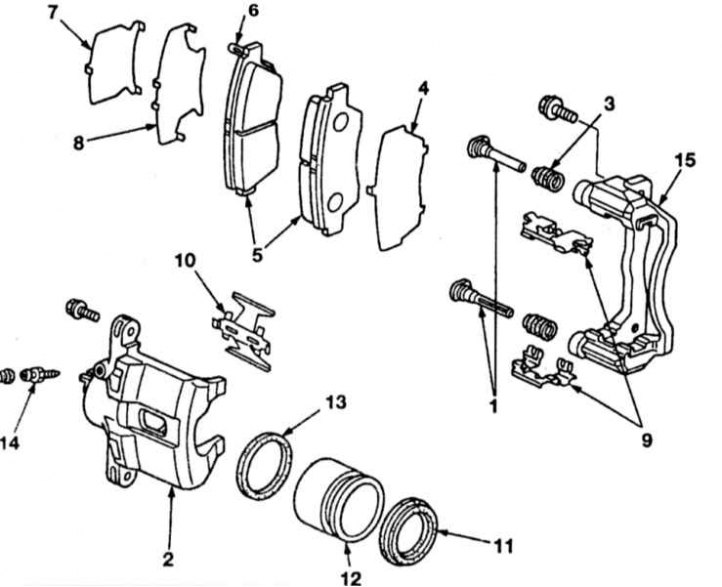
Nissin support
1 - Caliper bolts; 2 - Caliper housing; 3 - Protective case; 4 - Outer shoe adjusting shim; 5 - Outer shoe; 6 - Inner shoe (with wear indicator); 7 - Inner lining; 8 - Inner shoe adjusting lining; 9 - Spring pad holders; 10 - Brake shoe spring; 11 - Piston dust cover; 12 - Piston; 13 - Piston cuff; 14 - Bleed valve; 15 - Anchor bracket
1. Design options for disc brake calipers are shown in the accompanying illustrations above.
2. Place the caliper on a clean workbench. If the caliper has spring pad retainers, note their location on the assembly, then remove them. If the piston boot is secured with a spring ring, remove it by prying it off with a screwdriver.
3. Remove the dust cover.
4. Before removing the piston, place a wooden block between it and the wall of the caliper (to protect the piston). The piston is pushed out by supplying compressed air to the brake hose connection nipple. The air pressure should be minimal.
Caution! Be careful not to get your fingers between the piston and the caliper!
5. Assess the condition of the working surfaces of the piston and cylinder in the caliper. If cavities, scoring, roughness and areas with changed coloring are detected, replace the caliper assembly.
6. If the components are in good condition, remove the piston seal from the groove in the cylinder by prying it up with a wooden or plastic tool (using a metal tool may damage the cylinder mirror).
7. Push the caliper mounting bolt bushings out of the lugs in the caliper body. If so equipped, first remove the rubber protective covers installed on both sides.
8. Wash all removed parts with a special cleaning agent. Prepare a repair kit that matches the design of the caliper. Moisten the new piston seal with clean brake fluid and insert it into its groove in the caliper cylinder. Make sure that the seal is not twisted.
9. If the piston boot is installed without a snap ring (nissin calipers), insert the boot into the upper groove in the caliper cylinder. Make sure that the boot flange is fully seated in the groove.
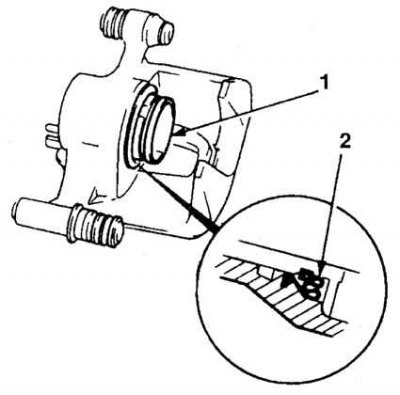
10. Lubricate the piston with clean brake fluid, carefully push it through the new dust boot and insert it into the caliper cylinder (the piston should enter the cylinder with little resistance). Make sure the dust boot fits into the piston groove (see accompanying illustration).
11. If a spring retaining ring is provided to secure the boot (akebono calipers), install it in its place. Make sure that the dust boot fits into the piston groove.
12. Lubricate the caliper bolts with the silicone grease included in the repair kit and insert them into the housing lugs. Don't forget to install the protective covers.
Rear wheel brake caliper
To disassemble the rear wheel brake calipers, special tools are required, therefore, it would be reasonable to entrust their repair to car service specialists.
Installation
1. Installation is carried out in the reverse order. Do not forget to replace the copper sealing washers (gaskets) on both sides of the nipple connector connecting to the brake hose caliper. Usually a set of new gaskets is included in the repair kit.
2. Bleed the brake circuit (see Checking the proper functioning/tightness, removing and installing the brake booster assembly). Check the brake line fittings for signs of leaks.
3. Replace the wheels, lower the vehicle to the ground and tighten the wheel nuts to the required torque (see Specifications to the Chapter Current maintenance).
4. Before operating the vehicle, check that the brakes are functioning properly.