
General information
When a vehicle is equipped with a conventional braking system, abruptly pressing the foot brake pedal causes the wheels to lock. This disrupts the tread's grip on the road surface, and the vehicle may skid, causing it to lose control. The anti-lock braking system (ABS) is designed to prevent premature wheel locking by continuously controlling the speed of the wheels during braking by modulating the hydraulic fluid pressure in each brake mechanism.
ABS consists of two main subsystems: electrical and hydraulic. The electrical part of the system includes four wheel speed sensors, a control processor, and a set of connecting electrical wiring. The hydraulic part includes a pressure modulator, disc brake calipers, and hydraulic lines connecting the components.
The principle of the system's operation is quite simple. Each wheel is equipped with an individual speed sensor. The sensor consists of a rotor (rings with teeth evenly spaced around their perimeter) and a sensitive element in the form of a magnetized coil. The sensitive element of the sensor records the moments when the rotor teeth pass by it and converts the information received into electrical signals that are continuously transmitted to the ABS control processor. Based on the results of processing the incoming signals, the processor receives information about the relative rotation speed of each wheel. While all four wheels rotate at the same frequency, the ABS is in a passive state. As soon as any of the wheels begins to lock, the processor records a change in the incoming signal and generates a command to operate the modulator, which instantly releases the hydraulic fluid pressure in the brake mechanism of the corresponding wheel. As soon as normal wheel rotation is restored, the processor suspends the operation of the modulator.
In reality, the ABS operating scheme is much more complicated than it may seem, so the authors of this Guide do not recommend that car owners attempt to repair the system themselves. In case of problems, it would be wiser to contact car service specialists.
Reading ABS fault codes
1. When the engine is started, the ABS indicator lamp on the vehicle's instrument panel should briefly turn on and then go out again almost immediately. If, due to some malfunction, the lamp remains on after the engine is started, the ABS processor records the corresponding digital code in the self-diagnostic unit's memory. To read the code from the indicator lamp:
- a) Release the diagnostic connector plug from its cover located under the glove compartment (see Chapter Engine management systems);
- b) Connect the two connector pins with a jumper wire.
Civic Models (and Integra since 1998.)
1. Turn on the ignition (do not start the engine). Two seconds after turning the key to the ON position, the ABS processor will begin to output the fault codes stored in its memory, causing the ABS indicator lamp on the vehicle's instrument panel to flash. The display of codes begins with a pause lasting 3.6 seconds. Then a sequence of pulses of the first code stored in the processor's memory is output (a series of flashes of the main code, then, after a one-second pause, a series of flashes of the additional code [if provided]). Then, after a five-second pause, a combination of codes is displayed (primary and secondary) second malfunction, etc. The system allows you to read any number of codes. After writing down the read information, compare it with the code map provided on the accompanying table.
| Fault code | Possible source of malfunction |
| 11 | Right Front Wheel Speed Sensor (open/short circuit) |
| 12 | Right Front Wheel Speed Sensor (electrical interference or instability of generated signals) |
| 13 | Left Front Wheel Speed Sensor (open/short circuit) |
| 14 | Left Front Wheel Speed Sensor (electrical interference or instability of generated signals) |
| 15 | Right rear wheel speed sensor (open/short circuit) |
| 16 | Right rear wheel speed sensor (electrical interference or instability of generated signals) |
| 17 | Left rear wheel speed sensor (open/short circuit) |
| 18 | Left rear wheel speed sensor (electrical interference or instability of generated signals) |
| 21 | Right Front Wheel Speed Sensor Rotor |
| 22 | Left Front Wheel Speed Sensor Rotor |
| 23 | Right rear wheel speed sensor rotor |
| 24 | Left Rear Wheel Speed Sensor Rotor |
| 31 | Right Front Wheel Sensor Input Solenoid Coil |
| 32 | Right Front Wheel Sensor Output Solenoid Coil |
| 33 | Left Front Wheel Sensor Input Solenoid Coil |
| 34 | Left Front Wheel Sensor Output Solenoid Coil |
| 35 | Right rear wheel sensor input solenoid coil |
| 36 | Right rear wheel sensor output solenoid coil |
| 37 | Left rear wheel sensor input solenoid coil |
| 38 | Left rear wheel sensor output electromagnetic coil |
| 41 | Right front wheel lock |
| 42 | Left front wheel lock |
| 43 | Right rear wheel lock |
| 44 | Left rear wheel lock |
| 51 | Engine blocking |
| 52 | The motor does not turn on |
| 53 | The engine does not turn off |
| 54 | The safety relay is faulty |
| 61 | Excessively low voltage in the ignition circuit |
| 62 | Excessively high voltage in the ignition circuit |
| 71 | Wheels of different diameters are installed |
| 81 | The central processing unit and ROM/RAM (ROM/RAM)are defective |
Integra models up to 1997.
1. Turn on the ignition (do not start the engine). Two seconds after turning the key to the ON position, the ABS processor will begin to output the fault codes stored in its memory, causing the ABS indicator lamp on the vehicle's instrument panel to flash. The codes will begin to flash with a 2-second pause. Then a sequence of pulses of the first code stored in the processor's memory is output (a series of flashes of the main code, then, after a one-second pause, a series of flashes of the additional code [if provided]). Then, after a five-second pause, a combination of codes is displayed (primary and secondary) second malfunction, etc. The system allows reading up to three codes.
2. If you lose count when reading the codes, turn off the ignition, then turn it on again and start again. Do not forget that any ABS repair should be carried out by car service specialists.
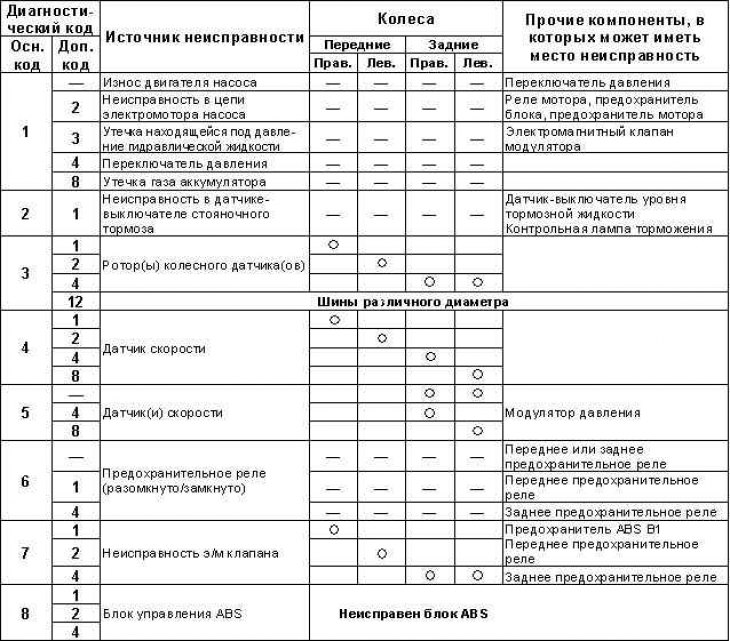
ABS fault code map for Integra models through 1997.
Clearing ABS CPU Memory
After troubleshooting the identified problems in the system, the processor memory should be cleared.
Civic Models (and Integra since 1998.)
1. To clear the processor memory, remove the jumper wire from the diagnostic connector terminals, then remove the ABS B2 15 A fuse from the fuse box installed in the engine compartment of the vehicle for at least three seconds. Replace the fuse and connect the diagnostic connector plug to the cover.
Integra models up to 1997.
1. Without removing the jumper wire, turn off the ignition, then depress the foot brake pedal and turn the ignition key to the ON position again. When the ABS indicator light on the instrument panel goes out, release the pedal - the light should come on again. Depress the pedal again and wait until the light goes out. Release the pedal.
2. The indicator lamp should flash twice, confirming that the processor memory has been cleared, after which you can turn off the ignition, remove the jumper wire and restore the original connection of the diagnostic connector.
(The original text of the article is located on the website: «www.hondabook.ru»)