
Checking the correct functioning
1. Without starting the engine, press the foot brake pedal several times. Make sure that there is no change in the pedal travel.
2. Keeping the pedal depressed, start the engine. If the pedal "sinks" slightly immediately after starting, then the brake booster is working properly.
Checking for leaks
1. Run the engine for a few minutes, then turn it off. Slowly press the foot brake pedal several times. If the pedal travel gradually decreases with each press, the vacuum booster assembly is not leaky.
2. Press the foot brake pedal while the engine is running. Keep the pedal pressed and turn off the engine. If after 30 seconds of holding the pedal pressed, its position does not change, then the vacuum booster assembly is not leaking.
Removal
1. The brake booster unit is not subject to repair and in case of failure must be replaced as an assembly.
2. Remove the brake master cylinder assembly from the vacuum booster (see Removal and installation the master brake cylinder).
3. Disconnect the hose coming from the engine. Be careful not to damage the hose when removing it from the nipple on the booster assembly.
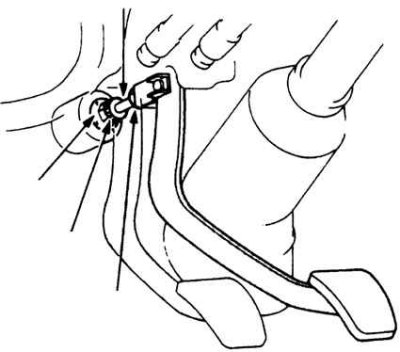
3. Under the instrument panel, find the connection point of the vacuum booster push rod to the foot brake pedal.
4. Remove the cotter pin and disconnect the push rod from the pedal.
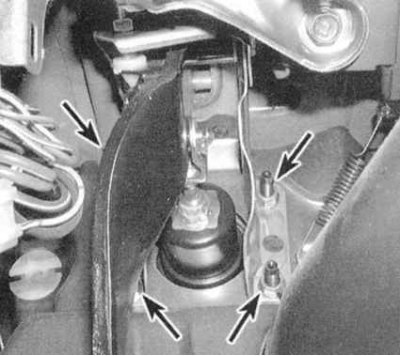
5. From the passenger compartment side, loosen the four nuts securing the vacuum booster assembly to the engine compartment bulkhead (see accompanying illustration), remove the washers (if necessary, use a pocket flashlight).
6. Go to the engine bay and remove the vacuum booster assembly from the studs on the rear bulkhead. Also remove the brackets and shims.
Installation
1. Installation is carried out in the reverse order of dismantling. Make sure that all fasteners are tightened to the required force, and that pins and cotter pins are replaced.
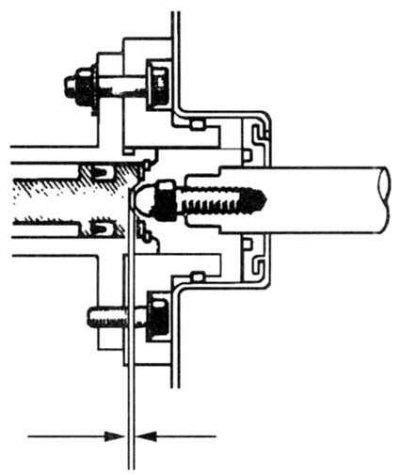
2. When installing a new brake booster, it is necessary to adjust the working clearance of its pusher rod (see accompanying illustration), for what:
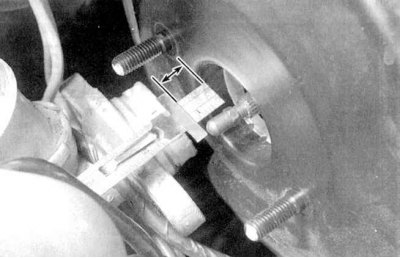
- a) Using a hand vacuum pump, create a vacuum of 508 mm Hg on the booster, then measure the amount of the pushrod protrusion above the assembly surface mating with the master cylinder (taking into account the gasket, if any). Write down the measurement result, let's call it "Size A".
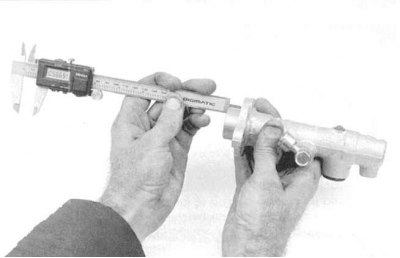
- b) Measure the distance from the master cylinder support flange to the end surface of the cylinder (see accompanying illustration). Record the measurement result, hereinafter referred to as "Dimension B".
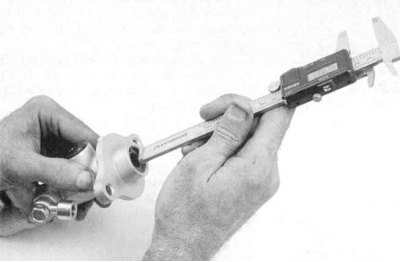
- c) Measure the distance from the end surface of the master cylinder to the bottom of the seat pocket in the end of its piston (see accompanying illustration). Record the result and call it "Size C".
- d) Subtract dimension B from dimension C, then subtract dimension A from the resulting difference. The resulting value will determine the required working clearance.
- e) Compare the calculation result with the requirements Specifications. If necessary, make the appropriate adjustments (see below).
3. To adjust the working clearance of the push rod, loosen the toothed lock nut and turn the adjuster in the appropriate direction. After completing the adjustment, tighten the lock nut and measure the clearance again. Repeat the procedure if necessary.
4. After installing the brake master cylinder, bleed the brake system (see Bleeding the brake system).
[Original published on this resource: www.hondabook.ru]