
2. Replacement steel and flexible brake lines can always be purchased at the service center of the car manufacturer, as well as in branded stores of car accessories.
Attention! Do not under any circumstances use any tubes as replacement tubes other than branded ones, specially designed for installation in the brake circuit of your car.
3. When installing brake lines, ensure that they are located at least 20 mm away from moving or vibrating components of the body, suspension or steering gear.
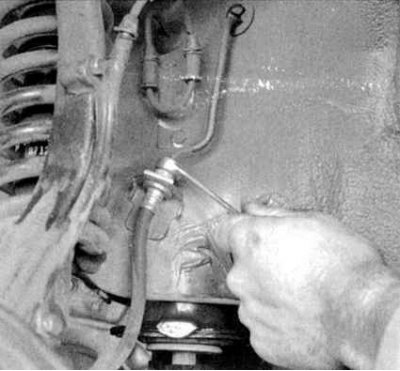
4a. To loosen the union nut connections of flexible hoses with steel tubes of hydraulic lines, use special open-end wrenches with a slotted head (see accompanying illustration).
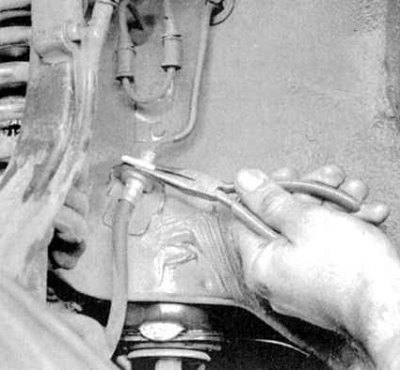
4b. After loosening the nut, remove the retainer and release the brake hose from the support bracket (see accompanying illustration).
5. Disconnect the two hoses using regular open-end wrenches. When connecting the units, make sure that the hoses do not twist.
6. Rigid hydraulic line tubes are usually secured along their entire length in special clamps. When removing the line, make sure it is released from all clamps.
7. When replacing brake lines, make sure that the replacement components exactly match the size and type characteristics of the old sections removed from the vehicle. Never replace steel tubes with copper ones!
8. When installing steel tubes, ensure that they are securely fastened in all provided brackets, clamps and clips. Avoid laying the tubes too close to moving components of the suspension and steering gear.
9. Finish installing the new hydraulic line sections, check the fluid level in the master cylinder reservoir. If necessary, make the appropriate adjustments. Bleed the brake system (see Bleeding the brake system).
10. Before operating the vehicle, make sure that the brakes are functioning properly.
[Material obtained from the website: hondabook.ru]