
If the owner of a new vehicle has strictly adhered to the schedule of routine maintenance procedures (see Schedule of current maintenance), performed critical parameter checks quite often, maintained the required level of lubricating fluids, the engine will extremely rarely require additional maintenance and repairs (in addition to the replacement of components and consumables subject to increased wear).
On the other hand, if regular maintenance procedures are performed carelessly and the established inspection schedules are frequently violated, the engine's efficiency will sooner or later inevitably decrease. The likelihood of such a situation occurring is especially high when purchasing a used car. In such cases, it becomes necessary to perform a set of powertrain adjustments beyond the scope of work on the car's current maintenance.
The first step in tuning or troubleshooting a poorly performing engine is always to check the cylinder compression pressure (see Engine Repair Without Removing It From the Vehicle - Integra Models), the analysis of the results of which allows you to assess the general condition of the internal components of the engine and outline a plan for upcoming adjustment and / or restoration work. For example, if a compression pressure check reveals signs of serious internal engine wear, a regular set of adjustments will not be enough to correct the situation, and its implementation will be a waste of time and money. In view of the value of the information obtained as a result of checking the compression pressure, its implementation should be entrusted to a sufficiently experienced and qualified mechanic who has the necessary diagnostic tools.
Below are lists of basic tuning procedures that will restore the efficiency of an engine that is in good mechanical condition.
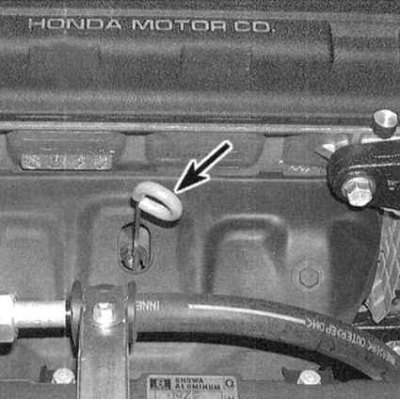
List of minimum checks and adjustments
- Check the levels of all engine related fluids (see Checking fluid levels (every 400 km or weekly)).
- Clean and check the battery condition (see Checking, servicing and charging the battery (every 12,000 km or once every 6 months)).
- Check the condition and tension of the drive belts and make adjustments if necessary (see Checking the condition, adjusting the tension force and replacing the drive belts, (every 12,000 km or once every 6 months)).
- Check the condition of all hoses located in the engine compartment (see Checking the condition and replacing the hoses located in the engine compartment (every 12,000 km or once every 6 months)).
- Check the condition and service the cooling system components (see Checking the condition of the cooling system components (every 12,000 km or once every 6 months)).
- Check the condition of the air cleaner filter element (see Replacing the air cleaner filter element (every 24,000 km or every two years)).
- Check the condition of the distributor cap and rotor (see Checking the condition of the power supply system components (every 24,000 km or once every 12 months)).
- Check the idle speed setting and make adjustments if necessary (see Automatic Transmission Fluid Replacement (AT/CVT) (every 48,000 km or once every 24 months)).
List of the full range of checks and adjustments
In addition to the checks listed below:
- Replace the air cleaner filter element (see Checking the condition of seat belts (every 24,000 km or once every 12 months)).
- Check the proper functioning and condition of the power supply system components (See. Checking the condition of the power supply system components (every 24,000 km or once every 12 months)).
- Replace the spark plugs (see Checking the condition and replacing spark plugs).
- Replace the distributor cap and rotor (see Checking the condition and replacing the spark plug wires, cover and distributor rotor (every 48,000 km or once every 24 months)).
- Check the condition of the ignition system high voltage wires (see Checking the condition and replacing the spark plug wires, cover and distributor rotor (every 48,000 km or once every 24 months)).
- Check the correct operation and condition of the charging system components (see Chapter Engine electrical equipment).