
HondaBook.ru
Auto companies Volkswagen Auto companies Ford Auto companies Lada Auto companies Skoda Auto companies BMW Auto companies Mazda Auto companies Peugeot
English Русский
Български
Беларускі
Український
Српски
Hrvatski
Română
Polski
Slovenský
Magyar
Bookmark Contacts Sitemap   


Accord Civic Fit / Jazz CR-V HR-V Others Articles
Civic 3 and 4 (1983-1991) Civic 5 and 6 (1991-2000) Civic 6 (1995-2000) Civic 7 (2000-2005) Civic 8 (2005-2011)

Bleeding the brake system (Honda Civic 3)

  • Main
  • Honda Civic
  • 3 (1983-1991)
  • Chassis and running gear
  • Brake system
  • Bleeding the brake system
0
Caution: If brake fluid gets into your eyes, rinse them immediately with water and consult a doctor.


1. Bleeding the system is necessary to remove air that has entered the system during dismantling and assembling components of the hydraulic part of the brakes.

2. If the brake pipe was disconnected only from the wheel, only that brake caliper or wheel cylinder needs to be bled.

3. If the tubes were disconnected from the master cylinder, the entire system needs to be bled.

4. Release the vacuum from the brake booster by pressing the brake pedal several times with the engine off.

5. Remove the brake reservoir cap and fill it with brake fluid.

Caution: Monitor the fluid level in the reservoir during the bleeding procedure. Do not allow the fluid to drain completely from the reservoir.


6. To do this, you will need a clean container partially filled with brake fluid, a reserve of brake fluid for topping up, a sufficiently long rubber or vinyl hose with an internal diameter of about 5 mm, a key for unscrewing the bleed nipple and an assistant.

7. Start working with the left front wheel. Slightly loosen the bleed nipple, tighten it and check the ease of rotation of the nipple when unscrewing and screwing.

8. Place the hose on the bleed nipple and immerse the other end in a container with brake fluid.
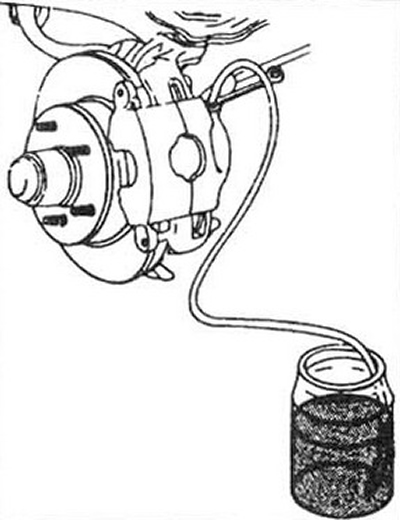
Fig. 10.8 Preparation for bleeding the brake…

Fig. 10.8 Preparation for bleeding the brake system circuit


9. The assistant should press the brake pedal several times and hold it in the lower position after you feel resistance from the pressure.


10. With the pedal pressed, unscrew the bleed nipple so that the liquid flows through the hose. Wait until all the air bubbles come out, tighten the nipple.

11. Repeat steps 9 and 10 until no more air bubbles come out of the tube. Tighten the bleeder screw and move to the right rear wheel, then the right front wheel, and finally the left rear. Check the fluid level in the brake reservoir regularly.

12. Do not use the brake fluid collection container to top up the fluid.

13. Add fluid to the reservoir at the end of the bleeding operation.

14. Check the operation of the brakes: the pedal should be "hard" at the end of the braking stroke.
This article is available at: russian, bulgarian, belarusian, ukrainian, serbian, croatian, romanian, polish, slovak, hungarian
This information has been verified: Yaroslav Shiryaev
Share with friends:
◀ Previous
Civic 3 and 4: Brake system
Next ▶

Brake pipes and hoses — inspection and replacement
Brake force distributor — general information
Master Brake Cylinder — Removal, Repair and Installation
Wheel Brake Cylinder — Removal, Repair and Installation
Drum brake shoes — replacement
Brake booster — inspection, removal and installation
Parking brake — adjustment
Replacing the parking brake cable
Parking brake lever — removal and installation
Brake light switch — inspection, replacement and adjustment
See also other articles from Honda manuals:
Bleeding the brake system Honda Accord 3 (1985-1989)
Bleeding the brake system Honda Fit 1 (2001-2008)
Bleeding the brake system Honda CR-V 1 (1995-2001, petrol)
Bleeding the brake system Honda HR-V 1 (1998-2006, petrol)
Brake system — bleeding Honda Avancier 1 (1999-2003, petrol)
Link in different formats to this article
Comments and feedback from visitors
No comments yet


How much will 50 + 15 ?


Civic 8 (2005-2011) 
  • General information
  • Technical data
  • Governing bodies
  • Driving and maintenance
  • Power unit
  • Gasoline engines (L13A)
  • Gasoline engines (R18A)
  • Diesel engines (N22A)
  • Cooling and lubrication (L13A)
  • Cooling and lubrication (R18A)
  • Cooling and lubrication (N22A)
  • Injection system (gasoline)
  • Injection system (diesel)
  • Toxicity reduction system
  • Troubleshooting
  • Transmission
  • Clutch and drive shafts
  • Mechanical gearbox
  • Chassis and running gear
  • Suspension and wheels
  • Steering
  • Brake system
  • Body and interior
  • Exterior (external elements)
  • Doors, locks and windows
  • Electrical equipment
  • Equipment and devices
  • Headlights and lighting
  • Power devices
  • Electrical circuits
Civic 7 (2000-2005) 
  • General information
  • User manual
  • Maintenance
  • Power unit
  • Engines D15B and D17A
  • K20A Engines
  • Overhaul engine
  • Cooling system
  • Lubrication system
  • Fuel injection system
  • Toxicity reduction system
  • Engine electrical equipment
  • Transmission
  • Clutch
  • Manual gearbox
  • Automatic gearbox
  • Variator (CVT)
  • Drive shafts
  • Chassis and running gear
  • Car suspension
  • Steering
  • Brake system
  • Body and interior
  • Exterior (external elements)
  • Interior (internal elements)
  • Doors, locks and windows
  • Heater and air conditioner
  • Manual air conditioner
  • Automatic air conditioner
  • Security system
  • Electrical equipment
  • Equipment and devices
  • Headlights and lighting
  • Windscreen wipers
  • Audio system
  • Electrical diagrams
Civic 6 (1995-2000) 
  • General information
  • Introduction to guide
  • User manual
  • Maintenance
  • Power unit
  • Engine in car (Civic)
  • Engine in car (Integra)
  • Engine overhaul
  • Cooling and heating
  • Power and exhaust systems
  • Engine electrical equipment
  • Engine management systems
  • Transmission
  • Manual gearbox
  • Automatic transmission (AT/CVT)
  • Clutch and drive shafts
  • Chassis and running gear
  • Brake system
  • Car suspension
  • Steering
  • Body and interior
  • Exterior (external elements)
  • Interior (internal elements)
  • Doors, locks and windows
  • Electrical equipment
  • Equipment and devices
  • Electrical circuits
Civic 5 and 6 (1991-2000) 
  • Power unit
  • SOHC engines
  • DOHC engines
  • Engine overhaul
  • Cooling and lubrication system
  • Intake and exhaust system
  • Fuel injection system (SOHC)
  • Fuel injection system (DOHC)
  • Carburetor
  • Transmission
  • Clutch
  • Manual gearbox S4C
  • Manual gearbox S40
  • Automatic gearbox
  • Drive shafts
  • Chassis and running gear
  • Car suspension
  • Steering
  • Brake system
  • Body and interior
  • Body elements
  • Heater and air conditioner
  • Electrical equipment
  • Power devices
  • Equipment and instruments
  • Electrical circuits
Civic 3 and 4 (1983-1991) 
  • General information
  • Maintenance
  • Power unit
  • Engine in a car
  • Engine overhaul
  • Cooling system
  • Power and exhaust system
  • Engine electrical equipment
  • Emission control system
  • Transmission
  • Mechanical gearbox
  • Automatic gearbox
  • Clutch and drive shafts
  • Four-wheel drive
  • Chassis and running gear
  • Brake system
  • Car suspension
  • Steering
  • Body and interior
  • Body elements
  • Electrical equipment
  • Equipment and devices
  • Electrical circuits
HondaBook.ru © 2018–2026 • Mobile version • Sitemap: EN BG BY UA RS HR RO PL SK HU • Feedback • Driver Information • Search system • Bookmark
Accord 3 (1985-1989) • Accord 6 (1997-2002) • Civic 3 and 4 (1983-1991) • Civic 5 and 6 (1991-2000) • Civic 6 (1995-2000) • Civic 7 (2000-2005) • Civic 8 (2005-2011) • Fit 1 (2001-2008) • CR-V 1 (1995-2001) • CR-V 2 (2002-2006) • HR-V 1 (1998-2006) • Avancier 1 (1999-2003) •
 
This website uses cookies to ensure proper functioning. By clicking "OK," you agree.