


Attention:
- Prevent foreign particles and water from entering the system when adding brake fluid.
- To prevent chemical changes in the brake fluid, do not mix different types of fluid.
- Use genuine Honda Ultra DOT 3 or DOT 4 brake fluids.
- Make sure that brake fluid does not come into contact with paintwork. If it does come into contact with paintwork, wash it off immediately with water.
- Do not reuse drained brake fluid.
1. Remove the filter and remove the brake fluid and sediment from the reservoir,
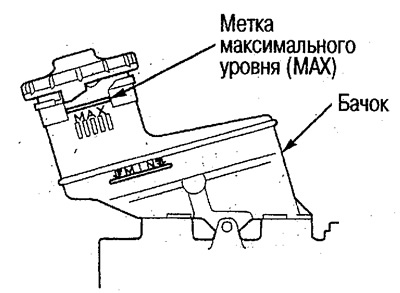
2. Install the filter on the reservoir and fill with fresh brake fluid up to the maximum level mark (MAX).
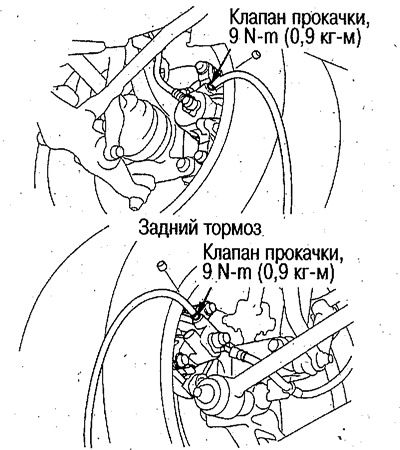
3. Place the transparent tube on the bleed valve and place a suitable container underneath to receive the liquid,
4. The assistant slowly presses the brake pedal several times and leaves it pressed.
5. Slowly loosen the bleeder valve and release the brake fluid along with the air. When the brake pedal reaches the floor and the brake fluid stops flowing out, tighten the bleeder valve.
6. Repeat steps 4 and 5 until the flow of air bubbles stops, then tighten the bleed valve to the required force.
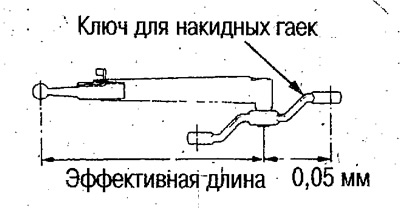
Determine the tightening torque using a nut wrench as follows:
Formula for calculation:
Value read from Torx key = Effective length of Torx key (m) x Required tightening force N·m (kg m) / Effective length of Torx key (m) + 0.05 (m)
Calculation example:
If a Torx key with an effective length of 250 mm is used, the value read from the Torx key will be: 0.25x0.9/0.25+0.05=0.75 kg·m
7. Place the caps on each bleed valve.
Add brake fluid to the reservoir.
9. In a safe place, check the braking efficiency.