HondaBook.ru
Auto companies Volkswagen Auto companies Ford Auto companies Lada Auto companies Skoda Auto companies BMW Auto companies Mazda Auto companies Peugeot
English Русский
Български
Беларускі
Український
Српски
Hrvatski
Română
Polski
Slovenský
Magyar
Bookmark Contacts Sitemap   


Accord Civic Fit / Jazz CR-V HR-V Others Articles
Civic 3 and 4 (1983-1991) Civic 5 and 6 (1991-2000) Civic 6 (1995-2000) Civic 7 (2000-2005) Civic 8 (2005-2011)

Starting the engine from an external battery (Honda Civic 8)

  • Main
  • Honda Civic
  • 8 (2005-2011)
  • General information
  • Driving and maintenance
  • Starting the engine from an external battery
0
If your car battery is dead, you can try to jump start the engine using an external battery (for example, from the battery of another car). Despite the apparent simplicity of this procedure, you must take certain precautions, which are described below. When starting the engine from an external battery, strictly follow the instructions.

Warning! If you do not follow these precautions and handle the battery incorrectly during engine start-up, it may explode, causing serious injury to people in the vicinity.


Keep sparking objects, open flames, lighted matches and burning cigarettes away from the battery.

To start the engine using an external battery, follow these steps:.

Open the hood and check the condition of the battery. At low negative ambient temperatures, check the condition of the electrolyte in the battery. If there are ice crystals floating in the electrolyte or it is covered with an ice crust, do not try to start the engine until the electrolyte has completely thawed.

Warning! If the battery is stored in freezing temperatures, the electrolyte in it may freeze. When trying to start the engine, the casing of the frozen battery may burst.


Turn off all electrical consumers: climate control system, audio system, lighting devices, etc. Move the manual transmission range shift lever to neutral position and apply the parking brake.

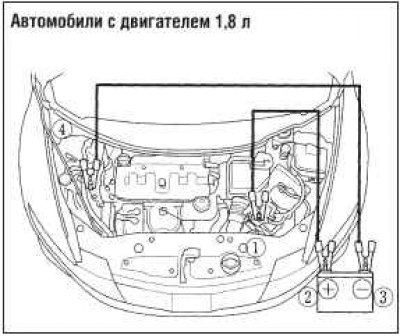
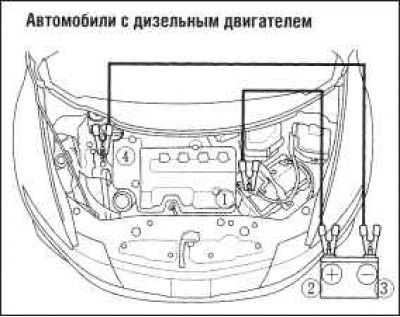
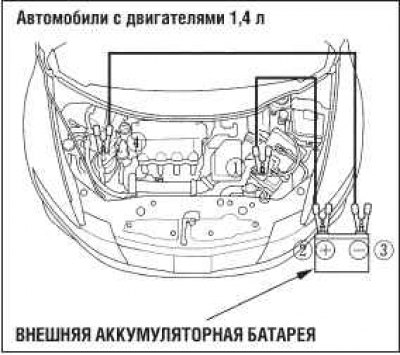
The sequence of connecting the cables is indicated by numbers in the illustrations.

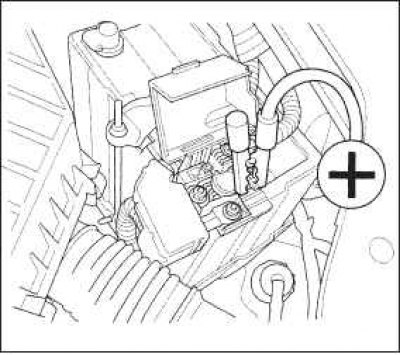
Attach one clamp of the "positive" extension cable to the positive (+) terminal of the dead vehicle battery. Attach the other clamp of this cable to the positive (+) terminal of the booster battery.


Starting the engine from an external battery

Attach one of the clamps of the second extension…


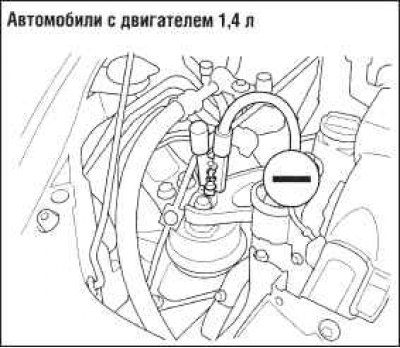
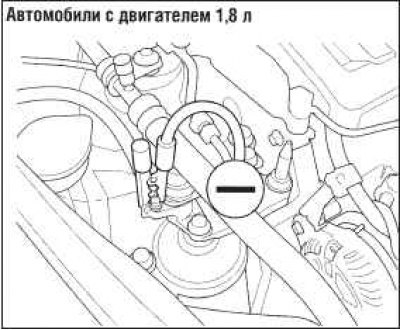
Attach one of the clamps of the second extension cable (the "negative" one) to the negative (-) terminal of the external battery. Attach the other clamp of this cable to the "ground" terminal of the wire (see picture). Do not connect the second cable clamp to other engine parts.

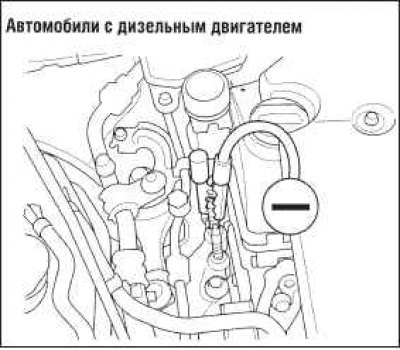
For vehicles with diesel engines Attach one clamp of the second extension cable (the "negative" one) to the negative (-) terminal of the booster battery. Attach the other clamp of this cable to the threaded stud on the side of the engine (see picture). Do not connect the second cable clamp to other engine parts.


If you are using another vehicle's battery as a booster battery, have an assistant start that vehicle's engine and set the idle speed to high.
Attach one of the clamps of the second extension…

Turn on the car starter and try to start the…

Turn on the car starter and try to start the engine. If the starter still turns the engine slowly, check the tightness of the contacts in the electrical connections of the extension cables.


After the engine has started successfully, disconnect the negative extension cable clamp from the vehicle's engine, then the other clamp of this cable from the negative terminal of the booster battery. Disconnect the clamp of the remaining extension cable (the positive one) from the positive terminal of the vehicle's battery, then the other clamp of this cable from the positive terminal of the booster battery.

When disconnecting cables, be careful not to short-circuit uninsulated sections of one cable to another cable or to any metal parts of the vehicle. Otherwise, a short circuit may occur.
This article is available at: russian, bulgarian, belarusian, ukrainian, serbian, croatian, romanian, polish, slovak, hungarian
This information has been verified: Yaroslav Shiryaev
Share with friends:
◀ Previous
Civic 8: Driving and maintenance
Next ▶

Replacing a damaged wheel
Small spare tire
Battery charge level
Wheel rotation
Wheel installation parameters and their balancing
Fuses — location and replacement
Lighting and signaling devices — testing
Adjusting the direction of the headlight beams
Replacing lamps in headlights and lighting devices
Installing a towing eye
See also other articles from Honda manuals:
Jump starting a dead car from another car's battery Honda Accord 3 (1985-1989)
Starting the engine Honda Fit 1 (2001-2008)
Starting the engine in extreme conditions Honda CR-V 1 (1995-2001, petrol)
Engine Starting Procedure Honda HR-V 1 (1998-2006, petrol)
Starting the engine Honda Avancier 1 (1999-2003, petrol)
Link in different formats to this article
Comments and feedback from visitors
No comments yet


How much will 18 + 26 ?


Civic 8 (2005-2011) 
  • General information
  • Technical data
  • Governing bodies
  • Driving and maintenance
  • Power unit
  • Gasoline engines (L13A)
  • Gasoline engines (R18A)
  • Diesel engines (N22A)
  • Cooling and lubrication (L13A)
  • Cooling and lubrication (R18A)
  • Cooling and lubrication (N22A)
  • Injection system (gasoline)
  • Injection system (diesel)
  • Toxicity reduction system
  • Troubleshooting
  • Transmission
  • Clutch and drive shafts
  • Mechanical gearbox
  • Chassis and running gear
  • Suspension and wheels
  • Steering
  • Brake system
  • Body and interior
  • Exterior (external elements)
  • Doors, locks and windows
  • Electrical equipment
  • Equipment and devices
  • Headlights and lighting
  • Power devices
  • Electrical circuits
Civic 7 (2000-2005) 
  • General information
  • User manual
  • Maintenance
  • Power unit
  • Engines D15B and D17A
  • K20A Engines
  • Overhaul engine
  • Cooling system
  • Lubrication system
  • Fuel injection system
  • Toxicity reduction system
  • Engine electrical equipment
  • Transmission
  • Clutch
  • Manual gearbox
  • Automatic gearbox
  • Variator (CVT)
  • Drive shafts
  • Chassis and running gear
  • Car suspension
  • Steering
  • Brake system
  • Body and interior
  • Exterior (external elements)
  • Interior (internal elements)
  • Doors, locks and windows
  • Heater and air conditioner
  • Manual air conditioner
  • Automatic air conditioner
  • Security system
  • Electrical equipment
  • Equipment and devices
  • Headlights and lighting
  • Windscreen wipers
  • Audio system
  • Electrical diagrams
Civic 6 (1995-2000) 
  • General information
  • Introduction to guide
  • User manual
  • Maintenance
  • Power unit
  • Engine in car (Civic)
  • Engine in car (Integra)
  • Engine overhaul
  • Cooling and heating
  • Power and exhaust systems
  • Engine electrical equipment
  • Engine management systems
  • Transmission
  • Manual gearbox
  • Automatic transmission (AT/CVT)
  • Clutch and drive shafts
  • Chassis and running gear
  • Brake system
  • Car suspension
  • Steering
  • Body and interior
  • Exterior (external elements)
  • Interior (internal elements)
  • Doors, locks and windows
  • Electrical equipment
  • Equipment and devices
  • Electrical circuits
Civic 5 and 6 (1991-2000) 
  • Power unit
  • SOHC engines
  • DOHC engines
  • Engine overhaul
  • Cooling and lubrication system
  • Intake and exhaust system
  • Fuel injection system (SOHC)
  • Fuel injection system (DOHC)
  • Carburetor
  • Transmission
  • Clutch
  • Manual gearbox S4C
  • Manual gearbox S40
  • Automatic gearbox
  • Drive shafts
  • Chassis and running gear
  • Car suspension
  • Steering
  • Brake system
  • Body and interior
  • Body elements
  • Heater and air conditioner
  • Electrical equipment
  • Power devices
  • Equipment and instruments
  • Electrical circuits
Civic 3 and 4 (1983-1991) 
  • General information
  • Maintenance
  • Power unit
  • Engine in a car
  • Engine overhaul
  • Cooling system
  • Power and exhaust system
  • Engine electrical equipment
  • Emission control system
  • Transmission
  • Mechanical gearbox
  • Automatic gearbox
  • Clutch and drive shafts
  • Four-wheel drive
  • Chassis and running gear
  • Brake system
  • Car suspension
  • Steering
  • Body and interior
  • Body elements
  • Electrical equipment
  • Equipment and devices
  • Electrical circuits
HondaBook.ru © 2018–2026 • Mobile version • Sitemap: EN BG BY UA RS HR RO PL SK HU • Feedback • Driver Information • Search system • Bookmark
Accord 3 (1985-1989) • Accord 6 (1997-2002) • Civic 3 and 4 (1983-1991) • Civic 5 and 6 (1991-2000) • Civic 6 (1995-2000) • Civic 7 (2000-2005) • Civic 8 (2005-2011) • Fit 1 (2001-2008) • CR-V 1 (1995-2001) • CR-V 2 (2002-2006) • HR-V 1 (1998-2006) • Avancier 1 (1999-2003) •
 
This website uses cookies to ensure proper functioning. By clicking "OK," you agree.