
Contents: Installing a spare tire ⇊ For some vehicle versions ⇊ Installation of decorative cap (for…⇊
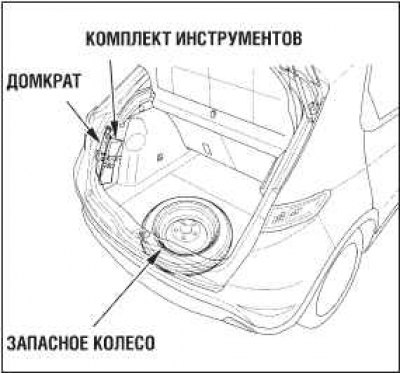
If a tire is damaged, stop immediately in a safe place. Stopping your car to change a damaged tire on the roadway or on the side of a busy road can be dangerous. If a tire is damaged, drive slowly and carefully along the side of the road or the far right lane to the nearest exit to a suitable site. The parking place should be far enough from the roadway.
Caution! When changing a tire, use the jack provided with the vehicle tool kit. Attempts to use unsuitable jacks, or using the jack provided with the vehicle tool kit to change a tire on another passenger car, may result in failure of the jack or damage to the vehicle.
An insecurely supported vehicle may fall off the jack and cause serious injury to anyone near or underneath the vehicle.
Always observe all safety precautions when replacing a damaged wheel. Never get under a vehicle that is jacked up if there are no secure safety supports.
Installing a spare tire
Place the vehicle on a level surface with a firm, non-slip supporting surface at a sufficient distance from the roadway. Engage the reverse gear of the manual transmission. Engage the parking brake.
If a trailer was previously towed, disconnect it from the vehicle.
Turn on the hazard warning lights and turn the ignition key to the "LOCK" (0) steering lock position. Ask all passengers to exit the vehicle.
 |
 |
The tool is stored in the rear left corner of the luggage compartment.
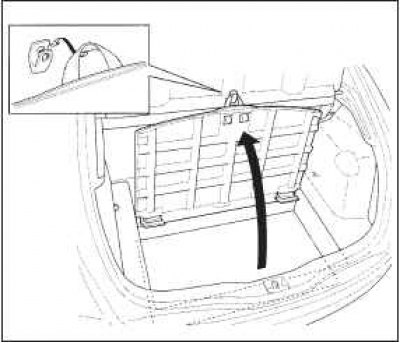
Open the rear door. Using the strap, lift the luggage compartment floor lid.
Attach the strap to the hook located on the wall of the luggage compartment (if available).
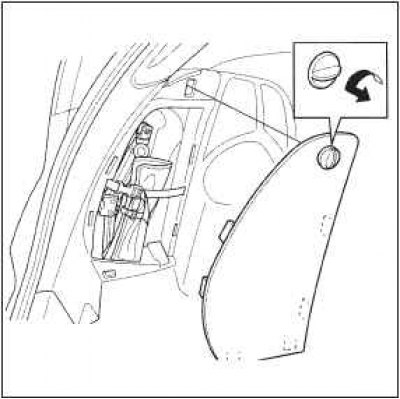
Remove the tool bag from the luggage compartment.
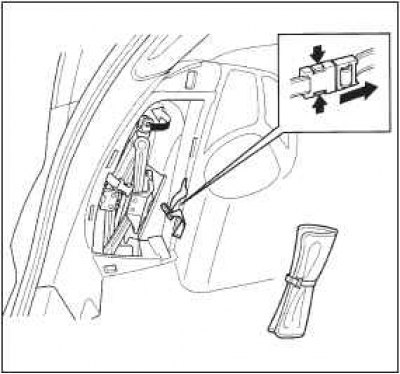
Turn the lock handle counterclockwise and remove the cover. Then press the lock and unfasten the strap.
Turn the jack end bracket counterclockwise, then remove the jack.
 |
 |
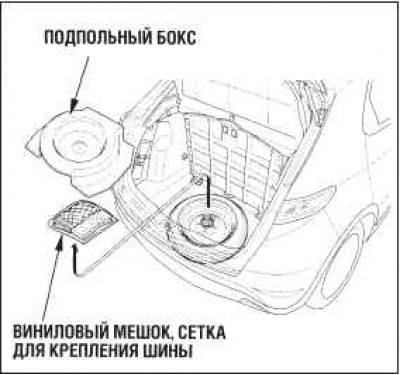
Remove the underfloor box and take out the vinyl bag and tire mounting net.
Replace the underfloor box and lower the lid.
Remove the wing bolt and remove the spare tire.
Put it on both sides (front and back) thrust blocks under the wheel that is located diagonally from the damaged one.
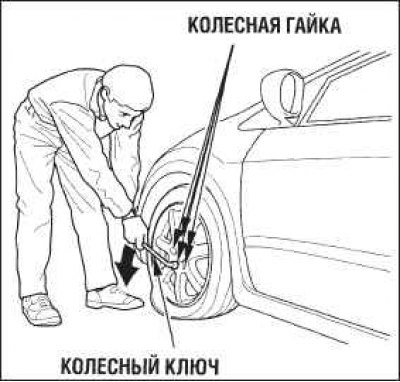
Using a wheel wrench, loosen all wheel nuts by half a turn.
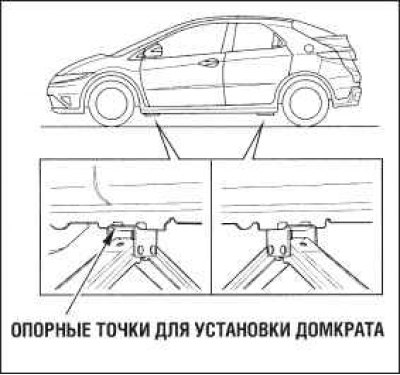
Find the jack support point under the body sill closest to the damaged wheel. Place the jack with the upper head under the body support point. Rotate the jack screw clockwise to extend the jack to bring its upper head under the body support. Make sure that the body support rib enters the recess of the jack head.
Using a lug wrench and extension, turn the jack screw clockwise to raise the vehicle until the damaged wheel is clear of the supporting surface.
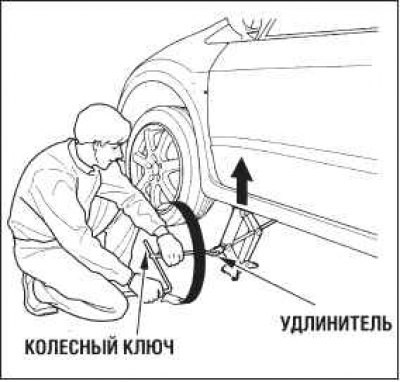
Loosen the wheel nuts and remove the damaged wheel. Note that the wheel nuts may be very hot. Temporarily place the removed wheel on a platform near the car with the outer side facing up.
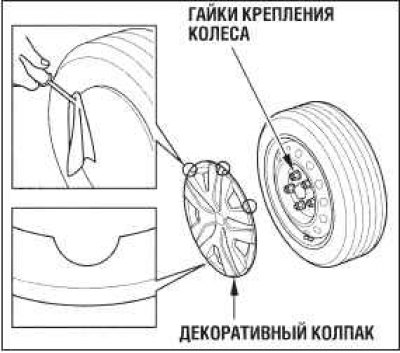
For some vehicle versions
Before unscrewing the wheel nuts, remove the decorative cap using a flat-blade screwdriver as a lever. Place a piece of cloth under the screwdriver to avoid damaging the cap. Do not press the screwdriver with great force.
Before installing the spare wheel, thoroughly clean the adjacent surfaces of the wheel disc and hub from dirt using a clean rag. Be careful. As a result of braking, the wiped parts may have heated up to a high temperature.
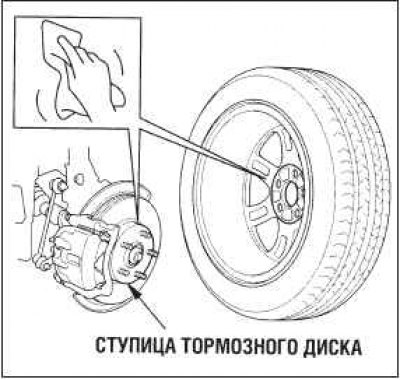 |
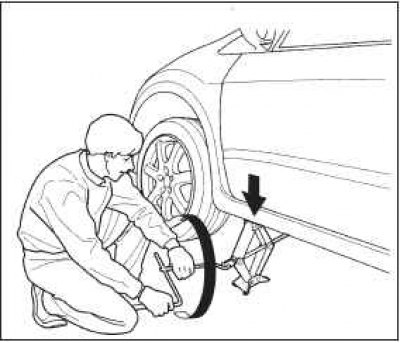 |
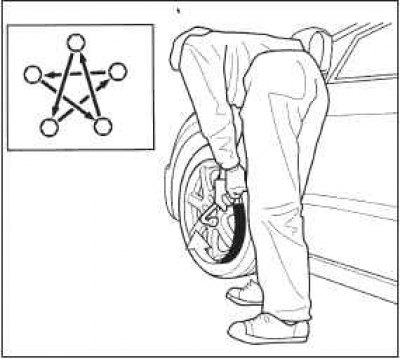
Install the spare wheel. Screw on and tighten the wheel nuts by hand. Then tighten the nuts with a wheel wrench. Tighten the nuts gradually in the sequence shown in the figure. The wheel should be tightly and evenly pulled to the hub flange. Do not tighten the wheel nuts completely on the suspended wheel.
Lower the vehicle and remove the jack.
Tighten the wheel nuts to the required tightening torque. Tighten the nuts in the sequence shown in the figure, gradually increasing the tightening torque to the nominal value. Check the tightening of the wheel nuts at the nearest service station.
The nominal tightening torque of wheel nuts is: 108 Nm.
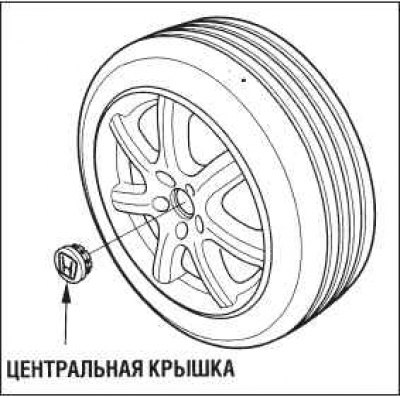
On some vehicle versions, before putting the damaged wheel in the trunk, it is necessary to remove the central cover of the decorative cap.
Place the decorative cap or center cap in the luggage compartment. Make sure that they are not damaged or scratched.
Pack the damaged wheel in the provided vinyl bag.
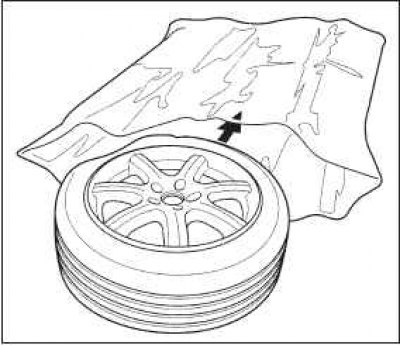
Place the damaged wheel on the floor of the luggage compartment.
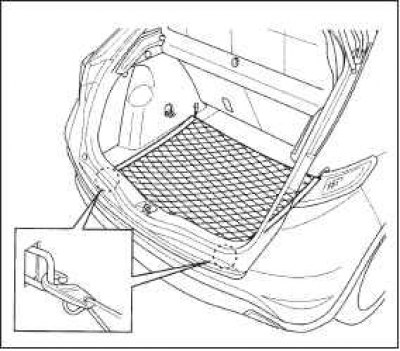
Don't forget to set the trunk lid to the upper position (if available), then place the damaged wheel on the cover.
Place the supplied net in the luggage compartment, hook the two hooks of the straps to the loops located in the rear door opening.
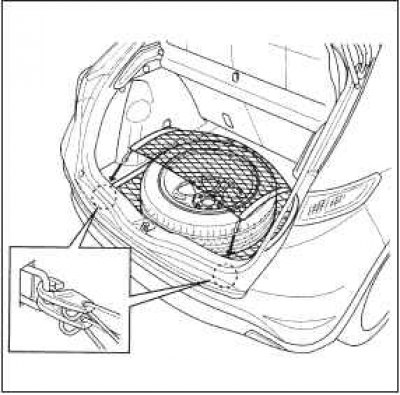
Wrap the net around the damaged wheel and attach two more hooks of the straps to the same loops (see picture).
Place the jack in the recess of the left rear corner of the luggage compartment. Rotate the end bracket to secure the jack.
Put the tool bag back in place.
Warning! If tools and other equipment are not stored in the stowed position, the driver and passengers may be seriously injured by these items in the event of a traffic accident.
Before driving again after replacing a damaged tire, store and securely fasten the removed wheel, jack, and tools.
Close the trunk door.
 |
 |
Installation of decorative cap (for some vehicle versions)
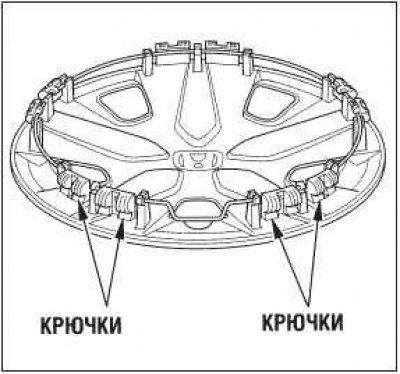
Make sure the retaining wire ring is placed over the hooks on the back of the decorative cap.
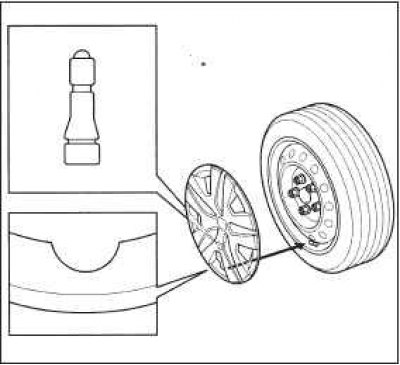
Align the valve location mark with the wheel valve, then install the cap.
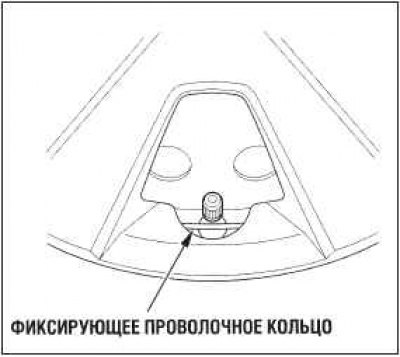
Make sure the wire ring is positioned outside the valve as shown in the picture.