
- 1. Make sure both batteries have the same voltage.
- 2. Make sure both batteries have the same polarity (have the same ground terminal).
- 3. Make sure the cars do not touch.
- 4. Make sure that the ventilation holes in the lids are not blocked.
- 5. Do not smoke near the battery.
- 6. In cold weather, check whether the electrolyte has frozen. Do not use a frozen battery.
CAUTION: Make sure the ignition key is in the OFF position in a vehicle with a dead battery. Connecting cables to a vehicle with an on-board computer will destroy the computer if the key is not in the OFF position.
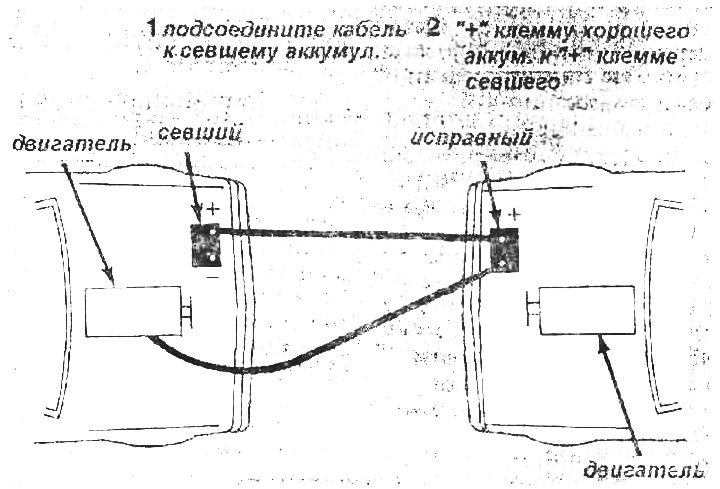
Startup procedures:
- 1. Determine the voltages of two batteries; they must be the same.
- 2 Place the vehicles next to each other (but not touching) so that the batteries are easily accessible.
- 3. Switch off all electrical consumers on both engines. Put both cars in neutral position and apply the handbrake.
- 4. Cover the cell lids with rags - do not cover the terminals.
- 5. If the terminals on the dead battery are heavily corroded, clean them.
- 6. Identify the positive and negative terminals on the batteries and connect the cables in the order shown.
- 7. Start the engine of the car with a normal battery and let it run at a speed slightly higher than idle. Try to start the car with a dead battery. Start it for no more than 10 seconds with a 20-second break between attempts.
- 8. If it doesn't start after 3 tries, something else is wrong.
- 9. Disconnect the cables in reverse order.