
Contents: Test on a fully braked car (stall…⇊ Hydraulic test ⇊ Table. Test on a fully braked…⇊ Table. Hydraulic test. ⇊
Test on a fully braked car (stall test)
This test checks the performance of the CVT and engine by measuring the speed at maximum load in all ranges.
Note:
- Carry out the check at the operating temperature of the variator working fluid (50-80°C).
- Turn off the air conditioner before checking.
- The duration of each check should not exceed ten seconds.
- Carry out checks only at the specified selector positions.
- Do not perform tests with hydraulic test pressure gauges connected.
1. Place wheel chocks under the wheels.
2. Connect the tachometer.
3. Apply the parking brake.
4. Start the engine.
5. Warm up the engine to operating temperature (until the moment the radiator fan of the cooling system turns on).
6. Move the selector to position "D".
7. Press the brake pedal all the way down.
8. Press the accelerator pedal all the way down. Quickly read the tachometer readings and compare them with the specified values.
Rotation speed with the vehicle fully braked (range "D"):
- nominal 2500 rpm
- acceptable range
- values 2350 - 2650 rpm
9. Wait approximately two minutes before performing the next test to prevent the variator from overheating.
10. Perform the test on the "S", "L" and "R" ranges in the same way.
Rotation speed with the vehicle fully braked:
Models with D15B engine:
- nominal 3000 rpm
- acceptable range
- values 2800 - 3100 rpm
Models with D17A engine:
- nominal 2800 rpm
- acceptable range
- values 2600 - 2900 rpm
11. If the measured values do not correspond to the nominal values, then determine the possible malfunction from the table " Test on a fully braked vehicle (stall test)".
Hydraulic test
Note:
- Carry out the check at the operating temperature of the variator working fluid (50-80°C).
- The duration of each check should not exceed five seconds.
1. Warm up the CVT working fluid to operating temperature (50-80°C).
2. Place the front of the vehicle on stands.
3. Apply the parking brake and place chocks under the rear wheels.
4. Remove the lower protective covers.
5. Make sure the front wheels can turn freely.
6. Warm up the engine to operating temperature (until the moment the radiator fan of the cooling system turns on).
7. Unscrew the plug and connect a special pressure gauge to hole "A" to check the reverse brake pressure.
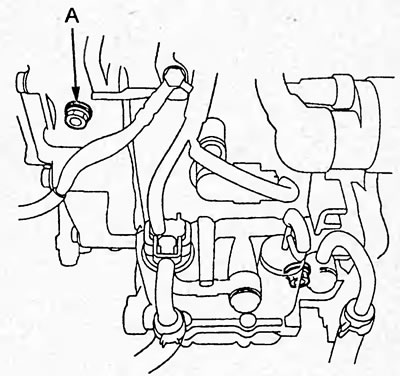
Table. Test on a fully braked vehicle (stall test).
| Check result | Malfunction |
| The measured rotation speed is higher than the nominal speed on the ranges "D", "S", "L" and "R" | - Low level of CVT working fluid or low pump performance. - Contamination of the CVT filter. - Pressure regulator sticking. - Malfunction of the forward clutch. - Malfunction of the starting clutch. |
| The measured speed is greater than the nominal speed in the "R" range | - Reverse brake failure. - Starter clutch failure. |
| The measured rotation speed is less than the nominal speed on the ranges "D", "S", "L" and "R" | - The engine does not develop maximum power. - Malfunction of the starting clutch. - Malfunction of the electromagnetic valve distributing pressure between the pulleys. |
8. Unscrew the plug and connect a special pressure gauge to hole "B" to check the forward clutch pressure.
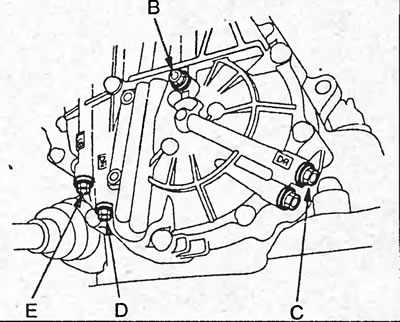
9. Connect the pressure gauges (with a measured pressure of at least 4.9 MPa) into hole "C" for measuring the pressure of the driving pulley and into hole "D" for measuring the pressure of the driven pulley.
10. Connect a special pressure gauge to the "E" hole to measure the lubricant pressure.
11. Start the engine.
12. Move the selector to position "D" and measure the forward clutch pressure at an engine speed of 1700 rpm.
Nominal pressure - 1.57 - 1.84 MPa
13. Move the selector to the "R" position and measure the reverse brake pressure at an engine speed of 1700 rpm.
Nominal pressure - 1.57 - 1.84 MPa
14. Move the selector to the "N" position and measure the pressure of the leading pulley and the pressure of the driven pulley at an engine speed of 1700 rpm.
Nominal pressure:
- leading pulley - 0.35-0.45 MPa
- driven pulley - 1.40-1.64 MPa
15. Measure the lubrication pressure at an engine crankshaft speed of 3000 rpm.
Nominal pressure - 0.30 - 0.35 MPa
16. After checking, disconnect all pressure gauges.
17. Install the plugs with new gaskets.
Tightening torque - 18 Nm
18. If the measured pressures do not correspond to the nominal values, then determine the possible malfunction using the "Hydraulic Test" table.
Table. Hydraulic test.
| Check result | Malfunction |
| The pressure in the forward clutch circuit is below the nominal value or is absent | - Forward clutch |
| The pressure in the reverse brake circuit is below the nominal value or is absent | - Reverse brake |
| The pressure in the driven pulley circuit is below the nominal value or is absent | - Variator pump. - Pressure regulator. - Hydraulic pressure control valve. - Hydraulic valve for distributing pressure between pulleys. |
| The pressure in the driven pulley circuit is higher than the nominal value | - Variator pump. - Pressure regulator. - Hydraulic valve for pressure distribution between pulleys. - Solenoid valve for pressure distribution between pulleys. |
| The pressure in the drive pulley circuit is below the nominal value or is absent | - Variator pump. - Pressure regulator. - Hydraulic valve for pressure distribution between pulleys. - Solenoid valve for pressure distribution between pulleys. |
| The pressure in the drive pulley circuit is higher than the nominal value | - Pressure regulator |
| Lubrication pressure is below nominal or absent | - Pump. - Hydraulic valve of the lubrication system. |
[Original published on this resource www.hondabook.ru]