
2. Check the resistance at the terminals of the solenoid valve block connector and compare with the values given in the table.
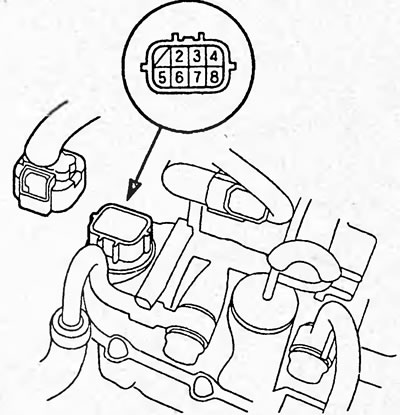
| Solenoid valve | Conclusions | Resistance, Ohm |
| pressure distribution between pulleys | 3<->7 | 3,8-6,8 |
| pressure control | 2<->6 | 3,8-6,8 |
| starting clutch control | 4 <-> 8 | 3,8-6,8 |
| launch prohibitions | 5 <-> weight | 11,7-21,0 |
If the resistance is not within the norm, check the functionality of the electromagnetic valves.
3. Checking the functionality of electromagnetic valves.
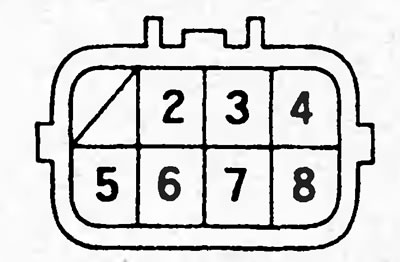
| Solenoid valve | Conclusions |
| pressure distribution between pulleys | 3(+)<->7(-) |
| pressure control | 2(+)<->6(-) |
| starting clutch control | 4 (+)<->8 (-) |
| launch prohibitions | 5 (+)<->weight (-) |
If no clicking noise is heard during testing, replace the faulty valve.
4. (Models with D15B engine) Check solenoid valves "A" and "B".
a) Disconnect the connector of the solenoid valves "A" and "B".
Apply battery voltage to the corresponding terminals of the solenoid valve block connector and make sure that you can hear the valves clicking.
b) Check the resistance between terminals "1" and "3" and terminals "2" and "4".
Resistance - 8-24 Ohm
c) If the resistance of the electromagnetic valves does not correspond to the norm, then check the functionality of the valves.
d) Check the functionality of the solenoid valve "A": connect terminal "1" to the positive terminal of the battery, and terminal "3" to the negative terminal and make sure that you can hear the valve clicking.
d) Check the functionality of the solenoid valve "B": connect terminal "2" to the positive terminal of the battery, and terminal "4" to the negative terminal and make sure that you can hear the valve clicking.
If necessary, replace the faulty solenoid valve.