
Contents: Air conditioning system ⇊ Service ⇊ Examination ⇊ Adding refrigerant ⇊ Heating system ⇊ On-board diagnostics ⇊ Eliminating Air Conditioning Odors ⇊
Air conditioning system
Warning! The air conditioning system is under constant high pressure. Never disconnect refrigeration lines or remove any system components without first discharging the system. Discharging the air conditioning system must be done by an experienced technician in a car service workshop. Always wear safety glasses when disconnecting refrigeration lines!
When replacing air conditioning system components, a certain amount of replacement refrigeration oil will be required to fill the volume of the new unit. Use only oil suitable for use in R-134a systems (check the container label carefully).
Service
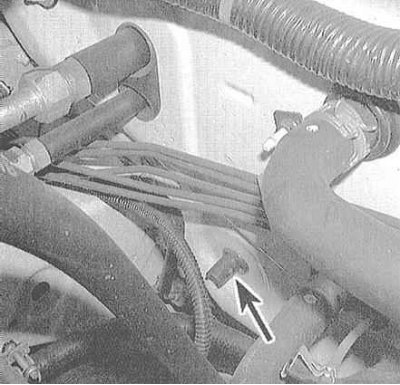
The following checks should be performed on a regular basis to maintain the air conditioning system in good working order:
- a) Check the condition of the compressor drive belt. If defects or signs of wear are detected, replace it (see Chapter Settings and ongoing maintenance);
- b) Check the tension of the drive belt and adjust it if necessary (see Chapter Settings and ongoing maintenance);
- c) Check the refrigeration hoses for cracks, swelling, signs of hardening and aging of the rubber. Replace if necessary;
- d) Check the condenser plates for insect remains, old leaves and other debris stuck between them. If necessary, clean the gaps with a thin brush or blow them out with compressed air;
- e) Check the system charge level;
- f) If you find water leaks on the carpets in the passenger compartment under the instrument panel, remove the condensate drain pipe from the evaporator casing (located in the lower front corner) and use a piece of wire to check the patency of both holes. The air conditioning system should be turned on for at least 10 minutes at least once a month (even in winter). Long periods of inactivity of the air conditioning system will cause the sealing rings and cuffs of the connecting line to harden and fail.
Note: When the deicing function is turned on, the A/C compressor is activated.
In case of malfunctions in the operation of the compressor, first of all check the proper functioning of the compressor clutch (see Section Checking the electrical circuit of the K/V compressor clutch).
Due to the complexity of the system design and the need to use special equipment, its maintenance, in-depth diagnostics and repair are beyond the skill level of the average amateur mechanic and must be performed in a car service workshop. The car owner is only competent to perform the simplest checks and replacements listed below in this Section.
The most common cause of malfunction of the air conditioner is a decrease in the charge level of the refrigerant oil. The following simple tests will allow you to quickly identify signs of a decrease in the refrigerant level.
Examination
1. Warm up the engine to normal operating temperature.
2. Turn on the air conditioner to maximum cooling capacity. Select the maximum fan speed. Open the doors to eliminate closed air circulation in the cabin.
3. After the system reaches operating temperature, feel the two tubes connected to the evaporator on the engine compartment bulkhead.
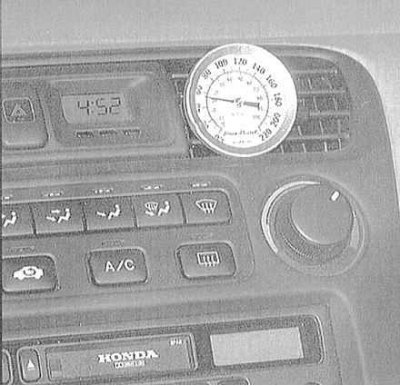
4. The thinner tube going to the evaporator from the condenser outlet fitting should be quite cold to the touch. The thicker tube going from the evaporator outlet fitting back to the compressor should be a little colder (by 2-6 degrees). If the outlet tube is noticeably warmer to the touch than the inlet tube, the system needs recharging. Insert a thermometer into the outlet air duct through the central deflector on the instrument panel. When the air conditioning is on, the temperature of the air coming out of the deflector should be 19-22 degrees lower than the ambient temperature (up to 4.5°C). In very hot weather (+40°C), an increase in the outlet temperature to 15.6°C is permissible, but not more.
5. If the requirements listed in the previous paragraph are not met, then the system needs charging. For a more detailed diagnosis of the system's condition, the car should be taken to a specialized workshop. Performing some on-board diagnostic tests will help determine the nature of the damage and the scope of the upcoming repair work.
Adding refrigerant
Caution! Only R-134a refrigerant oil should be used to charge the air conditioning system of the vehicles covered in this Manual.
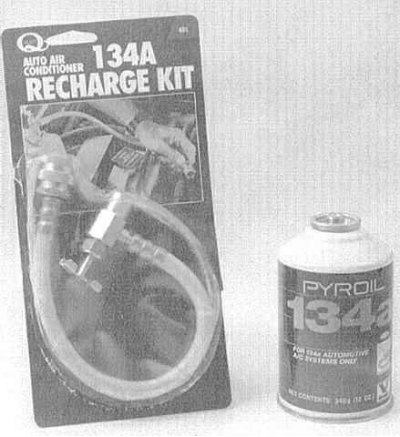
1. Prepare a standard R-134a charging kit (ask at car accessory stores). The kit includes a can of refrigeration oil, a valve nozzle, and a section of hose that connects between the valve and the low-pressure part of the refrigeration system (see accompanying illustration). Since one can of oil may not be enough to fully charge the system, it makes sense to buy a couple just in case. Make sure that at least one of the cans contains oil that is tinted red, which will allow you to quickly identify refrigerant leaks if any occur.
Attention! Never fill the system with more than two cans of refrigerant!
2. Connect the charging kit to the system according to the manufacturer's instructions.
Attention! Do not attempt to connect the kit to the high-pressure part of the tract under any circumstances! The design of the nipple connections allows the kit to be connected only to the low-pressure part of the system.
3. Close the valve on the adapter and screw the latter onto the head of the can, having first checked that the sealing ring/rubber gasket is present.
Attention! Be sure to wear protective glasses!
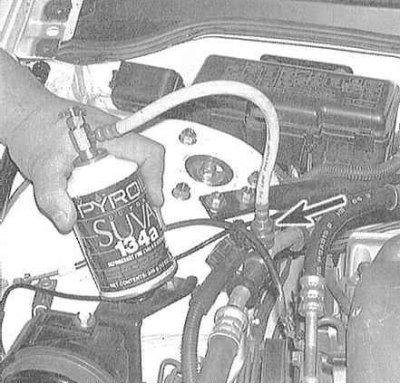
4. Remove the dust cap from the low-pressure part of the refrigeration line and connect the charging kit hose equipped with a quick-connect connector to it.
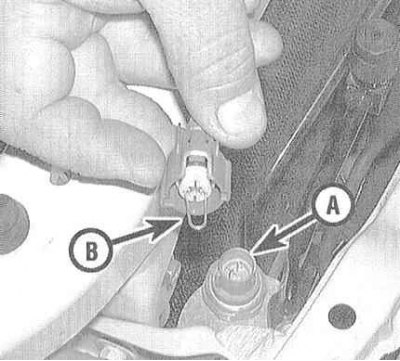
5. Warm up the engine and turn on the A/C. Make sure that the charging kit hose does not come into contact with the fan blades of the engine cooling/air conditioning systems.
Note: The system must be charged with the compressor running. If the compressor clutch disengages, the system must be switched to maximum cooling capacity and all cabin doors must be opened.
To prevent the compressor from shutting off while charging, disconnect the connector from the low pressure switch (some models use a combination low/high pressure switch) and bridge it with a paper clip or a piece of stiff wire.
6. By rotating the valve nozzle, pierce the head of the canister, thereby opening the supply of refrigerant (you should hear the characteristic sound of escaping gas). During the entire charging process, hold the canister strictly vertically, shaking it from time to time. Between charging series, make a pause necessary for stabilizing the system.
7. If you have an accurate thermometer at hand, insert it through the deflector into the central air duct of the air conditioner and use it to monitor the temperature of the air supplied to the cabin.
8. When the can is empty, close the valve and disconnect the hose from the low-pressure fitting of the system. Immediately put the dust cap on the fitting.
9. Disconnect the valve nozzle from the cylinder, if necessary, move it to the second cylinder and continue filling. After completing the procedure, place the unfinished cylinder vertically on the rack and use it to recharge the system as needed.
Heating system
Wet carpeting on the floor under the heater heat exchanger, or steam escaping through the air duct deflectors indicate heat exchanger leaks. Remove the heat exchanger (see Section Removal and installation the heater heat exchanger) and replace it with a new one (the heater heat exchanger cannot be repaired).
If the heater does not provide adequate heating of the air supplied to the passenger compartment, the cause of such failure may be one of the following:
- a) The thermostat is stuck in the open position, which prevents the engine coolant supplied to the heater heat exchanger from heating up to normal temperature;
- b) There is a blockage in the cooling tract, which blocks the supply of coolant to the heater heat exchanger. Feel the hoses connected to the pipes on the rear bulkhead of the engine compartment - both of them should be hot, otherwise the tract is blocked (the hoses, heat exchanger, or heater control flap are blocked). Disconnect the hoses and perform a reverse-flow flush of the heat exchanger. After disconnecting them, also flush both hoses;
- c) If it is not possible to restore the heat exchanger"s patency by flushing, the unit should be replaced.
On-board diagnostics
Standard heating/air conditioning system
On the models considered in this Manual, diagnostics of electrical circuit failures of the heater/air conditioner control device can be performed without using a scanner reader.
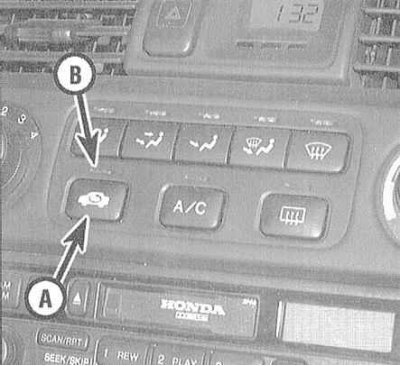
Turn on the ignition and, by pressing the closed recirculation mode initiation button, ensure that the indicator lamp located directly above it turns on. The heater fan must be off. Press the button again (the indicator lamp must go out) and hold it depressed. Repeated switching on of the indicator lamp indicates the initiation of the self-diagnostic mode. Now the lamp will start displaying codes of the simplest faults detected in the system. One flash indicates a malfunction of the air mixing control electric motor (jamming of the damper, malfunction of the windings, or short circuit). Two flashes mean a failure of the mode selection control electric motor. Three flashes indicate faults associated with breaks or short circuits in the evaporator temperature sensor circuit, or an internal malfunction of the sensor assembly itself.
Electric motor circuit for controlling the air mixing process
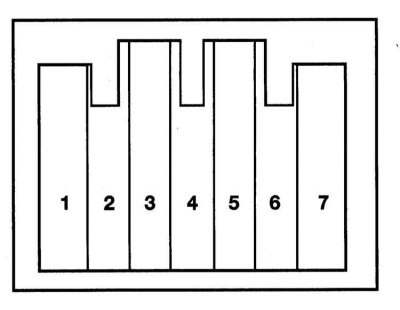
Disconnect the electrical wiring from the motor assembly. Using a jumper wire, apply battery voltage to terminal 1 of the electric motor connector, ground terminal 2. The motor should start rotating, otherwise swap the jumper wires, which should cause the motor to rotate in the opposite direction. A faulty motor must be replaced. Next, measure the resistance between terminals 5 and 7 of the connector (the required value is 4.2÷7.8 kOhm) and terminals 3 and 5 (0.58÷1.09 kOhm when cold air is supplied to the passenger compartment and 3.52÷6.55 kOhm when selecting the maximum heating intensity mode). If there are any doubts about the proper functioning of the damper, disconnect the electric motor drive rod from the actuator rod and repeat the above test using jumper wires. If the engine now starts to function properly, replace the damper or its rod.
Electric motor for mode selection
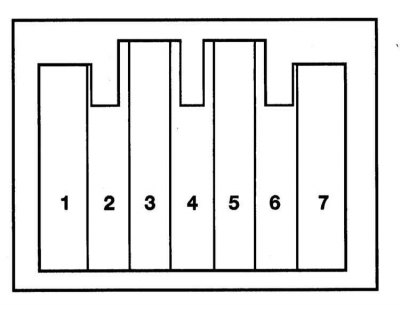
The test is performed by applying battery voltage to terminal 2 and grounding terminal 1 of the motor. The motor should turn to the stop and stop, after which the power supply should be immediately disconnected. Reversing the polarity of the jumper wires should cause the motor to rotate in the opposite direction. If you have a universal circuit meter with a digital indicator at hand, turn on the device in the resistance measurement mode (range up to 20 kOhm with an output current of no more than 1 mA) and check for conductivity between the terminals of the contact connector during the procedure). There should be instantaneous conductivity between terminal 7 and terminals 3, 4, 5 and 6.
If the electric motor rotates too slowly or does not rotate at all, disconnect its drive rods of the corresponding damper and repeat the check. If now the rotation occurs normally, try to identify and eliminate the cause of jamming of the damper or its rod.
Electric motor for switching on the closed air circulation mode
Disconnect the electrical wiring from the motor.
Using a jumper wire, apply battery voltage to terminal 1 of the electric motor, ground terminals 5 and 7 to ground. The motor should begin to rotate smoothly and move to one of its two extreme positions ("Closed Circulation" or "Outside Air Supply") when ground is disconnected.
If the electric motor rotates too slowly or does not rotate at all, disconnect its drive rods of the corresponding damper and repeat the check. If now the rotation occurs normally, try to identify and eliminate the cause of jamming of the damper or its rod.
Models equipped with climate control system
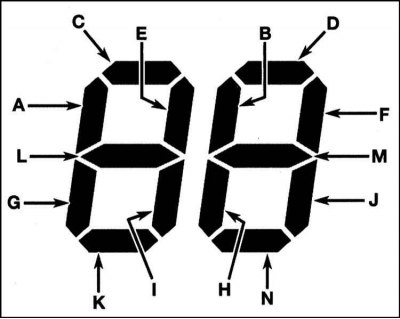
These models use a more complex self-diagnosis system. Instead of a control lamp, an LED display of the control panel temperature gauge is used as an indicator, capable of displaying up to 40 error codes. During the diagnostic check, two symbols in the form of the number 88 are displayed on the display. Each segment of both symbols is responsible for a specific failure in the system. Turn on the ignition, move the supply air temperature control lever to the minimum temperature position, then return it to the maximum heating intensity position. Wait one minute, then press the "AUTO" button on the control panel. While holding the "AUTO" button pressed, also press the "OFF" button, two symbols in the form of the number 88 should appear on the temperature gauge display.
When the self-diagnostic device detects one of the standard failures in the system, the corresponding segment of one of the symbols flashes. In accordance with the designations shown in the illustration above, write down the designations of the flashing sectors of the display. By checking the fault code map, determine the nature of the failure and prepare to carry out the corresponding repair.
Eliminating Air Conditioning Odors
Unpleasant odors that often occur when the air conditioner is turned on are caused by the formation of mold colonies on the evaporator heat exchanger plates. A warm, humid environment creates the most favorable conditions for the emergence and development of fungal microorganisms.
Access to the evaporator heat exchanger on most models is extremely limited. The procedure for guaranteed complete mold removal, performed in a car service workshop, is quite labor-intensive, time-consuming and requires the use of strong disinfectants. In principle, quite effective treatment can be performed at home by the car owner himself.
Special disinfectants in aerosol packaging designed for servicing air conditioning systems can be purchased at almost any car accessory store. It should be remembered that the price of the product is usually directly proportional to its effectiveness. Switch the system to closed air circulation mode and turn on the heater fan at maximum speed for ten minutes. In order to dry the system, turn on the heating at maximum intensity. Disconnect the wiring from the compressor in order to prevent it from operating (see Section Removal and installation of the air conditioning compressor).
The product is usually supplied through a long hose. Remove the electric motor of the heater fan drive (see Section Removal and installation the electric motor of the heater fan drive), insert the nozzle of the feeder into the resulting hole and move it to the left, directing it at the evaporator heat exchanger. The product is fed in accordance with the manufacturer's instructions. Try to treat the entire surface of the heat exchanger as completely as possible. The duration of each treatment cycle and the intervals between series must be indicated on the container label.
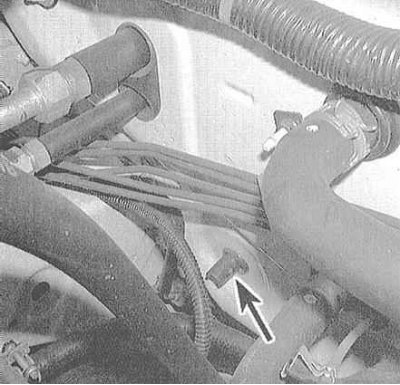
The best preventative measure against the formation of mold colonies in the evaporator heat exchanger is to regularly check the patency of the drain tube.