
Note: Before removing the connecting rod and piston assemblies from the engine, it is necessary to remove the cylinder head, oil pan and oil pump with oil pickup pipe (see Parts Engine Repair Without Removing It From The Car - Civic Models or Engine Repair Without Removing It From the Vehicle - Integra Models of this Chapter).
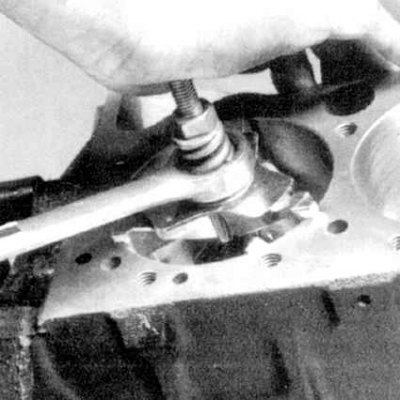
1. Using a special countersink, completely remove traces of stepped wear from the top of the cylinders (see accompanying illustration) – Follow the manufacturer's instructions for the countersink. The step is formed at the piston stroke limit, approximately 6.4 mm below the top edge of the cylinder due to mechanical wear of metal and carbon deposits. Attempts to remove the connecting rod and piston assemblies without removing the step wear may damage the pistons. 2. After completing the preparation of the cylinders, turn the engine upside down so that the crankshaft is on top.
3. On all engines except the B18B1, in order to provide access to the connecting rod assemblies, it is necessary to remove the main bearing cap bridge (see Removal the crankshaft).
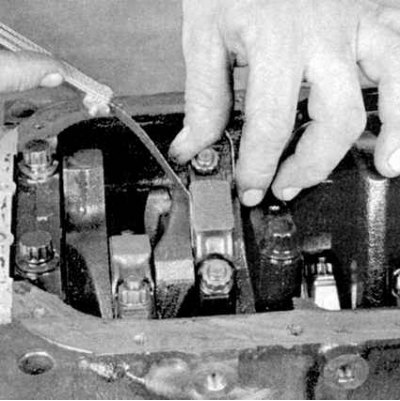
4. Before removing the connecting rods from the crankshaft, evaluate the amount of their axial clearance on the journals of the latter. Firmly insert the blade of the measuring gauge into the gap between the side wall of the lower head of the connecting rod and the crank cheek, completely removing the clearance of the connecting rod on the journal of the shaft (see accompanying illustration). The total thickness of the selected feeler blades will be equal to the value of the connecting rod axial clearance. Compare the result of the measurement with the requirements Specifications. If the axial clearance exceeds the maximum permissible value, this connecting rod must be replaced. The axial clearance of a new connecting rod, or an old one on a new shaft, may be less than the lower permissible limit, in which case the connecting rod can be turned - consult with car service specialists. Check all remaining connecting rods one by one.
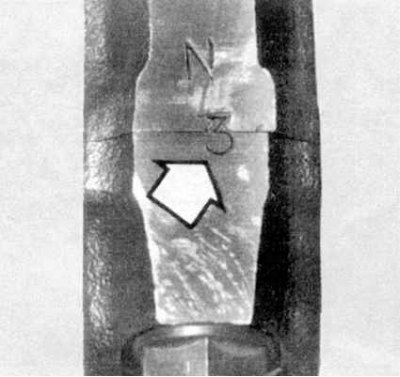
5a. Make sure that the connecting rod lower heads and their caps have identification marks indicating that they belong to your cylinder – do not confuse the connecting rod number with the connecting rod bearing size marking (see accompanying illustration).
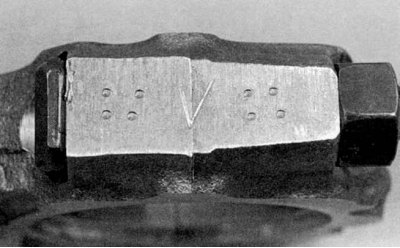
5b. If necessary, make marks yourself using a small center punch.
6. In several stages (1/2 turn per approach) loosen the nuts securing the connecting rod lower head caps so that they can be unscrewed by hand. Remove the first connecting rod cap together with the bearing shell placed in it – try not to drop the latter.
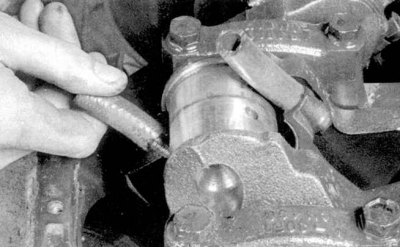
7. Pull sections of fuel hose onto the ends of the cover mounting studs to eliminate any possibility of accidental damage to the shaft journal and cylinder bore during the process of removing the connecting rod assembly from the last (see accompanying illustration).
8. Remove the bearing shell from the lower connecting rod head, then, using the wooden handle of a hammer against the bearing bed in the lower head, push the connecting rod and piston assembly out of the engine through the top of the cylinder. If resistance occurs, immediately stop removing the assembly and check that the stepped wear in the upper part of the cylinder has been completely removed.
9. In a similar manner, remove the remaining connecting rod and piston assemblies from the engine.
Note: The connecting rod to be removed is installed coaxially to its cylinder by turning the crankshaft accordingly – proceed with the extraction only after the connecting rod is positioned strictly parallel to the cylinder axis!
10. To avoid accidental mechanical damage to the bearings and loss of components, reinstall the bearing shells and secure the bearing caps to the lower heads of your connecting rods, hand tightening the nuts.
11. Do not remove the pistons from the connecting rods (for more details, see. Checking the condition of the connecting rod and piston group components).