
Disassembling the connecting rod and piston group
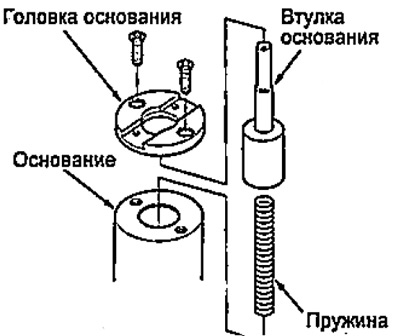
1. Assemble the special tool as shown in the figure.
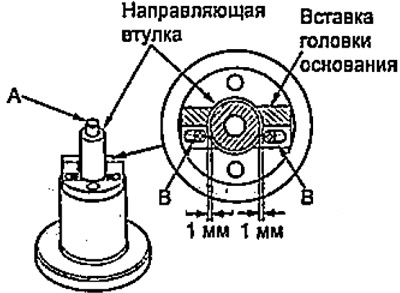
2. Temporarily install the guide bushing on the base bushing (A) and adjust the insertion position of the base head as shown in the figure, then tighten the screws (B). Remove the guide bushing.
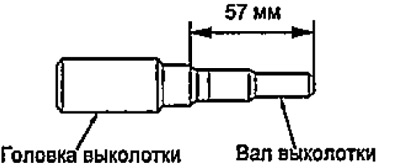
3. Assemble and adjust the length of the head and the drift shaft.
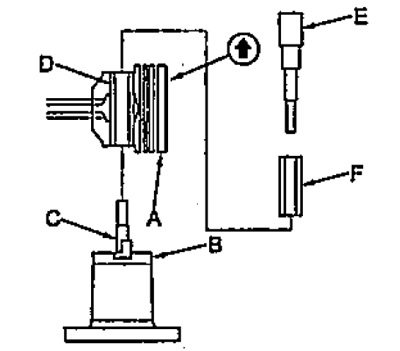
4. Place the piston assembly (A) on the special tool (B) with the mark on the piston bottom facing up. Make sure that the groove on the piston is positioned opposite the insert of the base head (C) as shown in the figure.
5. Press out the piston pin (D) with a punch (E) through the guide (F) using a hydraulic press.
Examination
1. Measure the piston pin diameter.
Note: Check the connecting rod and piston group components at room temperature.
- Nominal piston pin diameter - 17.996- 18.000 mm
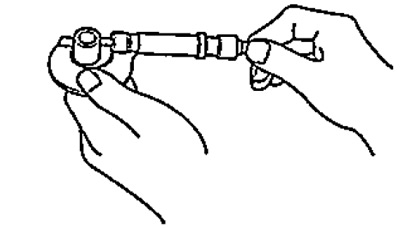
2. Set the dial indicator to the piston pin diameter and reset the reading to zero.
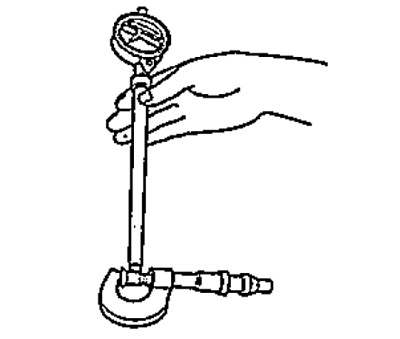
3. Determine the difference between the piston boss diameter and the piston pin diameter.
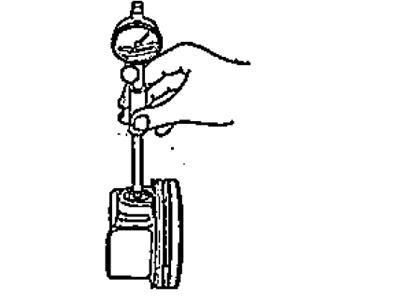
- The nominal clearance between the piston bosses and the piston pin is 0.010-0.018 mm
4. Measure the inner diameter of the connecting rod piston head.
- Nominal diameter - 17.964-17.977 mm
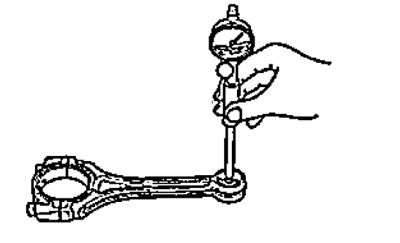
5. Determine the difference between the diameter of the connecting rod piston head and the piston pin.
- The gap between the piston head of the connecting rod and the piston pin is 0.020 - 0.036 mm
Assembly
1. Assemble the piston and connecting rod so that the arrow on the piston and the relief mark on the connecting rod are located on the same side.
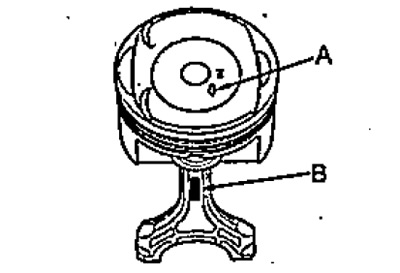
2. Install the guide sleeve (A) into the piston and connecting rod.
3. Place the piston and connecting rod assembly (B) with the marks facing up on the special tool (C). Make sure that the recess in the piston is positioned opposite the insert in the base head (D) as shown in the figure.
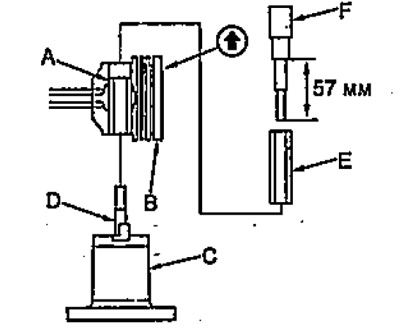
4. Press in the piston pin (E) with a drift (F) using a hydraulic press.