
Note: New connecting rod bearings must be selected according to the identification marks applied to the connecting rod and crankshaft (see below).
When assembling, lubricate all internal parts with engine oil.
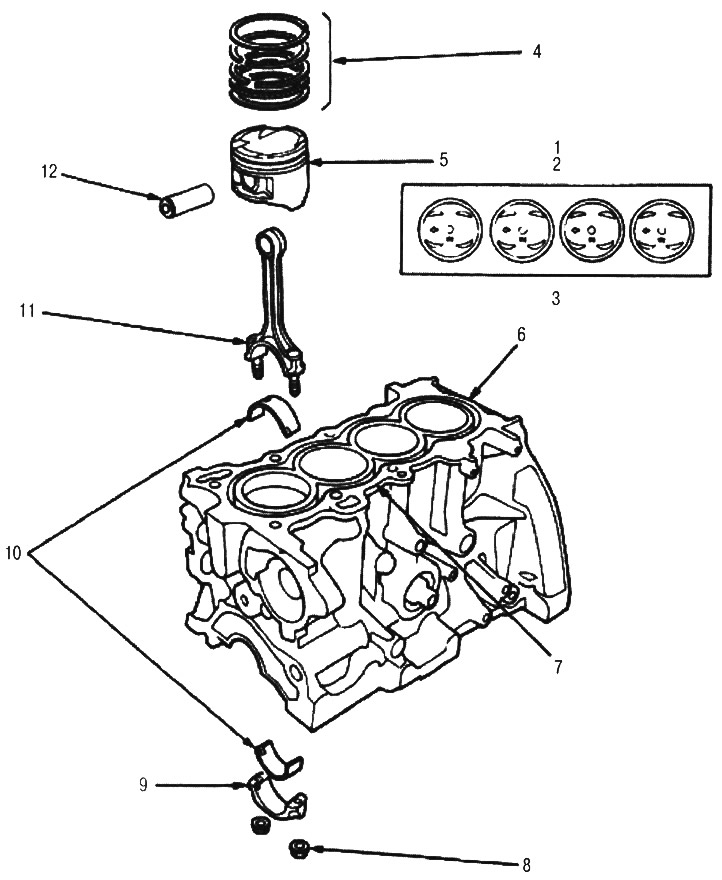
1. DIRECTION OF INSTALLATION OF PISTONS
2. RELEASE
3. INLET
4. PISTON RINGS. Replacement (see below). Measurement (see below).
5. PISTON. Check (see below)
Note: Before removing the pistons, check to see if a ring of carbon deposits has formed on the top of the cylinder. Remove carbon deposits if necessary.
6. CYLINDER BLOCK. Checking the cylinders (see below). Check for warpage (see below). Cylinder honing (see below)
7. Before removing the piston, check whether a ring-shaped protrusion from carbon deposits has formed at the top of the cylinder. Remove carbon deposits if necessary.
8. CONNECTING ROD CAP NUT, 8x0.75 mm, 31 Nm (3.2 kgf/m). Apply engine oil to the nut threads.
Note: After tightening each bearing cap, rotate the crankshaft to ensure that it does not bind.
9. CONNECTING ROD BEARING CAP. Installation (see below)
Note: Install the caps so that the recesses in the bearings are on the same side as the recesses in the connecting rods.
10. CONNECTING ROD BEARINGS. Clearance (see below). Selection (see below)
11. CONNECTING ROD. Axial play (see below). Selection (see below)
12. PISTON PIN. Removal (see below) Installation (see below). Examination (see below)