
2. Perform an external inspection of the block to detect traces of corrosion, cracks and other damage. Check the condition of the threads of the bolt holes. It would also be reasonable to test the block for hidden cracks in a car service workshop using special diagnostic equipment. If defects are detected, the block is subject to restoration repair or replacement.
3. Check the condition of the cylinder mirrors.
4. Estimate the values of the existing conicity and ovality of the cylinders (see accompanying illustrations).
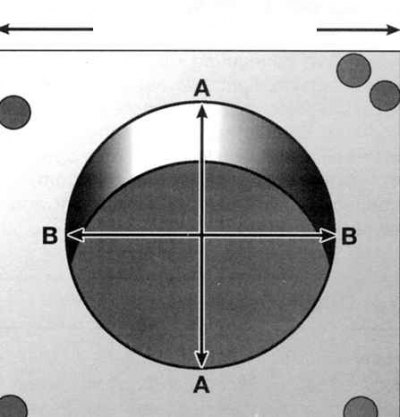
5a. Measure the diameter of each of the cylinders in the upper (just below the step wear boundary), central and lower sections, first in a plane parallel to the crankshaft axis (IN), then perpendicular to the block axis (A).
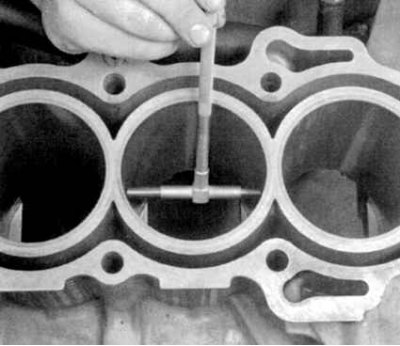
5b. Cylinder diameters should be measured using a telescopic bore gauge and a micrometer. The ability to use a bore gauge correctly does not come immediately - do not rush, take several measurements until you are absolutely sure that your conclusions are correct.
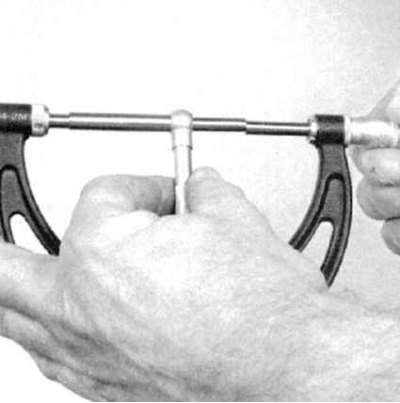
6. After the diameter has been recorded with a bore gauge, measure the latter with a micrometer (see illustration).
7. The cylinder taper value is determined by the difference between the measurement results in the upper and lower sections. Ovality is the difference in diameters in planes parallel and perpendicular to the crankshaft axis. Compare the test results with the permissible values (see Specifications).
8. Proceeding in the manner described, check all cylinders in turn.
9. If noticeable defects are detected or the measurement results deviate from the standard requirements, the cylinder block is subject to mechanical restoration in the conditions of the car service workshop. If the cylinders were bored during the restoration repair, the engine must be equipped with new pistons of the corresponding repair grade (in excess) size.
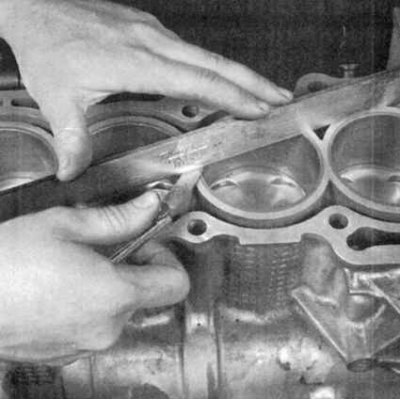
10a. Check the flatness of the mating surface of the block (see accompanying illustrations). Compare the measurement result with the requirements Specifications, if necessary, give the block a regrind.
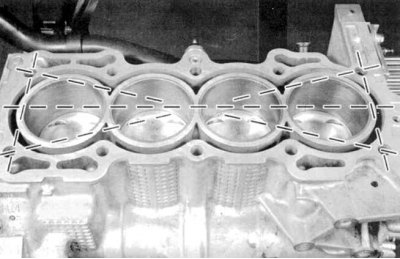
10b. Perform the measurement in three directions: along the block axis and its two diagonals. 11. If the condition of the cylinder mirrors during the inspection is found to be satisfactory while simultaneously complying with the regulatory requirements for the shape of the cylinders and the clearances for the pistons to fit in them (see Checking the condition of the connecting rod and piston group components), there is no need to bore the cylinders. It will be enough to simply hone the mirrors (see Honing of cylinder mirrors).