
Note: If the original spark plugs are to be reinstalled on the engine after checking their condition, they must be screwed strictly into the previous cylinders – mark them accordingly.
All models of cars considered in this Manual are equipped with transversely mounted engines. The spark plugs are installed in the upper part of the engine.
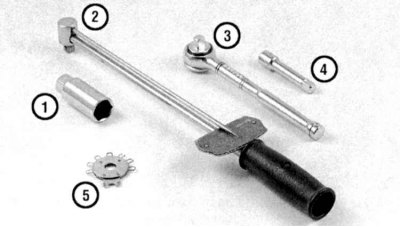 |
Tools needed when replacing spark plugs
1. Spark plug head — Equipped with a special soft insert that eliminates the possibility of accidental damage to the porcelain insulator when unscrewing the spark plug. 2. Torque wrench - Although not mandatory, it provides a reliable guarantee of the correct tightening force of the spark plugs. 3. Ratchet drive — Used in combination with a spark plug head and torque wrench. 4. Extension cord — Depending on the model and its auxiliary units, access to the spark plugs may be limited to varying degrees, so using extensions of the appropriate shape and design will significantly facilitate the procedure. 5. Tool for measuring and adjusting spark plug gaps — There are several types of this type of tool available – make sure that the tool comes with a feeler gauge that matches the size of the spark plug gaps in your vehicle. |
In most cases, replacing spark plugs requires a special spark plug head (with soft liner inside) complete with ratchet drive, as well as a set of wrench drive extensions and a tool for checking and adjusting interelectrode gaps (see illustration above). A special tool is also available to safely disconnect the high-voltage wire ends from the spark plug tails, although its use is not strictly required. Using a torque wrench will help achieve the correct tightening force for the spark plugs.
The best thing to do is to keep a set of replacement spark plugs in your car at all times, with the interelectrode gap adjusted correctly. When buying new spark plugs, make sure that they meet the parameters of your car's engine. The necessary information is provided in Specifications to this Chapter and also on the VECI label attached under the hood (in case of discrepancies, preference should be given to the requirements of the latter).
1. Wait until the engine has cooled down completely, only then proceed to unscrew the spark plugs. In order not to waste time, use the pause to check the condition of the replacement set of spark plugs.
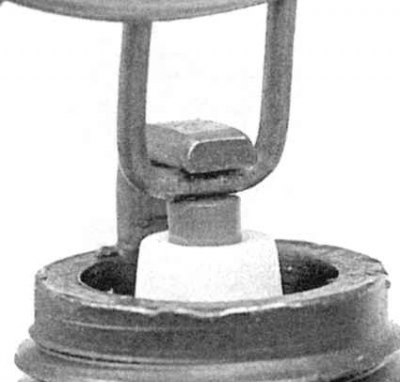
2a. The spark plug gap is checked by inserting the appropriate feeler gauge into it (see accompanying illustration) and must comply with the requirements given on the VECI label (alternatively see Chapter Engine electrical equipment). The probe should slide with slight resistance between the side and central electrodes of the cross-section.
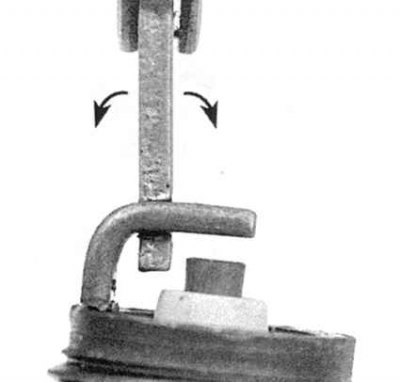
2b. The gap can be adjusted using a special device, usually included in the measuring device - bend the side electrode of the spark plug accordingly (see accompanying illustration). If the side electrode is not positioned exactly above the central one, adjust its position accordingly. Make sure there are no cracks or other damage in the porcelain insulator of the spark plug. The presence of any kind of defects in the insulator is unacceptable.
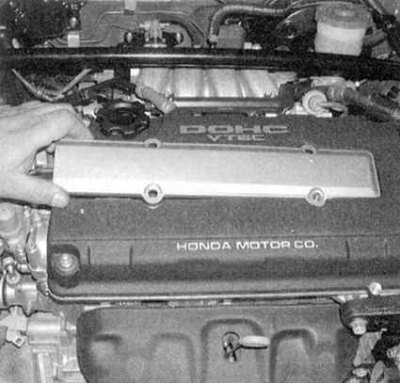
3. On Integra models, remove the spark plug cover (see accompanying illustration). With the engine cold, disconnect the high-voltage wire from the spark plug of the first cylinder (see Checking the condition and replacing the spark plug wires, cover and distributor rotor (every 48,000 km or once every 24 months)). Pull only the tip, and never the wire! It would be wise to use a special tool.
4. If you have a source of compressed air on hand, use it to remove debris from the spark plug niches of the engine (a regular bicycle pump would be just as good for this purpose).
Caution! When using compressed air, do not forget to wear safety glasses!
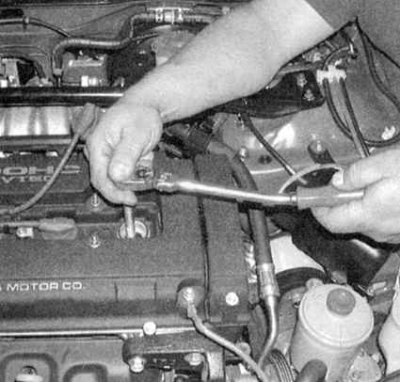
5. The spark plugs on the models in question are deeply recessed into the spark plug recesses, so you will need a key drive extension to unscrew them. After putting it on the spark plug head, connect the drive and, carefully turning the wrench counterclockwise, unscrew the spark plug (see accompanying illustration).
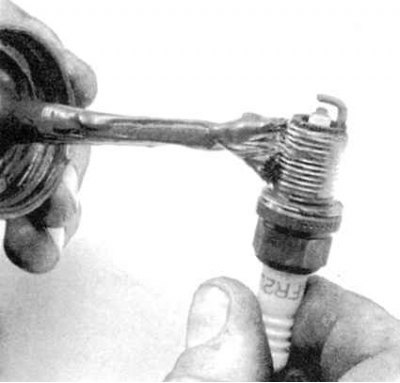
6. Compare the removed spark plug with the condition chart shown in the photographic insert, which will allow you to qualitatively assess the overall condition of the engine. Before screwing in new spark plugs, lightly lubricate their threaded part with anti-seize sealant (see accompanying illustration).
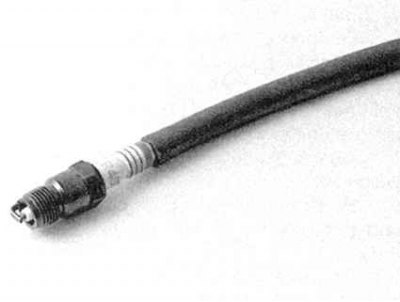
7. Thread one of the new spark plugs into the appropriate hole in the engine by hand. After making sure that the spark plug is not twisted in the threads, tighten it to the required torque (if you have a torque wrench at hand). To make the spark plug installation easier, pull a piece of flexible fuel hose over its tail (see accompanying illustration). This eliminates the possibility of thread stripping, since the slightest biting will simply cause the hose to start turning. 8. Before connecting the high-voltage wires to the spark plugs, follow the procedures Checking the condition and replacing the spark plug wires, cover and distributor rotor (every 48,000 km or once every 24 months).
9. The high-voltage wire is connected by rotating and reciprocating movements of its tip – the latter should fit tightly onto the spark plug tail.
10. Repeat the procedure for the remaining spark plugs, performing all steps one by one to avoid disrupting the order of connecting the high-voltage wires.
11. On Integra models, replace the spark plug cover.
Spark Plug Condition Chart
Normal condition of the candle
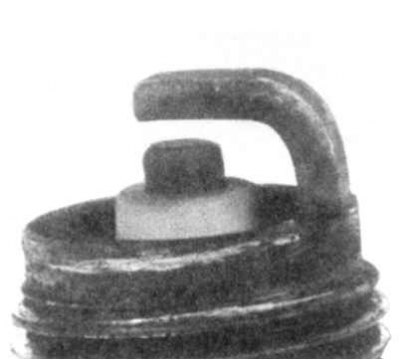
Symptoms: Grey-brown color and slight wear of the electrodes. The glow number of the spark plugs corresponds to the type of engine and its general condition.
Recommendations: When replacing spark plugs, install spark plugs of the same type.
Wear
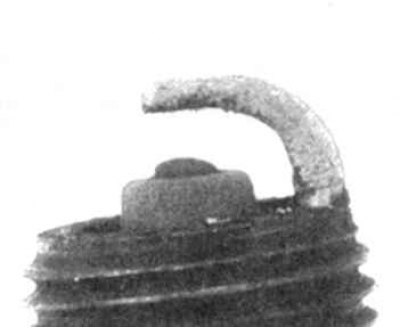
Symptoms: Rounding of the electrodes with a small accumulation of deposits at the working end. Color is normal. Causes difficulty starting the engine in cold, wet weather and increased fuel consumption.
Recommendations: Replace the spark plugs with new ones of the same type.
Coal deposits
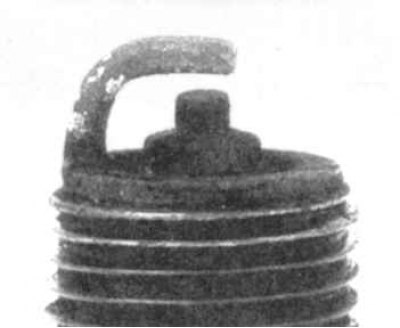
Symptoms: The presence of soot indicates an over-rich fuel-air mixture or weak spark intensity. Causes misfires, difficult starting and leads to unstable engine operation.
Recommendations: Check if the air cleaner is clogged, if the fuel level in the float chamber is too high, if the air damper is stuck and if the contacts are too worn. Try using spark plugs with a longer insulator, which increases resistance to contamination.
Ash formation
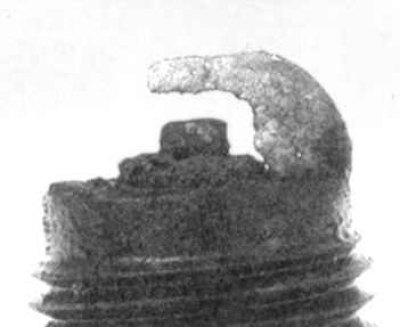
Symptoms: Soft, brownish deposits on one or both spark plug electrodes. These are caused by oil and/or fuel additives. Excessive buildup can insulate the electrodes and cause misfires and rough running under acceleration.
Recommendations: If deposits accumulate quickly, replace the oil seals, which will prevent oil from entering the combustion chambers. Try changing the fuel brand.
Oiling
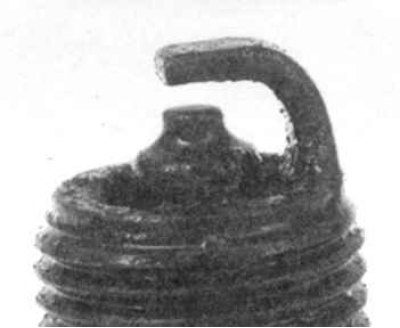
Symptoms: Oiling of the spark plug is caused by worn out oil deflector caps. Oil gets into the combustion chamber through worn valve guides or piston rings. Causes misfires, difficult starting and leads to unstable engine operation.
Recommendations: Perform mechanical repairs and replace spark plugs.
Short circuit of electrodes
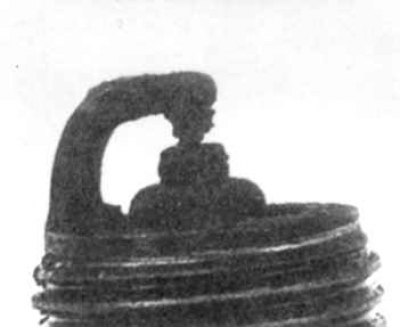
Symptoms: Combustion waste gets into the interelectrode space. Solid deposits accumulate, forming a bridge between the electrodes. Leads to ignition failure in the cylinder.
Recommendations: Remove deposits from the interelectrode space.
Overheat
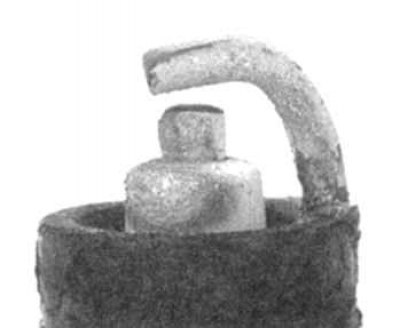
Symptoms: Porous, white insulator, erosion of electrodes and absence of any deposits. Leads to a reduction in spark plug life.
Recommendations: Check if it meets the requirements Specifications the glow plug rating, whether the ignition timing is set correctly, whether the fuel-air mixture is too lean, whether there are any vacuum leaks in the intake manifold and whether the valves are jammed. Also check the coolant level and whether the radiator is clogged.
Too early ignition
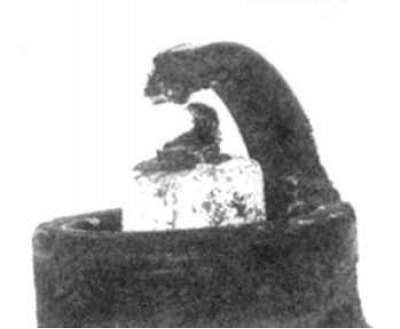
Symptoms: The electrodes are melted. The insulator is white, but may also be contaminated due to misfiring or foreign particles entering the combustion chambers. May cause engine failure.
Recommendations: Check the glow number of the installed spark plugs, the ignition timing, and the quality of the mixture (isn't it too poor?), whether the cooling system is clogged and whether the lubrication system is functioning normally.
Conductive gloss
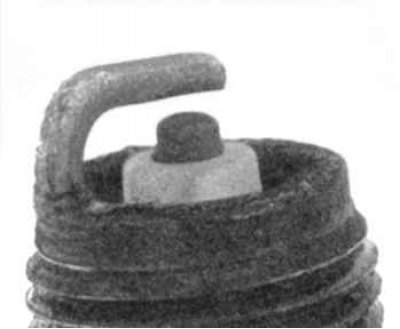
Symptoms: The insulator has a yellowish color and a polished appearance. Indicates a sudden increase in temperature in the combustion chambers during sharp acceleration. Normal deposits melt, acquiring the appearance of a varnish coating. Leads to misfires at high speeds.
Recommendations: Change the spark plugs (cooler, while maintaining the same driving style).
Detonation
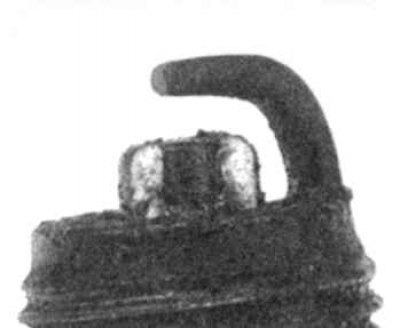
Symptoms: Insulators may be chipped or cracked. Insulator damage may also result from improper spark plug gap adjustment. Piston damage may result.
Mechanical damage
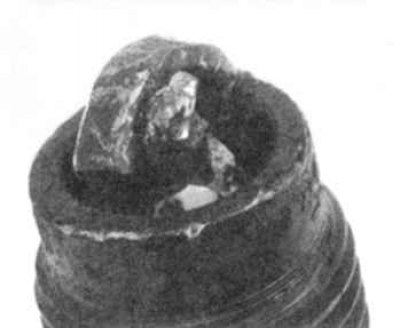
Symptoms: Can be caused by foreign material entering the combustion chamber or by the piston hitting a spark plug that is too long. Leads to cylinder failure and piston damage.
Recommendations: Remove foreign particles from the engine and/or replace. Since the service life of spark plugs is usually 15,000 km, it is sufficient to clean them every 8,000 km.
(Full text available on the portal: www.HondaBook.ru)