
 |
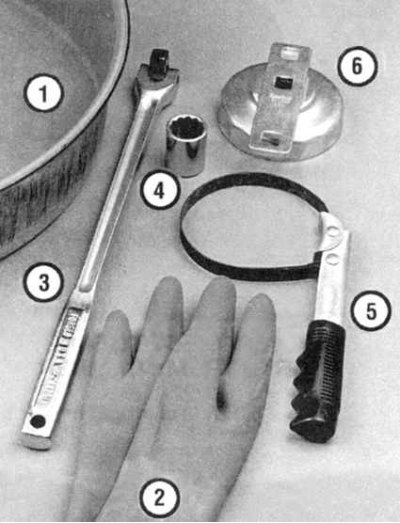
A set of tools needed to change engine oil and oil filter
1. Drainage tank - should be shallow and wide enough to minimize the chance of oil spilling on the ground. 2. Rubber gloves — will help protect your hands from burns when oil inevitably gets on them while unscrewing the oil pan drain plug. 3. Gate - sometimes the drain plug is tightened quite tightly, which requires considerable effort when unscrewing it. 4. Replaceable socket head - used in combination with a winch or a ratchet-equipped drive when unscrewing the drain plug; it must match the latter in size. 5. Ribbon key — allows you to unscrew a full-flow oil filter in conditions of limited access to it. 6. Special open-end wrench - is placed on the end of the filter and can then be rotated using a winch or ratchet drive, must match the size of the filter body. |
1. Prepare all necessary tools and materials (see illustration above). Also, stock up on enough old newspapers or rags to collect any spilled oil.
2. To ensure free access to the oil pan and oil filter, lift the vehicle with a winch or jack it up and place it on supports.
Attention! Never perform any work under a vehicle supported only by the bumper or held in a raised position only by a jack!
3. Get under the car and familiarize yourself with the location of the oil pan drain plug and oil filter. Remember that the power unit and exhaust system components will remain quite hot during the entire procedure - think of a scheme for safe hand manipulation to avoid accidental contact with hot surfaces.
4. Warm up the engine to normal operating temperature – hot oil is more fluid and washes out sludge and sediment better. Use the forced downtime to lay out all the necessary tools and materials in a convenient order. Turn off the engine and remove the cap from the oil filler neck on the cylinder head cover.
5. Make sure that the vehicle is securely fixed in the raised position.
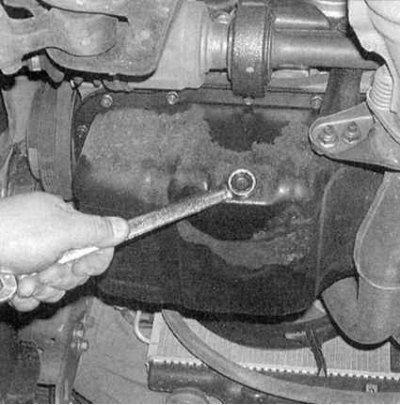
6. Get under the car and place a drain pan under the boat's sump, taking into account the fact that at first the oil will flow out through the hole with a decent pressure. Trying not to touch the heated surfaces of the power unit and components of the exhaust system, unscrew the drain plug from the bottom of the oil pan (see accompanying illustration). Depending on the oil temperature, you may or may not want to wear rubber gloves at the final stage of removing the plug.
7. Allow the oil to flow freely into the container. As the flow weakens, move the container accordingly.
8. After the oil stops flowing out of the engine crankcase, wipe the drain plug with a clean rag - small metal filings may stick to it, which will immediately lead to contamination of the fresh oil.
9. Wipe the surface of the pan around the drain hole, screw in the plug and tighten it securely with a wrench (torque wrench if possible).
10. Move the drain pan under the oil filter.
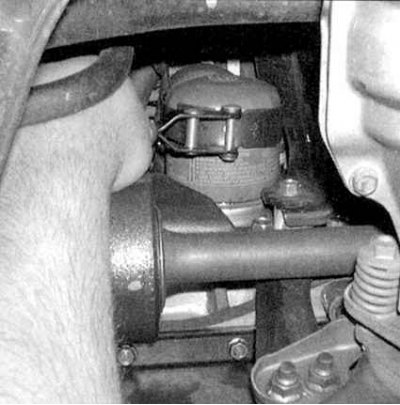
11. Using one of the special types of keys, loosen the filter (see accompanying illustration). During the process of unscrewing, the filter housing may be damaged, which is not of particular importance in the case of its unambiguous replacement (in the latter case, the old filter can be simply pierced with a large screwdriver for unscrewing - be prepared to collect the spilled oil). Manually unscrew the filter completely from the block - remember that some amount of oil remains in it, which should be released into the drain container. Make sure that the rubber sealing gasket has been removed together with the filter, if not, separate it from the surface of the engine block.
12. Using a clean rag, carefully wipe the filter mounting surface on the block. Once again, make sure that the old gasket is not left on the engine; if necessary, use a scraper.
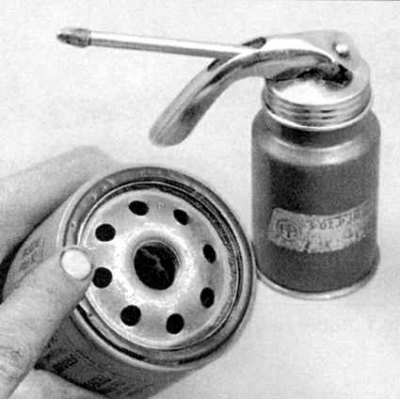
13. Make sure the new filter matches the size of the one removed from the vehicle. Lubricate the rubber seal of the new filter with a thin layer of clean engine oil (see accompanying illustration). Screw the new filter into the engine, observing the direction of rotation indicated by the arrow on its housing. To avoid damaging the gasket, do not use any wrenches to tighten the oil filter. After the filter is pressed by the gasket to the surface of the block, tighten it another 3/4 of a turn.
14. Remove all tools and materials from under the vehicle – try not to tip over the drain pan. Lower the vehicle to the ground.
15. Pour fresh oil into the engine intake pipe - use a funnel to minimize losses. Wait a few minutes to allow the oil to drain into the pan, then check the level on the dipstick (see Checking fluid levels (every 400 km or weekly)). If the level is above the lower mark on the dipstick blade, start the engine to circulate fresh oil.
16. After letting the engine run for about a minute, turn it off again and immediately look underneath the vehicle to check for leaks at the drain plug and full-flow filter. If necessary, tighten the leaking component slightly.
17. After the fresh oil has circulated through the engine, the new oil filter is finally filled. Now you need to check the oil level again and, if necessary, add some more, bringing the level to the upper mark on the dipstick blade.
18. During the first few trips after changing the engine oil, try to check its level as often as possible.
19. Used oil drained from the engine cannot be reused and must be handed over to a special collection point. Never pour used oil onto the ground or into the sewer – pour it into a hermetically sealed container and hand it over at the first opportunity.