
HondaBook.ru
Auto companies Volkswagen Auto companies Ford Auto companies Lada Auto companies Skoda Auto companies BMW Auto companies Mazda Auto companies Peugeot
English Русский
Български
Беларускі
Український
Српски
Hrvatski
Română
Polski
Slovenský
Magyar
Bookmark Contacts Sitemap   


Accord Civic Fit / Jazz CR-V HR-V Others Articles
Accord 3 (1985-1989) Accord 6 (1997-2002)

Checking the serviceability and tightness, removing and installing the brake booster assembly (Honda Accord 6)

  • Main
  • Honda Accord
  • 6 (1997-2002)
  • Chassis and running gear
  • Brake system
  • Checking the serviceability and tightness, removing and installing the brake booster assembly
0
Contents: Checking the correct functioning ⇊ Checking for leaks ⇊ Removal ⇊ Installation ⇊

Checking the correct functioning


1. Without starting the engine, press the foot brake pedal several times. Make sure that there is no change in the amount of pedal reserve travel (the distance between the pedal and the floor).

2. Keeping the pedal depressed, start the engine. If the pedal "sinks" slightly immediately after starting, then the brake booster is working properly.

Checking for leaks


1. Run the engine for a couple of minutes, then turn it off. Slowly press the foot brake pedal several times. If at first the pedal travel gradually decreases with each press, but stabilizes after three or four pumps, the vacuum booster assembly is not damaged.

2. Press the foot brake pedal with the engine running. Keep the pedal pressed and turn off the engine. If after 30 seconds of holding the pedal pressed, its reserve travel does not change, then the vacuum booster assembly is not leaking.

Removal


1. The brake booster unit is not subject to repair and in case of failure must be replaced as an assembly.

2. Remove the brake master cylinder assembly from the vacuum booster (see Section Removal and installation the master brake cylinder).

3. On models with manual transmission, remove the clutch master cylinder (see Chapter Clutch and drive shafts).

4. Disconnect the vacuum hose going to the booster from the engine. Be careful not to damage the hose when removing it from the nipple on the booster assembly.


5. On 4-cylinder models, remove the intake air temperature (IAT) sensor (see Chapter Engine management).

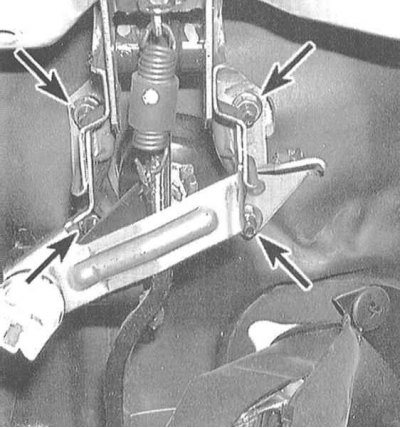
6. Under the instrument panel, find the connection point of the vacuum booster push rod to the foot brake pedal.

7. Remove the cotter pin and disconnect the push rod from the pedal.
7. Remove the cotter pin and disconnect the push…


8. From the passenger compartment, loosen the four nuts securing the vacuum booster assembly to the engine compartment bulkhead, remove the washers (use a flashlight if necessary).

9. Go to the engine bay and remove the rear bulkhead vacuum booster assembly. Once the booster mounting studs are completely clear of the bulkhead holes, begin to rotate the assembly to the right (toward the centerline of the vehicle), thereby releasing the pushrod tip from the bulkhead. Remove the assembly from the engine bay.

Installation


1. Installation is performed in the reverse order of dismantling. Make sure that all fasteners are tightened to the required force, and that pins and cotter pins are replaced.
1. Installation is performed in the reverse order…


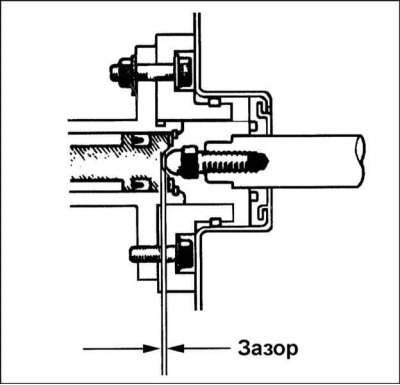
2. When installing a new brake booster, it is necessary to adjust the working clearance of its pusher rod, for which:


2. When installing a new brake booster, it is…

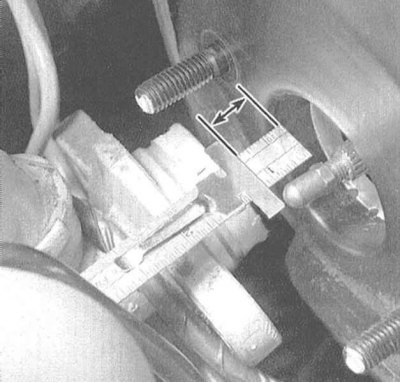
  • a) Using a hand vacuum pump, create a vacuum of 508 mm Hg on the booster, then measure the amount of the pushrod protrusion above the assembly surface mating with the master cylinder (taking into account the gasket, if provided). Record the measurement result, let's call it "Dimension A".
a) Using a hand vacuum pump, create a vacuum of…

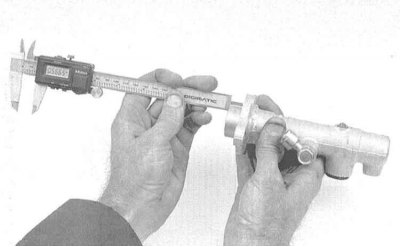
  • b) Measure the distance from the master cylinder support flange to the end surface of the cylinder. Record the measurement result, designating it: "Dimension B".
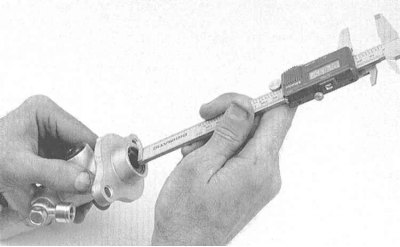
b) Measure the distance from the master cylinder…

  • c) Measure the distance from the end surface of the master cylinder to the bottom of the seat pocket in the end of its piston. Record the result, calling it: "Dimension C".
  • d) Subtract dimension B from dimension C, then subtract dimension A from the resulting difference. The resulting value will determine the required working clearance.
  • e) Compare the calculation result with the requirements of the Specifications. If necessary, make the appropriate adjustments.
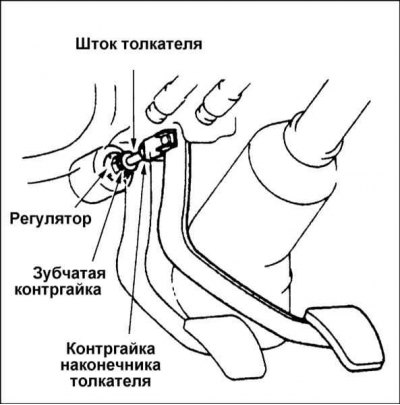
e) Compare the calculation result with the…


3. To adjust the working clearance of the push rod, loosen the toothed lock nut and turn the adjuster in the appropriate direction. After completing the adjustment, tighten the lock nut and measure the clearance again. Repeat the procedure if necessary.


4. After installing the brake master cylinder, bleed the brake system (see Section Bleeding the brake system).
This article is available at: russian, bulgarian, belarusian, ukrainian, serbian, croatian, romanian, polish, slovak, hungarian
This information has been verified: Timofey Goryachev
Share with friends:
◀ Previous
Accord 6: Brake system
Next ▶

Bleeding the brake system
Checking the condition and replacing brake lines and hoses
Removal and installation the master brake cylinder
Removal and installation wheel cylinders
Replacing the shoes of the rear wheel drum brake mechanisms
Adjusting the parking brake
Replacing the parking brake cables
Checking, replacing and adjusting the brake light switch sensor
Checking and replacing the brake fluid level switch sensor
See also other articles from Honda manuals:
Checking the serviceability/tightness, removing and installing the… Honda Civic 6 (1995-2000)
Vacuum Brake Booster — Checking and Adjusting the Rod Clearance Honda Fit 1 (2001-2008)
Battery — Checking, Removing and Installing Honda CR-V 1 (1995-2001, petrol)
Rubber parts of the brake system and brake booster Honda HR-V 1 (1998-2006, petrol)
Frequency of checking rubber components and brake booster Honda Avancier 1 (1999-2003, petrol)
Link in different formats to this article
Comments and feedback from visitors
No comments yet


How much will 27 + 27 ?


Accord 6 (1997-2002) 
  • General information
  • Introduction to the guide
  • User manual
  • Maintenance
  • Power unit
  • Four-cylinder engines
  • Six-cylinder engines
  • Engine overhaul
  • Cooling system
  • Heater and air conditioner
  • Power and exhaust systems
  • Engine electrical equipment
  • Engine management
  • Transmission
  • Mechanical gearbox
  • Automatic gearbox
  • Clutch and drive shafts
  • Chassis and running gear
  • Brake system
  • Car suspension
  • Steering
  • Body and interior
  • Exterior (external elements)
  • Interior (internal elements)
  • Electrical equipment
  • Equipment and devices
  • Electrical circuits
Accord 3 (1985-1989) 
  • General information
  • Maintenance
  • Power unit
  • Engine adjustment
  • Engine repair
  • Engine electrics
  • Emission management
  • Engine management (carburetor)
  • Electronic injection
  • Programmable injection
  • Schematic of emission system
  • Fuel system
  • Feedback management
  • Transmission
  • Manual gearbox
  • Automatic gearbox
  • Clutch
  • Chassis and running gear
  • Front suspension
  • Rear suspension
  • Steering
  • Brake system
  • Electrical equipment
  • Ventilation and heating
  • Air conditioner
  • Cruise control system
  • Equipment and devices
HondaBook.ru © 2018–2026 • Mobile version • Sitemap: EN BG BY UA RS HR RO PL SK HU • Feedback • Driver Information • Search system • Bookmark
Accord 3 (1985-1989) • Accord 6 (1997-2002) • Civic 3 and 4 (1983-1991) • Civic 5 and 6 (1991-2000) • Civic 6 (1995-2000) • Civic 7 (2000-2005) • Civic 8 (2005-2011) • Fit 1 (2001-2008) • CR-V 1 (1995-2001) • CR-V 2 (2002-2006) • HR-V 1 (1998-2006) • Avancier 1 (1999-2003) •
 
This website uses cookies to ensure proper functioning. By clicking "OK," you agree.