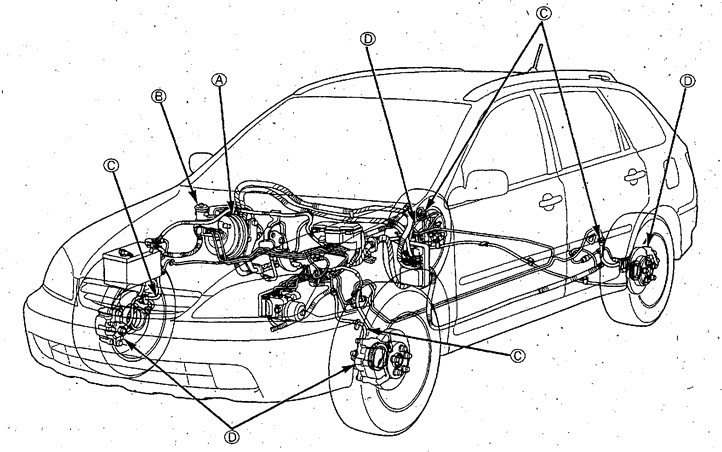
A. Checking the operation of the brake booster
Press the brake pedal and check the braking efficiency. If the efficiency is insufficient, check the operation of the brake booster and its tightness (see below).
If the brake booster is the cause of the ineffective braking system, replace it with a new one.
B. Checking the seals and the master cylinder rod
1) Press the brake pedal and check the braking performance (*1).
2) Check whether the pedal stroke differs when pressing the pedal smoothly or sharply.
3) Visually check that the master cylinder is not damaged or leaking fluid.
If the master cylinder is damaged or leaking (*2), or the pedal stroke changes, disassemble the master cylinder and replace non-reusable components (see below).
C. Checking the brake hoses
Check brake hoses for damage and leaks.
If necessary, replace the brake hoses with new ones.
D. Checking the pistons and dust boots of the brake calipers
1. Press the brake pedal and check the braking performance (*1).
2. Visually inspect the brake calipers for damage and fluid leaks.
If the brake pedal does not work satisfactorily or the caliper sticks, there is damage, fluid leakage, etc., disassemble the caliper and check. Be sure to replace the components (piston seals, dust boots, etc.) (see below).
*1: Check the brake operation and whether the braking distance is within the specified value.
*2: There may be a trace of fluid leakage on the bottom side of the master cylinder-brake booster connection area, but if the area is dry, everything is fine.