
Contents: Examination ⇊ Honing a hole ⇊
Examination
1. Measure wear and taper in X and Y directions in three planes in each cylinder as shown.
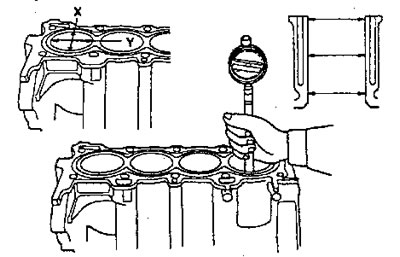
Cylinder bore size:
Engines A16A2, V16A4, V1BA5, V16A6:
- Nominal value: 81.00-81.02 mm
- Operational value: 81.07 mm
Other engines:
- Nominal value: 75.00-75.02 mm
- Operational value: 75.07 mm
Increased size:
Engines A16A2, B16A4, B16A5, B16A6:
- Increase by 0.25 mm: 81.25-81.27 mm
Other engines A16A2, B16A4, B16A5, B16A6:
- Increase by 0.25 mm: 75.25-75.27 mm
- Increase by 0.50 mm: 75.50-75.52 mm
Taper of the hole (difference between measurement in the first and third planes)
- Limit value: 0.05 mm
If the bore dimensions in any cylinder are greater than the increased service value, replace the block. If the block must be rebored, repeat the "Checking Piston Clearance" section after reboring.
Note: Scratched or nicked cylinder bores must be honed.
Limit values of boring:
Engines B16A2, B16A4, B16A5, B16A6:
- Enlargement of the hole by 0.25 mm;
Other engines:
- Enlargement of the hole by 0.50 mm
2. Check the top plane of the block for warpage. Measure around the edges and through the center as shown.
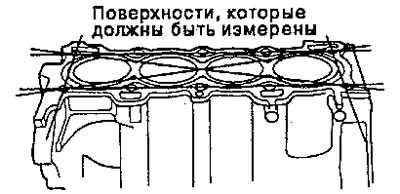
Cylinder block warpage:
Engines B16A2, B16A4, B16A5, B16A6:
- Nominal value 0.05 mm
- Operating values: 0.08 mm
Other engines:
- Nominal value: 0.07 mm
- Operating values: 0.10 mm
Honing a hole
1. Measure the cylinder bores. If the block is reused, the cylinders must be honed and the bores measured again.
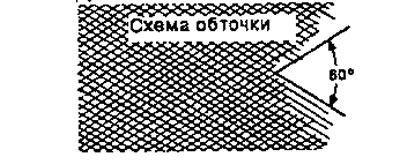
2. When honing cylinder bores, use coolant and fine-grained stone (grain size 400 conventional units) with a crossing grain trajectory at 60 degrees.
Note.
- Use only hard hone with 400 grit or finer abrasive such as Sunnen, Amrnco or equivalent.
- Do not use worn or broken abrasive stones.
3. When honing is complete, thoroughly clean the engine block of all metal particles. Wash the cylinder bores with hot soapy water, then dry and immediately coat with oil to prevent rust.
Note: Never use solvent, it will only cause stress redistribution.
4. If, after honing to operational values, scratches and nicks still remain, re-bore the cylinder block.
Note: Light vertical scratches and nicks, as long as they are not deep and your nail does not get stuck in them upon inspection, and as long as they do not run the entire length of the hole, are acceptable.
Note: After honing, wash cylinders thoroughly with soapy water; only holes with scratches or nicks are honed.
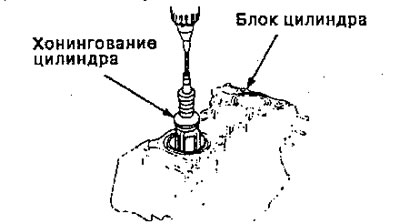
Note: After honing, thoroughly clean the cylinder in soapy water.
[The original is located on the website: HONDABOOK]