
HondaBook.ru
Auto companies Volkswagen Auto companies Ford Auto companies Lada Auto companies Skoda Auto companies BMW Auto companies Mazda Auto companies Peugeot
English Русский
Български
Беларускі
Український
Српски
Hrvatski
Română
Polski
Slovenský
Magyar
Bookmark Contacts Sitemap   


Accord Civic Fit / Jazz CR-V HR-V Others Articles
Accord 3 (1985-1989) Accord 6 (1997-2002)

Master brake cylinder (Honda Accord 3)

  • Main
  • Honda Accord
  • 3 (1985-1989)
  • General information
  • Maintenance
  • Master brake cylinder
0
Contents: Fluid Recommendations ⇊ Checking the level ⇊ Clutch fluid ⇊

Fluid Recommendations


Use only DOT 3 or DOT 4 specified brake fluid from a well-sealed container. If you are unsure of the condition of the fluid (whether it was properly sealed or not), use a new one. It is very important that the fluid meets the specification so that the high temperatures generated by modern disc brakes do not cause the fluid to boil and reduce braking ability. For the same reason, the fluid should be free of moisture.

Checking the level


The brake master cylinder fluid level should be checked every few weeks for signs of a leak or low level. A sudden drop in level may indicate a leak in the system. The reservoir is located at the left rear of the engine compartment near the bulkhead and is made of plastic; the level can be checked by shining it through the light.

Normal pressing of the brake pedal causes a gradual decrease in the level. But in this case, the fluid is not absent; it has only redistributed within the system. If the drop is gradual, check the front brakes before adding fluid. If the system was filled before the new brakes were installed, the reservoir will overflow.
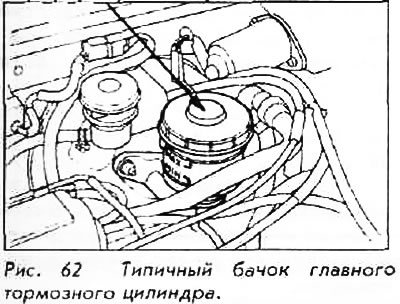

Normal pressing of the brake pedal causes a…


All Hondas have MAX and MIN lines on the brake fluid reservoir. The brake fluid should always be kept at the MAX line, but not above it. When adding brake fluid, take the following precautions:


1. Use only recommended fluids: DOT 3 or DOT 4; type SAE J 1703b HD.

2. Never reuse brake fluids or use contaminated, cloudy or air-bubble containing fluids.

3. Store the liquid in a clean, dry place in its container. Tighten the lid securely and do not puncture it.

4. Before opening, thoroughly clean any dirt around the master cylinder reservoir cap.

5. Be especially careful with liquid stains. The painted surface of the car can be damaged by brake fluid.

Clutch fluid


Manual transmissions on 1990-91 Accords and 1988-91 Preludes use a hydraulically actuated clutch system. When the clutch pedal is pressed to the floor, fluid is compressed and the clutch engages. Other cars use cable-actuated clutches.
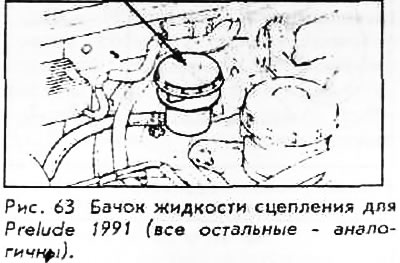
Manual transmissions on 1990-91 Accords and…


The clutch fluid reservoir is located in the same area as the master cylinder reservoir. The clutch reservoir is difficult to see due to its smaller size. The fluid used here, checking and filling are completely similar to the brake fluid reservoir. Always wipe the surface of the reservoir before removing it. Periodic fluid compensation may be required as the clutch wears.

(Original article on the website hondabook)
This article is available at: russian, bulgarian, belarusian, ukrainian, serbian, croatian, romanian, polish, slovak, hungarian
This information has been verified: Yaroslav Shiryaev
Share with friends:
◀ Previous
Accord 3: Maintenance
Next ▶

Cooling system
Automatic transmission
Manual transmission
Changing engine oil and filter
Checking the engine oil level
Power steering pump
Steering without power assistance
Chassis lubrication
Lubrication of the housing
Rear wheel bearings
See also other articles from Honda manuals:
Master Brake Cylinder — Removal, Repair and Installation Honda Civic 3 and 4 (1983-1991)
Master Brake Cylinder — Removal and Installation Honda Fit 1 (2001-2008)
Brake master cylinder Honda CR-V 1 (1995-2001, petrol)
Master cylinder, brake booster — removal and installation Honda HR-V 1 (1998-2006, petrol)
Master Cylinder and Brake Booster — Removal and Installation Honda Avancier 1 (1999-2003, petrol)
Link in different formats to this article
Comments and feedback from visitors
No comments yet


How much will 20 + 47 ?


Accord 6 (1997-2002) 
  • General information
  • Introduction to the guide
  • User manual
  • Maintenance
  • Power unit
  • Four-cylinder engines
  • Six-cylinder engines
  • Engine overhaul
  • Cooling system
  • Heater and air conditioner
  • Power and exhaust systems
  • Engine electrical equipment
  • Engine management
  • Transmission
  • Mechanical gearbox
  • Automatic gearbox
  • Clutch and drive shafts
  • Chassis and running gear
  • Brake system
  • Car suspension
  • Steering
  • Body and interior
  • Exterior (external elements)
  • Interior (internal elements)
  • Electrical equipment
  • Equipment and devices
  • Electrical circuits
Accord 3 (1985-1989) 
  • General information
  • Maintenance
  • Power unit
  • Engine adjustment
  • Engine repair
  • Engine electrics
  • Emission management
  • Engine management (carburetor)
  • Electronic injection
  • Programmable injection
  • Schematic of emission system
  • Fuel system
  • Feedback management
  • Transmission
  • Manual gearbox
  • Automatic gearbox
  • Clutch
  • Chassis and running gear
  • Front suspension
  • Rear suspension
  • Steering
  • Brake system
  • Electrical equipment
  • Ventilation and heating
  • Air conditioner
  • Cruise control system
  • Equipment and devices
HondaBook.ru © 2018–2026 • Mobile version • Sitemap: EN BG BY UA RS HR RO PL SK HU • Feedback • Driver Information • Search system • Bookmark
Accord 3 (1985-1989) • Accord 6 (1997-2002) • Civic 3 and 4 (1983-1991) • Civic 5 and 6 (1991-2000) • Civic 6 (1995-2000) • Civic 7 (2000-2005) • Civic 8 (2005-2011) • Fit 1 (2001-2008) • CR-V 1 (1995-2001) • CR-V 2 (2002-2006) • HR-V 1 (1998-2006) • Avancier 1 (1999-2003) •
 
This website uses cookies to ensure proper functioning. By clicking "OK," you agree.