1. Get to the point where the brakes do not fully release or the brake pedal becomes "hard". This may require 20 or more brake pedal presses during an extended test drive.
2. Raise the car on a lift, but do not turn off the engine. Try to spin the wheels of the car by hand.
Do you feel increased resistance to rotation of any wheel?
- YES - go to step 3.
- NO - look for other causes of pad wear: front brake pad, rear brake pad, high pedal, or vehicle vibration.
Note: Check the following items when your car vibrates:
- front brake disc;
- rear brake disc;
- wheel rim runout.
3. Turn off the engine, press the brake pedal several times to allow atmospheric air to penetrate the vacuum cavities of the booster. After this, turn the car wheels again by hand to make sure that the wheels are completely released.
Do you feel increased resistance to rotation of any wheel?
- YES - go to step 4.
- NO - replace the brake booster.
4. Without disconnecting the pipes from the master brake cylinder, unscrew the nuts securing the master brake cylinder and move it away from the vacuum booster. Check again whether any wheel is braking.
Do you feel increased resistance to rotation of any wheel?
- YES - go to step 5.
- NO - Check brake light switch setting and pedal free play.
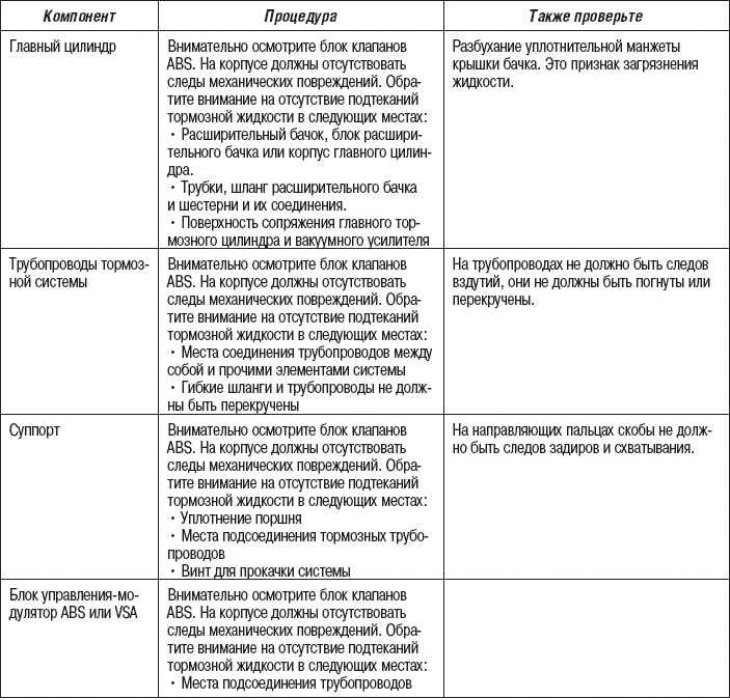
5. Loosen the brake line mounting bolts on the master cylinder and check that the wheels rotate easily.
Do you feel increased resistance to rotation of any wheel?
- YES - go to step 6.
- NO - Replace the master cylinder.
6. Loosen the bleed screws on each caliper, then turn the wheels to check for brake resistance.
Do you feel increased resistance to rotation of any wheel?
- YES - it is necessary to disassemble the brake mechanism of the wheel that does not fully release and eliminate the cause of the malfunction.
- NO - Check and replace faulty brake lines. If any of the above faults cannot be found, replace the ABS unit or VSA modulator-control unit. ABS, VSA.