
HondaBook.ru
Auto companies Volkswagen Auto companies Ford Auto companies Lada Auto companies Skoda Auto companies BMW Auto companies Mazda Auto companies Peugeot
English Русский
Български
Беларускі
Український
Српски
Hrvatski
Română
Polski
Slovenský
Magyar
Bookmark Contacts Sitemap   


Accord Civic Fit / Jazz CR-V HR-V Others Articles
Accord 3 (1985-1989) Accord 6 (1997-2002)

Checking the functionality of the electromagnetic valve for cutting off the primary idle mixture (Honda Accord 3)

  • Main
  • Honda Accord
  • 3 (1985-1989)
  • Power unit
  • Feedback management
  • Checking the functionality of the electromagnetic valve for cutting off the primary idle mixture
0
The valve is used to block the flow of idle mixture from the fuel-air channel to the bypass channel in order to prevent the engine from running when the ignition is off. The electromagnetic valve also serves to block the fuel supply during braking.

Place a clean towel around the solenoid valve to remove any gasoline residue. Then loosen the screws and remove the solenoid valve.

CAUTION: Wipe off all traces of gasoline before testing. Ground the solenoid valve before removing it for testing to avoid sparking or flames when the ignition is turned on.
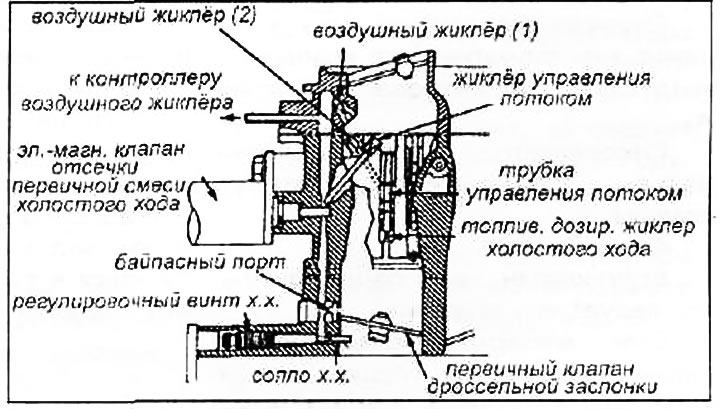

CAUTION: Wipe off all traces of gasoline before…


Ground the valve in a location as far away from the carburetor as possible.

Turn the ignition ON.

If the electromagnetic valve operates, then see point A). If not, then point B).

A) Reinstall the valve.

Start the engine and allow it to warm up to operating temperature until the cooling fan comes on.

Block the rear wheels and apply the parking brake. Jack up the front of the car and support it securely with stands.

Shift the transmission into second gear and accelerate the engine.

Release the accelerator pedal quickly and measure the voltage between terminal 28 (Green/Red(+)) and


32 (Black(-)) control unit. Should be measured during braking at a speed of over 20 km/h.

If there is voltage, then you should refer to the control module input diagnostics section. If not, then the solenoid valve is normal.

B) Turn off the ignition.

Disconnect the 2-pin connector near the solenoid valve.

Turn on the ignition.

Measure the voltage between the Green/Red (+) wire and the ground wire in the engine wiring harness.

If there is battery voltage, then the solenoid valve should be replaced.

If not, then you should check the Green/Red wire between the valve and terminal 28 of the control unit. If the wire is normal, then you should refer to the diagnostics section of the control module inputs.
This article is available at: russian, bulgarian, belarusian, ukrainian, serbian, croatian, romanian, polish, slovak, hungarian
This information has been verified: Yaroslav Shiryaev
Share with friends:
◀ Previous
Accord 3: Feedback management
Next ▶

Checking the functionality of the air conditioning idle speed increase solenoid…
Checking the solenoid valve for increasing the idle stroke
Checking the frequency solenoid valve C
Checking the functionality of the leakage solenoid valve at startup
Checking the performance of the electromagnetic frequency valve A
Checking the performance of the electromagnetic valve frequency B
Checking the functionality of the feedback control solenoid valve
Checking the performance of the electromagnetic air suction control valve
See also other articles from Honda manuals:
Checking and replacing the fast idle speed (FIT) temperature… Honda Civic 6 (1995-2000)
Checking the idle speed on a cold engine Honda Fit 1 (2001-2008)
Checking valve train parts Honda CR-V 1 (1995-2001, petrol)
Valve Rocker Arms and Axles — Checking Clearances Honda HR-V 1 (1998-2006, petrol)
Checking the VTEC solenoid valve Honda Avancier 1 (1999-2003, petrol)
Link in different formats to this article
Comments and feedback from visitors
No comments yet


How much will 24 + 48 ?


Accord 6 (1997-2002) 
  • General information
  • Introduction to the guide
  • User manual
  • Maintenance
  • Power unit
  • Four-cylinder engines
  • Six-cylinder engines
  • Engine overhaul
  • Cooling system
  • Heater and air conditioner
  • Power and exhaust systems
  • Engine electrical equipment
  • Engine management
  • Transmission
  • Mechanical gearbox
  • Automatic gearbox
  • Clutch and drive shafts
  • Chassis and running gear
  • Brake system
  • Car suspension
  • Steering
  • Body and interior
  • Exterior (external elements)
  • Interior (internal elements)
  • Electrical equipment
  • Equipment and devices
  • Electrical circuits
Accord 3 (1985-1989) 
  • General information
  • Maintenance
  • Power unit
  • Engine adjustment
  • Engine repair
  • Engine electrics
  • Emission management
  • Engine management (carburetor)
  • Electronic injection
  • Programmable injection
  • Schematic of emission system
  • Fuel system
  • Feedback management
  • Transmission
  • Manual gearbox
  • Automatic gearbox
  • Clutch
  • Chassis and running gear
  • Front suspension
  • Rear suspension
  • Steering
  • Brake system
  • Electrical equipment
  • Ventilation and heating
  • Air conditioner
  • Cruise control system
  • Equipment and devices
HondaBook.ru © 2018–2026 • Mobile version • Sitemap: EN BG BY UA RS HR RO PL SK HU • Feedback • Driver Information • Search system • Bookmark
Accord 3 (1985-1989) • Accord 6 (1997-2002) • Civic 3 and 4 (1983-1991) • Civic 5 and 6 (1991-2000) • Civic 6 (1995-2000) • Civic 7 (2000-2005) • Civic 8 (2005-2011) • Fit 1 (2001-2008) • CR-V 1 (1995-2001) • CR-V 2 (2002-2006) • HR-V 1 (1998-2006) • Avancier 1 (1999-2003) •
 
This website uses cookies to ensure proper functioning. By clicking "OK," you agree.