
Contents: Removal ⇊ Installation ⇊
Warning! Remember that gasoline is a highly flammable liquid - when working with fuel system components, observe all accepted fire safety measures. Do not smoke or approach the work area with an open flame or unprotected portable lamp. Do not service the system in a room equipped with heating devices operating on natural gas and equipped with a pilot flame (such as water heaters and clothes dryers). Remember that gasoline is a carcinogen that can cause cancer - try to avoid fuel coming into contact with exposed areas of the body - use protective rubber gloves, and in case of accidental contact, wash your hands thoroughly with warm water and soap. Collect spilled fuel immediately and do not store fuel-soaked rags near open flames. Remember that the fuel system of models equipped with fuel injection is constantly under pressure. Before disconnecting the fuel lines, release any residual pressure in the system (for more details, see Chapter Power and exhaust systems). Wear safety glasses when servicing fuel system components. Always keep a class B fire extinguisher on hand!
The air conditioning system line is also constantly under pressure, so before disconnecting the refrigeration lines, the system must be discharged in a specialized workshop.
Note. On the models in question, the engine is removed together with the transmission. Before starting work, carefully read the materials in this Section. It will be useful to soak such hard-to-remove fasteners as exhaust manifold mounting nuts/bolts, powertrain mounts, etc. in penetrating oil in advance.
Removal
1. Release the pressure in the fuel system (see Chapter Power and exhaust systems).
2. Disconnect the negative battery cable. Disconnect the positive cable as well, then release the fasteners on the opposite ends of both cables and remove the cables from the engine compartment. On Civic models, remove the battery and remove its mounting tray from the engine compartment (see Chapter Engine electrical equipment).
Warning! If the car stereo system is equipped with a security code, make sure you have the correct combination to activate the audio system before disconnecting the battery!
3. Cover the fenders and the air deflector under the windshield of the car with special protective covers, or just old blankets. Open the hood as wide as possible (civic models), or remove it completely (integra models) (See Chapter Body).
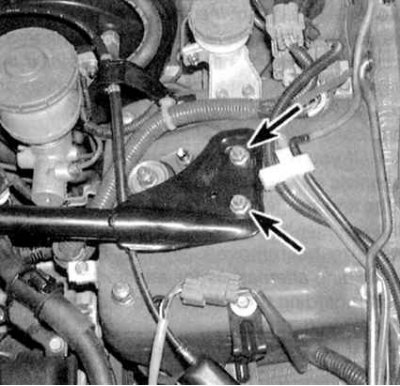
4. On Integra models, remove the engine bay strut bar (see accompanying illustration). 5. Remove the air cleaner assembly with the air intake sleeve (see Chapter Power and exhaust systems).
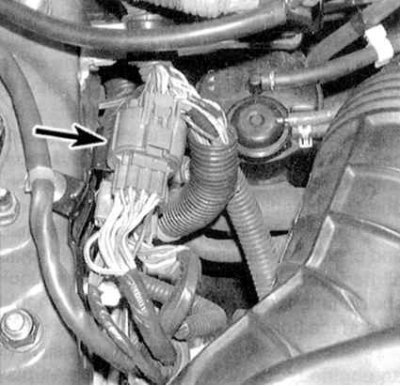
6a. Clearly label and disconnect all vacuum lines, emission control system hoses, connectors, electrical harnesses, ground straps, and fuel lines from the engine (see accompanying illustrations). On Civic models, disconnect the electrical harness from the power control module (PCM) in the passenger compartment (see Chapter Engine management systems), then remove the rubber bushings from the rear bulkhead of the engine compartment and push the main wiring harness through the bulkhead. It is best to mark the wiring, lines and hoses using tape. It will also be useful to draw a diagram of the wiring layout or take a series of photographs.
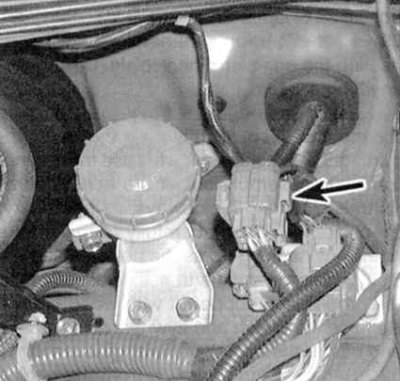
6b. On Integra models, the main harness connector is located on the left side of the engine compartment. 7. After marking, disconnect all coolant hoses from the engine.
8. Remove the expansion tank, cooling system fan with shroud and radiator (see Chapter Cooling and heating systems).
9. Remove the drive belt and tension roller (if such is provided) (See Chapter Routine maintenance).
10. Disconnect the fuel lines from the engine to the chassis (see Chapter Power and exhaust systems). Cap open ends of lines and fittings to prevent dirt from entering the power system.
11. Disconnect the accelerator rod from the engine (see Chapter Power and exhaust systems), as well as the drive cable and the actuator of the tempostat (with the appropriate vehicle configuration).
12. Unbolt the steering pump and move it to the side without disconnecting the hydraulic lines (see Chapter Suspension and steering). Make sure that the pump is secured strictly vertically.
13. On models equipped with air conditioning (A/C), unbolt and move the compressor aside - do not disconnect the refrigeration lines (see Chapter Cooling and heating systems).
Note: Securely support the removed compressor with wire, not allowing it to hang by the hoses.
14. Unbolt the generator and move it to the side together with the support bar (see Chapter Engine electrical equipment).
15. Jack up the vehicle and support it. Drain the cooling system (see Chapter Routine maintenance).
16. Drain the engine oil and remove the oil filter (see Chapter Routine maintenance).
17. Remove the starter (see Chapter Engine electrical equipment).
18. Remove the crankcase guard (see Chapter Body).
19. On models with automatic transmission, disconnect the throttle cable from the transmission case. Also disconnect all electrical wiring and the shift cable from the transmission (see 4-speed and continuously variable automatic transmissions (AT and CVT)).
20. On models with AT, also disconnect the ATF cooling lines from the transmission.
21. Remove the crankshaft pulley and screw the bolt back into place.
22. Disconnect the exhaust pipe from the engine (see Chapter Power and exhaust systems).
23. Support the transmission with a trolley jack. Be sure to place a block of wood between the jack head and the transmission case to distribute the load.
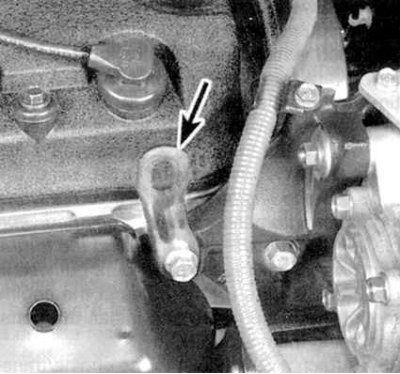
24. Attach slings or chains to the engine (see accompanying illustration). 25. Move the winch to the working position (directly above the engine) and fill the rigging without lifting the engine yet.
Caution! Avoid placing your hands under the suspended power unit!
26. Remove the drive shafts (see Chapter Cordon and drive shafts).
27. On models with manual transmission, unbolt the clutch slave cylinder and move it to the side without disconnecting the hydraulic lines (see Chapter Cordon and drive shafts). Disconnect the gear shift rods (see 5-speed manual transmission).
28. Unscrew the bolts securing the power unit supports to the chassis elements (see Parts Engine Repair Without Removing It From The Car - Civic Models or Engine Repair Without Removing It From the Vehicle - Integra Models of this Chapter).
29. Make sure that nothing else connects the power unit to the car. If necessary, make the necessary disconnections, having previously marked the forgotten communications.
30. Slowly lift the engine, carefully releasing its supports. At the same time, jack up the transmission. After making sure there are no obstructions, remove the powertrain assembly from the engine compartment.
31. Carefully lower the powertrain assembly to the garage floor and support it with wooden blocks. If necessary, remove the flywheel/drive plate and mount the engine on a mounting stand.
32. Separate the transmission from the engine (see Chapter Gearshift box).
Installation
1. Check the condition of the power unit supports. Replace defective components.
2. On models with manual transmission, check the condition of the clutch components (it would be correct to replace the entire assembly). Install the clutch (see Chapter Clutch and drive shafts) and lubricate the splines of the gearbox input shaft with high-temperature grease.
3. Carefully connect the transmission to the engine.
Caution! To avoid damage to major components, never use the mounting bolts to align the transmission and engine relative to each other! On models with AT, special care should be taken when installing the rotation converter (strictly follow the instructions in 4-speed and continuously variable automatic transmissions (AT and CVT)).
4. Connect the rigging to the power unit, lift the assembly and carefully move it into its regular place in the engine compartment of the car.
5. Screw in the mounting bolts and tighten them securely. Further assembly is carried out in the reverse order of disassembly.
6. Add coolant and engine oil to the engine, fill the transmission and power steering system (see Chapter Routine maintenance).
7. Start the engine and check it for proper operation and signs of leaks. Turn off the ignition and check the levels of the powertrain fluids. If removed (integra models), replace the hood. Test drive the vehicle.
8. On models equipped with air conditioning, evacuate and charge the air conditioning system in a specialized workshop.
(Information obtained from this source «HondaBook.ru»)