
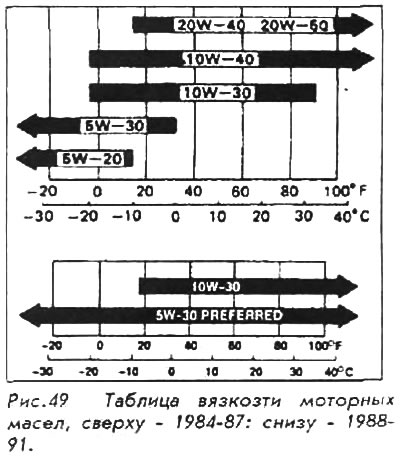
Multi-viscosity oils have the important advantage of being highly adaptable to extreme temperatures. These oils have designations such as 10W-40, 20W-50, etc. The "10W-40" means that in the winter (the "W" in the designation) the oil acts like a thin, 10 weight oil, allowing the engine to spin easily when cold and providing fast lubrication. However, as the engine warms up, the oil begins to act like a 40 weight, providing good lubrication and protection for the internal engine components. A 20W-50 oil would therefore be heavier and not as ideal as a 10W-40 in cold weather, but it would provide better protection at higher RPMs and temperatures because it acts like a 50 weight oil when warmed up. Whatever viscosity oil you choose when changing, make sure that the temperatures you expect your engine to operate at are within the range for that oil type. Refer to the oil viscosity chart for temperature recommendations.
Honda does not recommend the use of any oil additives or additives in the engine. A normal engine does not need them; if the engine is worn out or damaged, it is usually too late to save it with additives.
The API (American Petroleum Institute) designation indicates the classification of engine oil for use under certain given operating conditions. Only oils designated "Service SG" should be used. SG oils perform a variety of functions inside the engine in addition to the primary function of lubrication. In older vehicles, SG type oils can be replaced with SF or SE type oils. By requiring SG oil, newer vehicles may be damaged by using lower grade oils. API classifications may also have other letter classes such as CD or CC; these oils are only acceptable for use if the SG designation is also present.
The SAE grade number and API designation can be found on the top cap of the oil can. Refer to the chart to determine the recommended viscosity.
Synthetic oil
There are many excellent synthetic oils available today that can provide better gas mileage, longer life, and in some cases better engine protection. However, in addition to these benefits, the oil also has several disadvantages. The main disadvantage is the price of synthetic oils, which is three to four times higher than the price per liter of conventional oil.
Synthetic oil is not suitable for every car or every type of driving, so you must consider the condition of your engine and your driving habits. Both new and older, high-efficiency engines should not use synthetic oil. Synthetic oils are so slippery that they can prevent new engines from breaking in properly; most oil manufacturers recommend that you wait until the engine has been properly broken in (3,000 miles) before using synthetic oil. Old, worn-out engines have another problem with synthetics: They consume more oil during operation as they age. Slippery synthetics easily lubricate these worn parts. If your engine "consumes" conventional oil, it will use synthetic oil even faster.
Consider your driving pattern. If most of your mileage is at high speeds (highway cruising), a more expensive synthetic oil may be beneficial. Extended highway cruising allows the engine to warm up, build up fewer acids in the oil, and put less stress on the engine. Vehicles with synthetic oils may provide improved fuel economy in highway cruising due to less internal friction.
If synthetic oil is used, it should also be changed regularly as specified in the service intervals manual. While the oil itself will stay in good condition longer than conventional oil, contaminants such as soot, water, and unburned fuel will still accumulate in it. These are destructive elements inside the engine and must be drained regularly to prevent damage.
Vehicles used in severe conditions, such as stop-start, city traffic, short trips, or long idling, must be serviced more frequently. For engines in these vehicles, the use of synthetic oils is not justified. Internal wear increases even faster, leading to greater oil consumption and leaks.
Mixing conventional and synthetic oils is not recommended. When using synthetic oil, it would be wise to carry a few quarts of it with you on the road, no matter where you are going. Never use non-detergent or undiluted mineral oils.