
- a) Install the camshaft into the engine and secure it with the bearing caps;
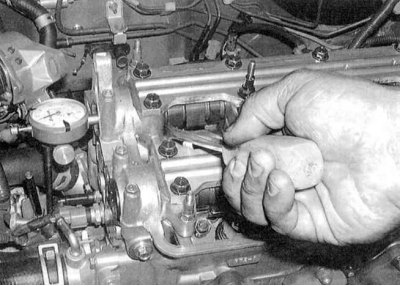
- b) Secure the dial gauge to the cylinder head, resting its plunger against the end of the shaft (see accompanying illustration);
- c) Using a large screwdriver as a lever, pull the shaft back as far as it will go and reset the meter to zero, then push the shaft forward and read the meter reading;
- d) Compare the measurement result with the requirements Specifications;
- e) Excessive axial clearance indicates wear of the camshaft or head. Replace defective components.
2. To check lateral runout:
- a) Place the camshaft removed from the engine in two V-shaped prisms, then press the plunger of the dial gauge against the journal of the central bearing and measure the runout value when the shaft rotates;
- b) Compare the measurement results with the requirements Specifications;
- c) If the camshaft is excessively loose, it must be replaced.
Engine B18B1 (without VTEC)
Removal
1. Remove the distributor (see Chapter Engine electrical equipment).
2. Remove the cylinder head cover (see Removal and installation the cylinder head cover). Loosen the valve adjusting screws completely (see Chapter Routine maintenance).
3. Bring the piston of the first cylinder to the TDC position (see Bringing the piston of the first cylinder to the top dead center (TDC) position).
4. Remove the timing belt and camshaft sprockets (see Removal, condition check and installation of the timing belt and timing drive gears).
5. Check the shaft bearing caps for markings in the form of arrows pointing towards the timing belt. If necessary, apply the corresponding marks yourself using a scriber. Also number the caps (from first to sixth in the direction from the timing belt) and mark them as belonging to a specific shaft (inlet or outlet).
Caution! Incorrect installation of shaft holders, as well as rotation of the latter in the wrong direction, can lead to jamming of assemblies.
6. Moving from the center outward, in several steps (1/4 turn per set) loosen the cover mounting bolts, reducing the force developed by the valve springs to zero.
7. Remove the camshafts from the cylinder head, then remove the rocker arms (mark the mounting position of the latter - during assembly they must be installed strictly in their original places).
Examination
1. Carefully wipe all components and check them for signs of wear and mechanical damage. Check the condition of the working surfaces of the rocker arms and camshafts. Check the condition of the rocker shafts. Replace defective components. Do not forget to make sure that the oil flows of the rocker shafts are passable.
2. Assess the degree of wear of the camshaft cams:
- a) Check the cam lifts for deep scratches, scoring, cavities and signs of uneven operation;
- b) If defects are detected, replace the shaft, having first identified and eliminated the cause of wear. Check the engine oil for abrasives, make sure the oil flows are clear. Cam wear is most often associated with oil contamination;
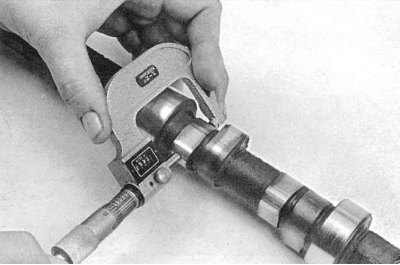
- c) Using a micrometer, measure the height of the cams (see accompanying illustration). 3. Check the bearing journals and shafts and bearing caps for scoring and signs of uneven wear. If any defects are found, replace the cylinder head.
4. Measure the bearing clearances using the calibrated wire from the Plastigauge kit:
- a) Wipe the bearing caps and shaft journals with a clean cloth soaked in acetone;
- b) Carefully place the shafts into the cylinder head (without any lubrication).
Note: The shafts should not rotate during this procedure.
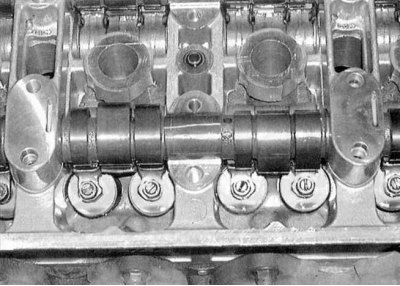
- c) Place lengths of calibrated plastic wire from the Plastigauge kit along the bearing journals of the shaft (see accompanying illustration);
- d) Install the bearing caps in place, then tighten their fasteners in several stages to the required force (move from the center of the shaft outward);
- e) Loosen the bolts and remove the covers;
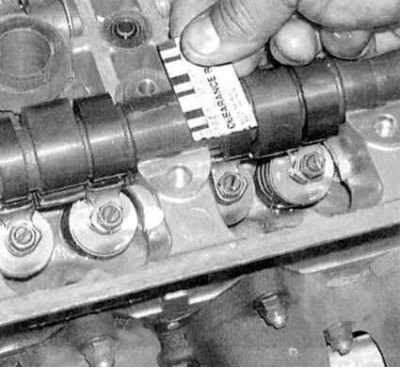
- f) Measure the width of the flattened pieces of calibrated wire using the scale printed on the kit packaging (see accompanying illustration);
- g) If the measurement results are outside the permissible range (see Specifications), replace worn components;
- h) Use the edge of a credit card or pay phone card to scrape off any remaining flattened wire from the shaft journals.
Installation
1. Lubricate all components with assembly grease or clean engine oil, then install the rocker arm assembly into place (watch for landing markings).
2. Lubricate the camshafts and journals with special assembly grease, then place the shafts in their bearings (do not confuse the intake shaft with the exhaust shaft). Lubricate the surfaces of the 1st and 6th bearing caps that are mating with the head with anaerobic sealant. Install the caps, then, moving from the center outward, tighten the mounting bolts evenly in several steps to the required force (see Fig. Specifications).
3. Further installation is carried out in the reverse order of dismantling the components. If necessary, adjust the valve clearances (see Chapter Routine maintenance).
4. Run the engine to check for signs of leaks and proper operation.
Engines V18S1 and V18S5 (VTEC)
Removal
1. Remove the timing belt and timing gears (see Removal, condition check and installation of the timing belt and timing drive gears).
2. Remove the cylinder head cover (see Removal and installation the cylinder head cover).
3. Remove the ignition distributor and crankshaft fluctuation sensor (see Chapters Engine electrical equipment and Engine management systems).
4. Loosen the lock nuts and turn the valve clearance adjustment bolts out as far as they will go.
5. Check the shaft bearing caps for markings in the form of arrows pointing towards the timing belt. If necessary, apply the corresponding marks yourself using a scriber. Also number the caps (from first to sixth in the direction from the timing belt) and mark them as belonging to a specific shaft (inlet or outlet).
Caution! Incorrect installation of shaft holders, as well as rotation of the latter in the wrong direction, can lead to jamming of assemblies.
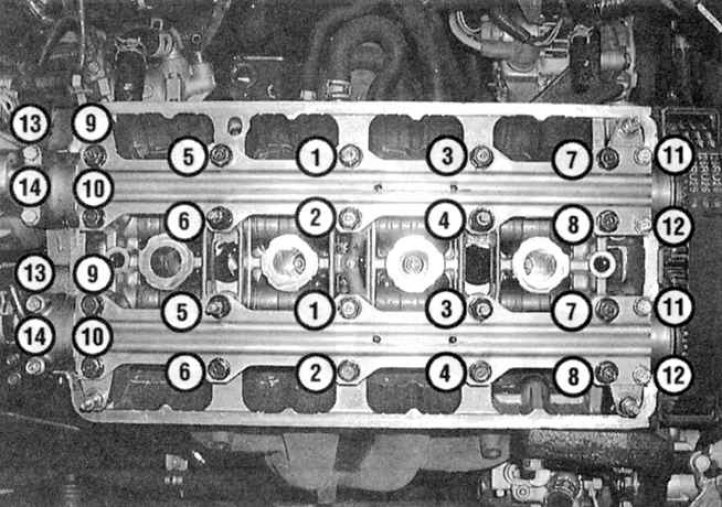
6. Moving from the center outward, in several steps (1/4 turn per set) loosen the cover mounting bolts, reducing the force developed by the valve springs to zero (see illustration – the bolts should be loosened in the reverse order to that shown in the picture). Remove the bearing holder plates and caps (the mating surface of the 3rd [central] bearing cap is equipped with a guide pin equipped with a rubber sealing ring – try not to lose small parts). 7. Remove the camshafts from the cylinder head.
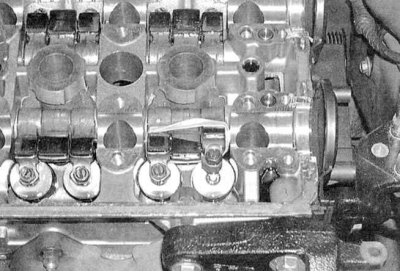
8. Fasten the rocker arms of each set of valves together using rubber bands (see accompanying illustration). 9. Remove the cylinder head mounting bolts that pass through the rocker arm shafts (see Removal and installation the cylinder head). Remove the oil sprayers from the axles (see Removal, condition check and installation of camshafts and rocker arm assemblies).
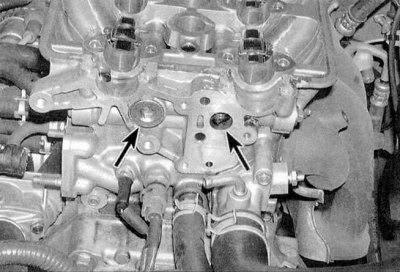
10a. Screw 12 mm bolts into the ends of the axles.
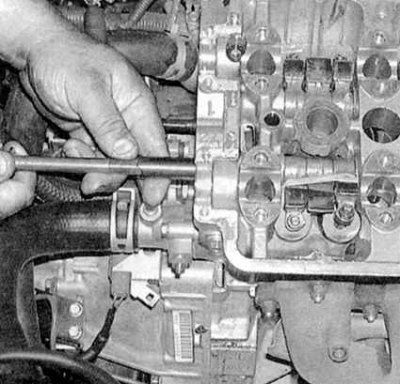
10b. Using the bolt heads, remove the axles from the cylinder head one by one (see accompanying illustrations).
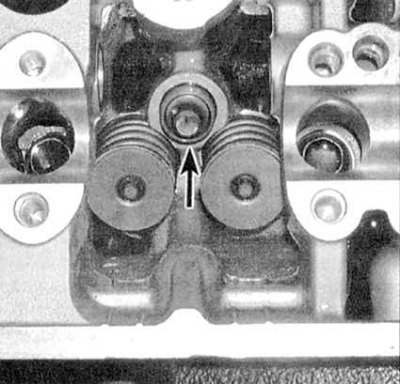
11. Remove the valve clearance adjuster assemblies from their sockets in the cylinder head (see accompanying illustration). Check the status of the assemblies (see VTEC systems - general information and component health check).
Examination
1. Check the condition of the shafts and rocker arms (see the inspection paragraphs for the B18B1 engine (without VTEC) above).
2. Disassemble the rocker arm assemblies and inspect the condition of the components (see VTEC systems - general information and component health check).
Note. Place the components in the order in which they belong to their kit - when assembling, they must be installed strictly in their original places. After making sure that the parts are in good condition, assemble the kits and fasten them together with rubber bandages.
Installation
1. Install the valve clearance adjuster assemblies in their regular places (see previous illustration).
2. Lubricate all components with assembly grease or clean engine oil. Loosen the valve clearance adjustment screws completely. Install the rocker arm assemblies secured with rubber bandages in their original places, then install the rocker arm shafts. Each rocker arm shaft has a socket for the oil sprayer. If the sockets are misaligned after installing the shafts, adjust the shafts using the heads of the bolts screwed into their ends.
3. Place new sealing rings on the oil sprayers, then install the sprayers into the head - do not confuse the inlet sprayer with the outlet (see VTEC systems - general information and component health check). Make sure that the nozzles fit into their sockets in the rocker arm axles (when installed correctly, the nozzles should lock the axles from turning).
4. Lubricate the camshafts and journals with special assembly grease, then place the shafts in their bearings (do not confuse the intake shaft with the exhaust shaft).
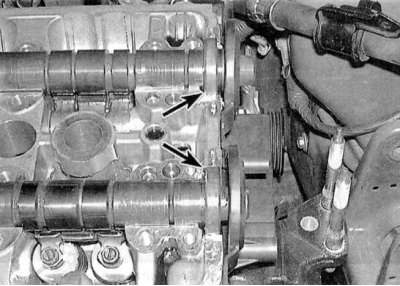
5. Carefully wipe the surfaces of the head that contact the seals with a dry cloth and install new seals (spring-equipped sides towards the head) (see accompanying illustration). 6. Lubricate the mating surfaces of the 1st and 5th bearing caps with anaerobic sealant.
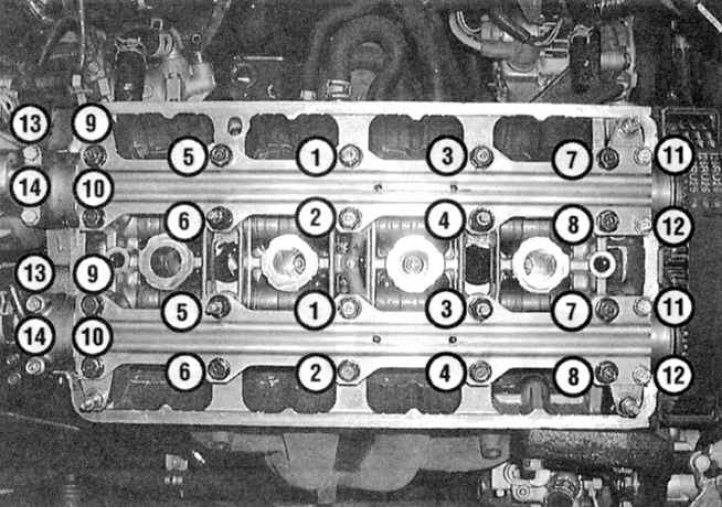
7. Install the holders on the lids, then, following the order shown (see accompanying illustration), tighten the mounting bolts evenly in several stages to the required torque (see Specifications).
8. Further installation is carried out in the reverse order of dismantling the components. If necessary, adjust the valve clearances (see Chapter Routine maintenance).
9. Run the engine to check for signs of leaks and proper operation.