
General information
Many Honda models are equipped with Variable Valve Timing Electronic Control (VTEC).
The difference between conventional engines and engines equipped with the VTEC system is in the configuration and operating principle of the valve mechanism. The design of the engine block and all mounted units and assemblies, as well as the lubrication and cooling system organization schemes on both units are the same. Externally, the engine equipped with the VTEC system is distinguished by the presence of a convex inscription with the corresponding content (VTEC) on top of the cylinder head cover.
The intake camshaft is equipped with three cams for each of the valves it drives. A special power control module (PCM), based on data coming from information sensors, determines which of the cam sets should drive the intake valves of the combustion chambers at any given moment. Based on the analysis of the incoming information, the PCM turns the VTEC system on or off.
The following are used as initial parameters determining the operation of VTEC:
- a) Engine speed (rpm);
- b) Vehicle speed (mph);
- c) Throttle Position Sensor (TPS) Output Signal;
- d) Current engine load determined by the absolute pressure sensor (MAP) readings;
- e) Coolant temperature.
At low engine speeds, both the primary and secondary intake valves operate from their own cams and open at the same height and with the same duration, providing good torque in the lower RPM range and a high gas response rate.
When it is necessary to increase the engine output, the rocker arms of the primary and secondary intake valves are locked with the intermediate rocker arm by means of a special hydraulic device with electronic control. In this case, the duration and height of opening of both valves is determined by the shape of the intermediate cam, which is distinguished by a greater height and a less pointed lift.
Note: The primary and secondary rocker arms are no longer in contact with their own cams until the system is disengaged. The system allows optimum torque to be achieved at both low and high engine speeds, depending on the current engine load being applied.
Checking the status of components
Solenoid valve lock/pressure switch
The VTEC system locking solenoid valve, which includes a pressure sensor switch, is located on the left side of the rear wall of the engine (from the engine compartment bulkhead side).
Models produced in 1994 and 1995.
Malfunctions in the VTEC lock-up solenoid circuit result in the registration of a diagnostic trouble code (DTC) 21 in the control unit memory. The "Check Engine" indicator lamp on the vehicle instrument panel lights up. Detailed information on DTCs of self-diagnostic systems is provided in Chapter Engine management systems.
Failure of the pressure switch sensor will cause DTC 22 to be stored and the Check Engine Light to be illuminated.
Models since 1996.
A failure in the solenoid or pressure switch circuits will cause the Check Engine Light to illuminate and DTC P1259 to be stored in the control unit. An OBD II scanner is required to read the diagnostic codes (see Chapter Engine management systems).
All models
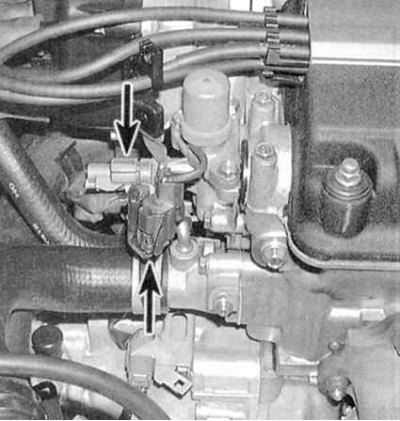
1. Disconnect the round electrical connector on the two pressure (see accompanying illustration).
2. Connect an ohmmeter between the terminals of the sensor switch. The device should record the presence of conductivity (zero resistance), otherwise the sensor switch must be replaced.
3. Connect a voltmeter between the body ground and the terminal of the blue-black wire in the connector on the harness side. With the ignition on (key in ON position) the device should show 12 V, otherwise check the condition of the blue-black wire and the reliability of its contact connections in the area between the connector and the terminal on the PCM.
4. If the voltage test is positive, connect a voltmeter between the two terminals of the harness side connector (blue-black and black wires). When the ignition is on, the device should record 12 V, otherwise check the condition of the black wire (grounding) and the reliability of its contact connections in the area between the connector and ground.
5. With the ignition off (key in OFF position) disconnect the 1-pin VTEC lock-up solenoid connector (see illustration above). Connect an ohmmeter between the valve terminal (no connector) and body weight. If the instrument reading is outside the range of 14 to 30 ohms, replace the solenoid valve (see below).
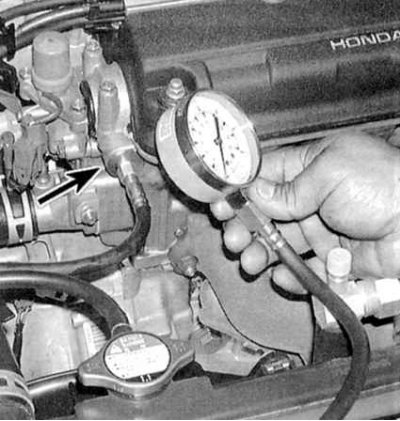
6. Remove the 10 mm bolt from the oil pressure test nipple on the solenoid valve. Connect a mechanical pressure gauge to the nipple to measure the oil pressure (see accompanying illustration).
7. Warm up the engine to normal operating temperature (the cooling system fan should start working).
8. Using short jerks, alternately increase the engine speed to 1000, 3000 and 5000 rpm. Read the pressure gauge reading at each of the listed engine speeds.
Caution! Do not increase engine speed without load for more than one minute.
9. The oil pressure should not be higher than 0.49 kgf/cm², otherwise the condition of the VTEC electromagnetic valve should be checked.
10. Connect a jumper wire between the positive battery terminal and the VTEC solenoid terminal (see illustration for paragraph 1). Increase engine speed to 5000 rpm for a short time (no more than one minute) and read the pressure gauge. This time it should be no less than 4.2 kgf/cm², otherwise check the condition of the valve.
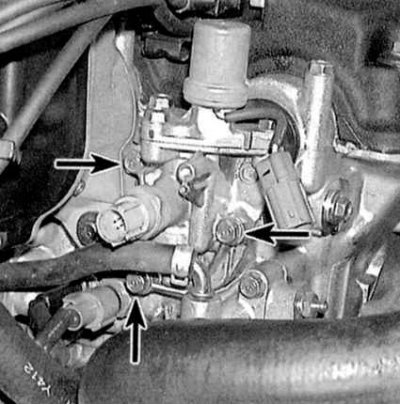
11a. Remove the solenoid valve assembly and separate the pressure switch sensor from it.
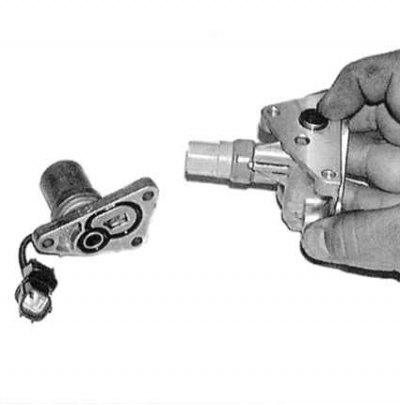
11b. Manually check the plunger for free movement (see accompanying illustrations). When installing the assembly back into place, be sure to replace the sealing ring.
12. Check the condition and patency of the full-flow oil filter. Clean the filter and install it in place (with new sealing ring). If the filter is not clear, change the engine oil.
Rocker arms with oil sprayers
1. Remove the cylinder head cover (see Equipment and controls in the cabin) and bring the piston of the first cylinder to the TDC position (see Seat adjustment).
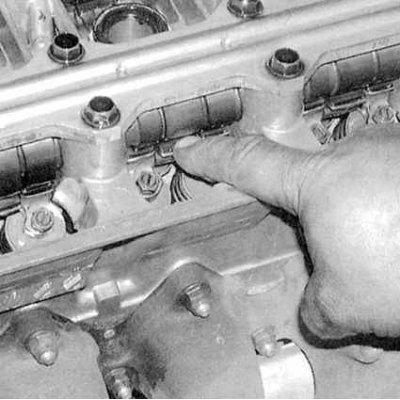
2. Press your finger on the intermediate rocker arm (see accompanying illustration) – it should move freely from the primary and secondary valve rocker arms. Otherwise, remove the rocker arms to check the condition of the assembly components (see Removal, condition check and installation of camshafts and assembly ki rocker arms).
3. After removing the rocker arms (see Unlocking the hood) remove the synchronizing pistons from them (see accompanying illustration).
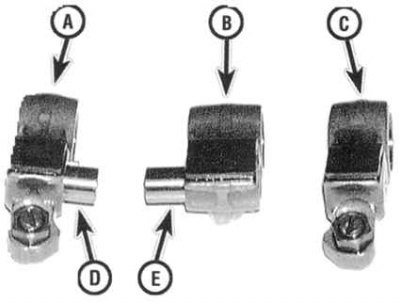
A) Primary valve rocker arm
IN) Secondary valve rocker arm
WITH) Intermediate rocker arm
D) Short piston
E) Long piston
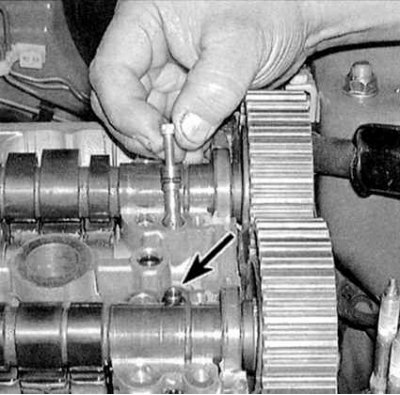
4. Check all components (rocker arms and pistons) for signs of wear, scoring and traces of overheating. Replace defective parts. Remove the oil sprayers from the inlet and outlet sides of the cylinder head (see accompanying illustration), clean them and install them in place. 5. Assembly is carried out in the reverse order of dismantling.
Note: Before installing the rocker arm kits on the axle, assemble them and secure them with rubber bands (see Unlocking the hood).
Valve clearance corrector assemblies
1. Four sets of valve clearance correctors are installed in the cylinder head.
2. Remove the individual corrector assemblies (see Unlocking the hood).
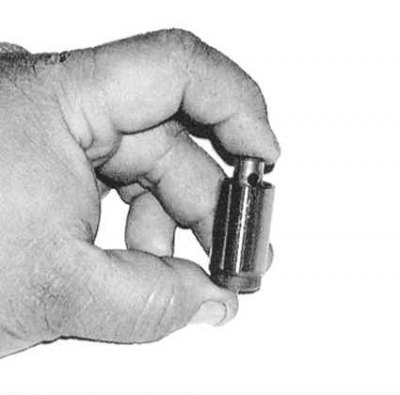
3. Use your fingers to check the freedom of movement of the corrector assembly plunger (see accompanying illustration) – there should be a slight resistance, but when the load increases, the plunger should be pressed freely. If defects are detected, replace the assembly.
[The text was taken from the website HONDABOOK]