
Contents: Removal ⇊ Installation ⇊
Caution! Wait until the engine has cooled down completely before starting work.
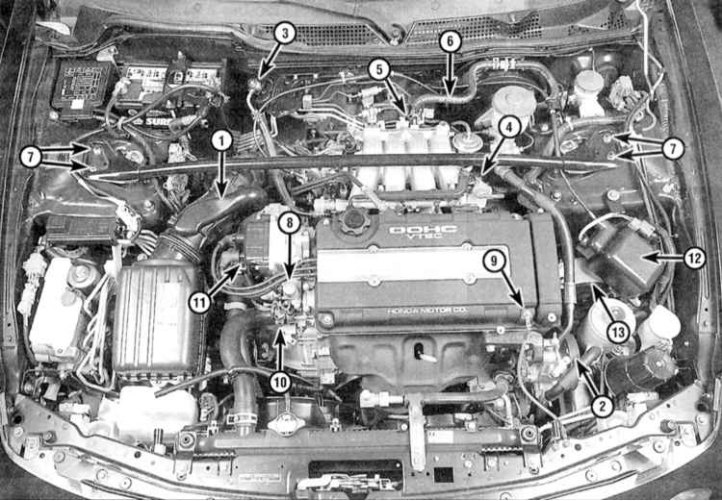
Components of the engine compartment of the vehicle that must be removed when removing the cylinder head
1 - Air intake duct; 2 - Steering pump; 3 - Fuel supply line; 4 - Fuel return line; 5 - PCV hose; 6 - Brake booster vacuum hose; 7 - Fastening of the spacer rod; 8 - Solenoid valve/sensor - pressure switch VITEC; 9 - Engine ground busbar; 10 - Cooling tract hose; 11 - Ignition distributor; 12 - Tempostat actuator; 13 - Upper support of the power unit
Removal
1. Bring the piston of the first cylinder to the TDC position at the end of the compression stroke (see Bringing the piston of the first cylinder to the top dead center (TDC) position).
2. Disconnect the negative battery cable and the ground bus from the engine (see illustration above).
Warning! If the car stereo system is equipped with a security code, make sure you have the correct combination to activate the audio system before disconnecting the battery!
3. Drain the cooling system and remove the spark plugs (see Chapter Routine maintenance).
4. Remove the air cleaner with the air intake sleeve (see Chapter Power and exhaust systems).
5. Remove the accessory drive belts (see Chapter Routine maintenance). Unbolt the steering pump and move it to the side without disconnecting the hydraulic lines, then remove the steering pump bracket (see Chapter Suspension and steering).
6. Disconnect the accelerator cable and release the pressure in the fuel system (see Chapter Power and exhaust systems).
7. Disconnect the following hoses and lines (see Chapters Power and exhaust systems and Engine management systems):
- a) Fuel supply and return hoses;
- b) Evaporative emission control system (EVAP) hose;
- c) Ventilation hose (breather pipe);
- d) PCV hose.
- e) Brake booster vacuum hose.
8. Disconnect the coolant bypass hose, heater hose and upper radiator hose (see Chapter Cooling and heating systems).
9. On VTEC models, remove the cross-mounted strut bar (see section General and major engine repairs of this Chapter).
10. Disconnect the electrical wiring from the following components:
- a) Fuel injection injectors;
- b) Coolant Temperature Sensor (CTS);
- c) Temperature meter sensor;
- d) TDC/crankshaft and camshaft position sensor;
- e) Crankshaft fluctuation sensor;
- f) Ignition coil;
- g) Throttle position sensor (TPS);
- h) Absolute pressure sensor in the pipeline (MAP);
- i) EVAP canister purge solenoid valve;
- j) VTEC solenoid valve (18C1 and 18C5));
- k) VTEC pressure switch sensor (18C1 and 18C5);
- l) Idle speed control valve (IAC);
- m) Intake air bypass solenoid valve (IAB) (18C1 and 18C5).
11. Remove the speed control actuator (tempostat) (See Chapter On-board electrical equipment).
12. Remove the crankcase guard.
13. Support the engine with a jack (to distribute the load between the jack head and the oil pan, place a wooden block). Remove the upper engine mount bracket (see Checking the condition and replacing the powertrain suspension supports).
14. Remove the mounting bracket supporting the intake manifold and unscrew the exhaust manifold flange bolts.
Note: If desired, the intake manifold and/or exhaust manifold can be separated from the engine (see sections Removal and installation the intake manifold and Removal and installation the exhaust manifold) to facilitate further manipulation of the head.
15. Remove the cylinder head cover (see Removal and installation the cylinder head cover).
16. Remove the ignition distributor (see Chapter Engine electrical equipment) together with the cover and high-voltage wires connected to it.
17. Remove the timing belt (see Removal, condition check and installation of the timing belt and timing drive gears), camshafts and rocker arm assembly (see Removal, condition check and installation of camshafts and rocker arm assemblies).
18. Proceeding in the reverse order to that shown in the illustration to paragraph 6 (see below), in several stages (1/4 turn per set) loosen the head mounting bolts enough to be able to unscrew them manually. Try to remember the location of each of the mounting bolts - when assembling, they must be screwed in strictly in their original places.
19. Remove the cylinder head from the engine. If the head does not separate from the block, you can use a lever that should be inserted between the steering pump bracket and the block (do not under any circumstances pry the head from the mating surface). Place the head removed from the engine on a couple of wooden blocks to avoid damaging the gasket surfaces.
20. A description of the procedures for disassembling the head and checking the condition of its internal components is given in Part General and major engine repairs of this Chapter. At this stage, evaluate only the flatness of the mating surface.
Installation
1. The mating surfaces of the cylinder head and block must be absolutely clean and dry.
2. Thoroughly clean the mating surfaces of the cylinder head and block. After scraping off the remaining gasket material and carbon deposits, wipe the surfaces with a rag soaked in acetone. The presence of old gasket material on the mating surfaces at the time of installation may lead to a violation of the seal of the gasket fit and, as a result, the development of leaks. When processing the block, plug the cylinder holes with a rag to prevent small debris and various foreign objects from getting into them (as a last resort, vacuum the cylinders thoroughly). Since the cylinder head and block are made of soft aluminum alloy, proceed with extreme caution, trying not to leave scratches and burrs on the mating surfaces (use only copper or plastic tools to scrape off deposits).
3. Check the mating surfaces of the head and block for deep scratches, burrs, and other damage. Light defects can be removed with fine-grained sandpaper. In more serious cases, the only alternative is to resurface the components.
4. Using a tap of the appropriate size, run the threaded holes for the head mounting bolts. Clamping the bolts one by one in a vice by the head, go over their threads with a die. The presence of old sealant, dirt and corrosion products in the threads leads to a discrepancy between the actual tightening force of the fastener and the readings of the torque wrench indicator.
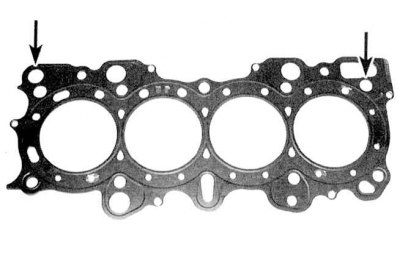
5. Place a new sealing gasket on the cylinder block (with the "TOP" marking facing up). Make sure that the holes for the guide pins are in their proper places (see accompanying illustration). Install the head oil sprayer with a new sealing ring. Carefully install the cylinder head onto the block.
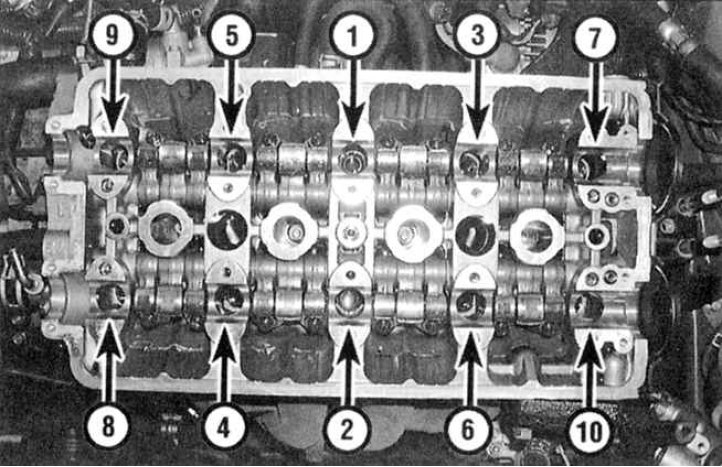
6. Lubricate the threads and the underside of the heads of the mounting bolts with clean engine oil and screw the fasteners back into their original positions. Proceed in the order shown (see accompanying illustration), tighten the cylinder head mounting bolts to the required torque (see Specifications).
7. Place the timing gears on the camshaft journals, then install the timing belt (see Removal, condition check and installation of camshafts and rocker arm assemblies).
8. Installation of the remaining components is carried out in the reverse order of their dismantling.
9. Do not forget to fill the cooling system and check the levels of all fluids (see Chapter Routine maintenance).
10. Manually turn the crankshaft slowly counterclockwise two full turns.
Caution: If resistance occurs when turning the shaft, stop immediately to avoid damaging the valves when they come into contact with the piston crowns.
11. Start the engine and check that the ignition timing is set correctly (see Chapter Routine maintenance).
12. Warm up the engine to normal operating temperature and check for signs of leaks. Make sure the engine is functioning properly.
(The article was copied from the website: Hondabook.ru)