
HondaBook.ru
Auto companies Volkswagen Auto companies Ford Auto companies Lada Auto companies Skoda Auto companies BMW Auto companies Mazda Auto companies Peugeot
English Русский
Български
Беларускі
Український
Српски
Hrvatski
Română
Polski
Slovenský
Magyar
Bookmark Contacts Sitemap   


Accord Civic Fit / Jazz CR-V HR-V Others Articles
Civic 3 and 4 (1983-1991) Civic 5 and 6 (1991-2000) Civic 6 (1995-2000) Civic 7 (2000-2005) Civic 8 (2005-2011)

Removal, checking and installation the timing belt and timing drive gears (Honda Civic 6)

  • Main
  • Honda Civic
  • 6 (1995-2000)
  • Power unit
  • Engine in car (Integra)
  • Removal, checking and installation the timing belt and timing drive gears
0
Contents: Removal ⇊ Examination ⇊ Installation ⇊

Removal


1. Disconnect the negative cable from the battery.

Warning! If the car stereo system is equipped with a security code, make sure you have the correct combination to activate the audio system before disconnecting the battery!


2. Support the rear wheels with wheel chocks and firmly apply the parking brake.

3. Loosen the front wheel nuts, then jack up the front of the car and place it on supports (see Chapter Routine maintenance).

4. Remove the front wheels and engine crankcase guard.

5. Support the power unit with a jack (to distribute the load, place a wooden block between the jack head and the engine oil pan).

6. Remove the upper engine mount bracket (see Checking the condition and replacing the powertrain suspension supports).

7. Remove the spark plugs and drive belts (see Routine maintenance).

8. Unbolt the steering pump and move it to the side without disconnecting the hydraulic lines (see Chapter Suspension and steering).

9. Remove the speed control actuator (tempostat) (See Chapter On-board electrical equipment).

10. Bring the piston of the first cylinder to the TDC position at the end of the compression stroke (see Seat adjustment).

Caution! The crankshaft should only be turned in the normal direction (counterclockwise) – failure to comply with this requirement will result in timing belt adjustments being disrupted.


11. Remove the cylinder head cover (see Equipment and controls in the cabin).
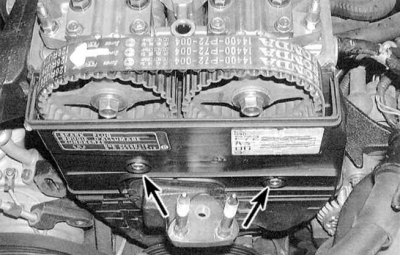
11. Remove the cylinder head cover (see Equipment…


12a. Remove the timing belt center cover.
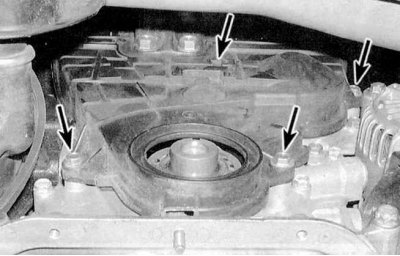


12a. Remove the timing belt center cover.


12b. Remove the lower timing belt cover. (see accompanying illustrations). The top cover is integrated with the head cover.
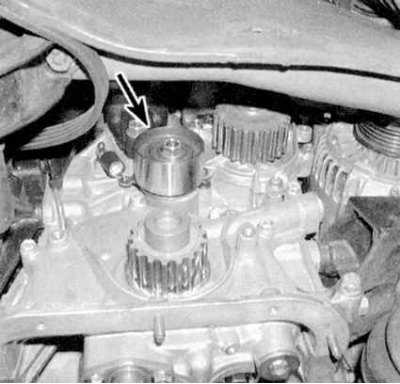
12b. Remove the lower timing belt cover. (see…


13. Loosen the belt tensioner bolt by half a turn (see accompanying illustration). After releasing the tensioner, loosen the belt, then retighten the bolt.
13. Loosen the belt tensioner bolt by half a turn…


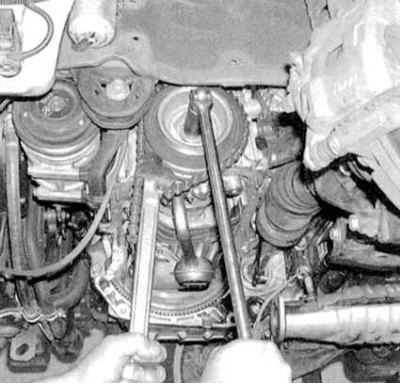
14. Using a chain or strap wrench, block the crankshaft pulley from turning, then loosen the pulley mounting bolt with a socket wrench (see accompanying illustration). 15. Remove the pulley from the crankshaft journal.


14. Using a chain or strap wrench, block the…


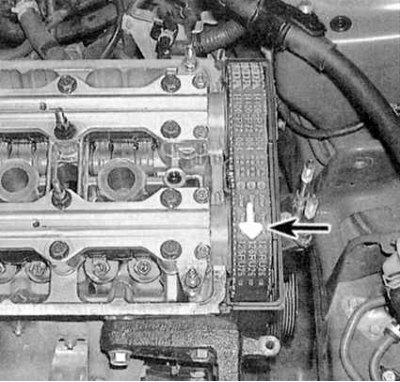
16. If the old belt is in good condition and will be installed in place, mark with chalk or white paint the original direction of its rotation and position relative to the shaft gears (see accompanying illustration). 17. Loosen the tensioner mounting bolt. Release the tensioner, loosen the belt, then tighten the bolt again. Slip the belt off the toothed wheels and remove it from the engine. If the belt is being removed to replace the crankshaft oil seal, slide the toothed wheel and inner belt guide off the crankshaft journal (see Fig. Security systems).

18. If it is necessary to remove the camshafts or replace their seals, insert a large screwdriver through the hole in the gear wheel of the corresponding shaft to prevent it from turning, then loosen the mounting bolt with an end wrench and remove the wheel. Remove the segment key from the camshaft journal. The wheel of the second shaft is removed in a similar manner.

Examination


Caution! Try not to allow the crankshaft or camshaft gears to turn when the timing belt is removed to avoid damaging the valves by hitting the piston crowns.


1. Manually check the tensioner roller for free rotation, then tug it from side to side to check for play in the bearing (see illustration for paragraph 13). The defective roller must be replaced.


1. Manually check the tensioner roller for free…


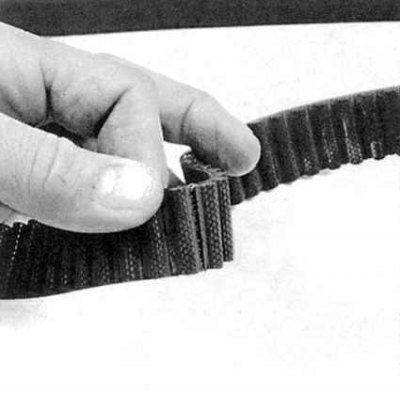
2. Carefully inspect the timing belt on both sides, checking for signs of wear (especially the persistent walls of the teeth), cracks, cuts, abrasions and traces of oiling (see accompanying illustration). A defective belt must be replaced.

Note: Unless the engine mileage is very low, it is recommended to replace the belt regardless of its condition. Never install an old belt on the engine unless you are 100% sure that it is in good condition.


Installation


1. If removed, reinstall the shaft gears (don't forget about the camshaft splines and the inner belt guide on the crankshaft). Tighten the camshaft timing gear mounting bolts to the required torque (see Specifications).
1. If removed, reinstall the shaft gears (don't…


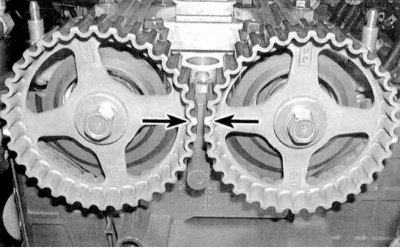
2. Before installing the belt, make sure that the camshaft gears are installed with the "UP" mark facing up. The timing marks should be aligned with the pointer on the rear belt cover (see accompanying illustration).


Note: If resistance occurs, stop turning the shaft immediately to avoid damaging the valves by hitting the piston crowns. Carefully adjust the position of the camshaft gears, then try again.

Note: If resistance occurs, stop turning the…


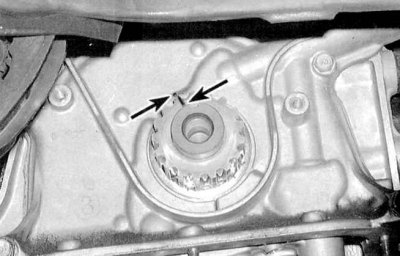
3. Temporarily install and secure the crankshaft pulley with the bolt, then turn the shaft (if it was shot down) so that the timing mark on its gear is aligned with the corresponding indicator on the oil pump housing (see accompanying illustration).

4. Fit the belt securely onto the crankshaft sprocket, then pass it under the tensioner pulley and around the water pump and camshaft sprockets. Loosen the tensioner bolt to provide belt tension, then temporarily tighten the bolt.

5. Carefully rotate the crankshaft six times in a counterclockwise direction, then check that the timing marks on the camshaft gears are positioned correctly (see illustrations above). If the crankshaft turns with jerks or jams, do not apply force, as this may result in damage to the valves when they hit the piston bottoms (if the adjustment is out of adjustment). Remove the belt and repeat the procedure, paying particular attention to aligning the timing marks.


6. To adjust the belt tension, loosen the tensioner bolt by half a turn (180°) and turn the crankshaft counterclockwise three teeth past TDC. Now tighten the bolt to the required force (see Fig. Specifications).

7. Reinstall all components removed during disassembly.

8. Adjust the tension of the drive belts (see Chapter Routine maintenance).

9. Start the engine and check its proper functioning.
This article is available at: russian, bulgarian, belarusian, ukrainian, serbian, croatian, romanian, polish, slovak, hungarian
This information has been verified: Timofey Goryachev
Share with friends:
◀ Previous
Civic 6: Engine in car (Integra)
Next ▶

Removal and installation the exhaust manifold
Removal and installation the intake manifold
Removal and installation the cylinder head cover
Bringing the piston of the first cylinder to the top dead center (TDC) position
Preparatory actions and list of repair procedures
Replacing the front crankshaft oil seal
VTEC Systems — General Information and Component Health Checks
Removal, inspection and installation of camshafts and rocker arm assemblies
Replacing valve springs with plates and oil deflector caps
Removal and installation the cylinder head — removing, checking and installing
See also other articles from Honda manuals:
Removal, condition check and installation of the timing belt and… Honda Accord 6 (1997-2002)
Checking the ignition timing angle Honda Fit 1 (2001-2008)
Timing Belt — Replacement Frequency and Maintenance Honda CR-V 1 (1995-2001, petrol)
Checking and adjusting the ignition timing angle Honda HR-V 1 (1998-2006, petrol)
Checking the timing belt Honda Avancier 1 (1999-2003, petrol)
Link in different formats to this article
Comments and feedback from visitors
No comments yet


How much will 21 + 32 ?


Civic 8 (2005-2011) 
  • General information
  • Technical data
  • Governing bodies
  • Driving and maintenance
  • Power unit
  • Gasoline engines (L13A)
  • Gasoline engines (R18A)
  • Diesel engines (N22A)
  • Cooling and lubrication (L13A)
  • Cooling and lubrication (R18A)
  • Cooling and lubrication (N22A)
  • Injection system (gasoline)
  • Injection system (diesel)
  • Toxicity reduction system
  • Troubleshooting
  • Transmission
  • Clutch and drive shafts
  • Mechanical gearbox
  • Chassis and running gear
  • Suspension and wheels
  • Steering
  • Brake system
  • Body and interior
  • Exterior (external elements)
  • Doors, locks and windows
  • Electrical equipment
  • Equipment and devices
  • Headlights and lighting
  • Power devices
  • Electrical circuits
Civic 7 (2000-2005) 
  • General information
  • User manual
  • Maintenance
  • Power unit
  • Engines D15B and D17A
  • K20A Engines
  • Overhaul engine
  • Cooling system
  • Lubrication system
  • Fuel injection system
  • Toxicity reduction system
  • Engine electrical equipment
  • Transmission
  • Clutch
  • Manual gearbox
  • Automatic gearbox
  • Variator (CVT)
  • Drive shafts
  • Chassis and running gear
  • Car suspension
  • Steering
  • Brake system
  • Body and interior
  • Exterior (external elements)
  • Interior (internal elements)
  • Doors, locks and windows
  • Heater and air conditioner
  • Manual air conditioner
  • Automatic air conditioner
  • Security system
  • Electrical equipment
  • Equipment and devices
  • Headlights and lighting
  • Windscreen wipers
  • Audio system
  • Electrical diagrams
Civic 6 (1995-2000) 
  • General information
  • Introduction to guide
  • User manual
  • Maintenance
  • Power unit
  • Engine in car (Civic)
  • Engine in car (Integra)
  • Engine overhaul
  • Cooling and heating
  • Power and exhaust systems
  • Engine electrical equipment
  • Engine management systems
  • Transmission
  • Manual gearbox
  • Automatic transmission (AT/CVT)
  • Clutch and drive shafts
  • Chassis and running gear
  • Brake system
  • Car suspension
  • Steering
  • Body and interior
  • Exterior (external elements)
  • Interior (internal elements)
  • Doors, locks and windows
  • Electrical equipment
  • Equipment and devices
  • Electrical circuits
Civic 5 and 6 (1991-2000) 
  • Power unit
  • SOHC engines
  • DOHC engines
  • Engine overhaul
  • Cooling and lubrication system
  • Intake and exhaust system
  • Fuel injection system (SOHC)
  • Fuel injection system (DOHC)
  • Carburetor
  • Transmission
  • Clutch
  • Manual gearbox S4C
  • Manual gearbox S40
  • Automatic gearbox
  • Drive shafts
  • Chassis and running gear
  • Car suspension
  • Steering
  • Brake system
  • Body and interior
  • Body elements
  • Heater and air conditioner
  • Electrical equipment
  • Power devices
  • Equipment and instruments
  • Electrical circuits
Civic 3 and 4 (1983-1991) 
  • General information
  • Maintenance
  • Power unit
  • Engine in a car
  • Engine overhaul
  • Cooling system
  • Power and exhaust system
  • Engine electrical equipment
  • Emission control system
  • Transmission
  • Mechanical gearbox
  • Automatic gearbox
  • Clutch and drive shafts
  • Four-wheel drive
  • Chassis and running gear
  • Brake system
  • Car suspension
  • Steering
  • Body and interior
  • Body elements
  • Electrical equipment
  • Equipment and devices
  • Electrical circuits
HondaBook.ru © 2018–2026 • Mobile version • Sitemap: EN BG BY UA RS HR RO PL SK HU • Feedback • Driver Information • Search system • Bookmark
Accord 3 (1985-1989) • Accord 6 (1997-2002) • Civic 3 and 4 (1983-1991) • Civic 5 and 6 (1991-2000) • Civic 6 (1995-2000) • Civic 7 (2000-2005) • Civic 8 (2005-2011) • Fit 1 (2001-2008) • CR-V 1 (1995-2001) • CR-V 2 (2002-2006) • HR-V 1 (1998-2006) • Avancier 1 (1999-2003) •
 
This website uses cookies to ensure proper functioning. By clicking "OK," you agree.