
Contents: Examination ⇊ Replacement ⇊
Fuel injectors have an electromagnetic drive and a fixed opening value, consist of a solenoid, a needle valve and a housing. When current flows through the solenoid winding, the valve needle rises, opening the passage and fuel is injected. Since the needle lift and fuel pressure are constant, the amount of fuel injected depends only on the valve opening time (i.e. from the time of current passage). The nozzle is also equipped with sealing rings in the upper and lower parts, which also help to reduce noise during operation.
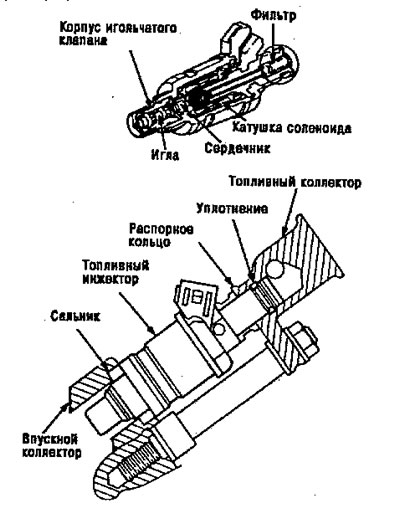
Examination
Note: Check the following before testing: idle speed, spark advance and CO content.
If the engine is running:
1. With the engine running, disconnect the connectors of each injector individually and note the change in idle speed.
If the revs drop almost equally on each cylinder, the injectors are normal.
If the idle speed and smoothness remain the same when any cylinder is turned off, replace that injector and recheck.
2. Check the clicking sound of each injector through a stethoscope at idle.
If any injector does not make the characteristic clicking sound, replace it and check the sound again.
If there is still no sound, check the following:
- There may be short circuits, breaks or poor contacts in the yellow/black wire between the main injection system relay and the common connector.
- The common connector may be open or oxidized.
- There may be short circuits, breaks or poor contacts in the red/black wire between the common connector and the injector.
- There may be short circuits, breaks or poor contacts in the wiring between the injector and the electronic control unit.
- If all of the above are OK, check the ECU and the main relay of the injection system.
If the engine does not start:
1. Disconnect the injector connectors and measure the resistance between the two injector terminals.
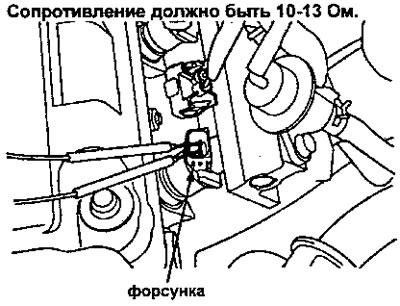
If the resistance is not within the specified limits, replace the injector.
If the resistance is normal, check the fuel pressure.
If the fuel pressure is normal, check the following:
- There may be short circuits, breaks or poor contacts in the yellow/black wire between the main injection system relay and the common connector.
- The common connector may be open or oxidized. Short circuits, breaks or poor contacts in the red/black wire between the common connector and the injector are possible.
- There may be short circuits, breaks or poor contacts in the wiring between the injector and the electronic control unit.
- If all of the above are OK, check the electronic control unit.
Replacement
Caution: Do not smoke when working on the fuel system. Keep open flames away from your work area.
1. Relieve fuel pressure.
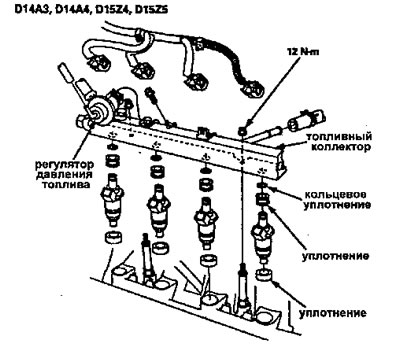
2. Disconnect the connectors from the fuel injectors (D14A3, D14A4, D15Z4, D15Z5 engine: remove ACL).
3. Disconnect the vacuum hoses and fuel return hose from the fuel pressure regulator.
Caution: Place a rag or cloth over the hoses before disconnecting them.
4. Loosen the retaining nuts on the fuel manifold.
5. Disconnect the fuel rail.
6. Remove the fuel injectors from the intake manifold.
 |
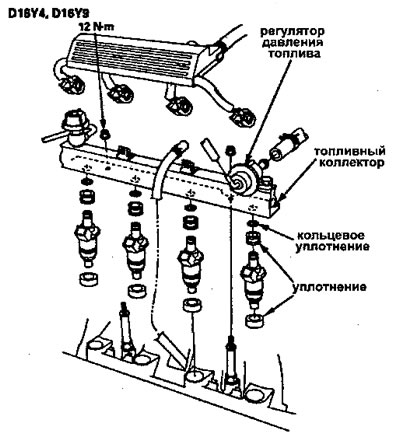 |
7. Place new seals on the injectors.
8. Apply engine oil to the new O-rings and install them on the injectors.
9. Insert the injectors into the fuel manifold first.
10. Coat the new O-rings with clean engine oil and insert them into the intake manifold.
11. Install the fuel injectors together with the fuel manifold onto the intake manifold.
Caution: Be careful not to damage the O-ring during installation.
12. Install and tighten (compress) the holder (clamp) nuts.
13. Connect the vacuum hoses and fuel return hose to the fuel pressure regulator.
14. Connect the injector connectors (engine D14A3, D14A4, D15Z4, D15Z5: Install ACL).
15. Turn on the ignition (II), but do not crank the engine with the starter. After the fuel pump runs for about two seconds, the fuel pressure in the fuel line will increase. Repeat this two or three times, then check for fuel leaks.
[The original is located on the website: hondabook.ru]