
Description
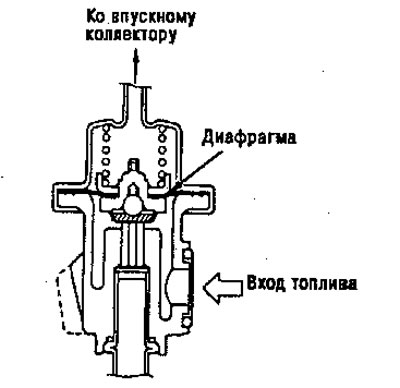
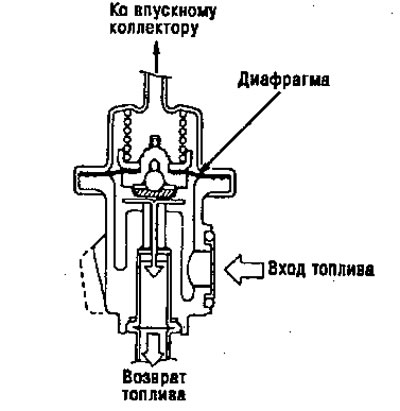
The check valve maintains the pressure at the fuel injectors constant. When the pressure difference between the fuel and intake manifolds exceeds 250 kPa (2.55 kg/cm²) (engines D16Y4, D16Y9 - 294 kPa, 3.0 kg/cm²), the diaphragm is pushed upward and excess fuel is drained into the tank through the return line.
Closed state:
Open state:
Examination
Warning: Do not smoke during the test. Do not allow open flames in the work area.
1. Attach the special tool to the fuel line service port (on the filter).
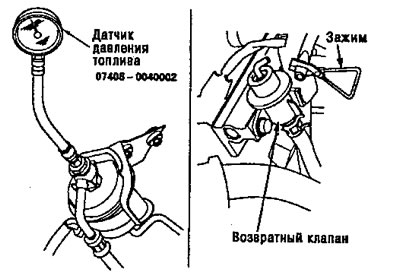
The pressure should be:
- Engines D14A3, D14A4, D15Z4, D15Z5: 226-275 kPa (2.3-2.8 kg/cm²)
- Engines D16Y4, D16Y9: 275-324 kPa (2.7-3.2 kg/cm²)
(With the vacuum hose of the check valve disconnected and clamped)
2. Connect the vacuum hose to the check valve.
3. Check that the fuel pressure increases when you disconnect the vacuum hose from the check valve again.
If the fuel pressure does not increase, replace the check valve.
Replacement
Caution: Do not smoke while working on the fuel system. Keep open flames away from the work area.
1. Place a napkin under the check valve, then release the fuel pressure.
2. Disconnect the vacuum hose and fuel return hose.
3. Unscrew the 2 M6 mounting bolts.
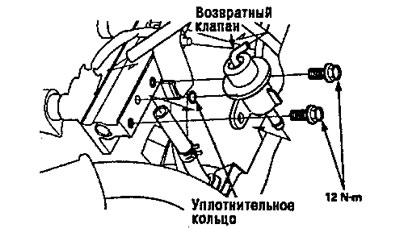
Note: Replace the O-ring. When installing the check valve, lubricate the O-ring with engine oil and place it in the correct position, be careful not to damage the ring.