
Contents: Models with carburetors -…⇊ Fuel pump control ⇊ Fuel pressure control ⇊ Pressure control ⇊ Fuel pump control ⇊ Main relay control ⇊
Models with carburetors - preliminary check
1. Disconnect the negative battery cable and remove the air cleaner housing (see Section 7).
2. Check for leaks in the system.
3. If there are no visible leaks, check the operation of the fuel pump.
Fuel pump control
4. Connect the remote starter key according to the manufacturer's instructions. If you do not have a remote key, you will need an assistant to control the pump.
5. Disconnect the fuel supply pipe from the carburetor.
6. Connect the negative cable to the battery.
7. Disconnect the low voltage wire from the ignition coil (see Chapter 5).
8. Place a container to collect gasoline under the open end of the outlet pipe of the fuel pump disconnected from the carburetor.
9. Crank the engine with the starter for a few seconds.
10. If gasoline flows freely and strongly from the tube, there are no faults in the fuel pump. Otherwise, replace the pump (see Section 4).
Fuel pressure control
11. Place a pressure gauge in the gap in the pipeline before the fuel filter.
12. Disconnect the return line from the fuel pump and plug the pump outlet with a suitable cap.
13. Start the engine and record the fuel pressure while idling. Turn off the engine.
14. Fuel pressure should be within specification. If not, replace the fuel pump. Fuel injection models.
Application: On 1985-1987 models, the fuel pump is located near the tank by the rear left wheel. On later models, the pump is mounted in the tank.
15. Put the car on the parking brake. When you turn the ignition key to the second position, you should hear the fuel pump work. The sound has a buzzing character and lasts 2-3 seconds. Start the engine. The buzzing sound should occur again (although it is difficult to see against the background of the working engine). If this does not happen, there is a defect in the booster pump or the main control relay.
Pressure control
16. Unload the fuel system (see Section 2).
17. Remove the bolt from the fuel filter cover and attach the pressure gauge.
18. Start the engine. Disconnect the vacuum hose from the pressure regulator. With the engine idling, record the pressure gauge reading and compare it to these specifications.
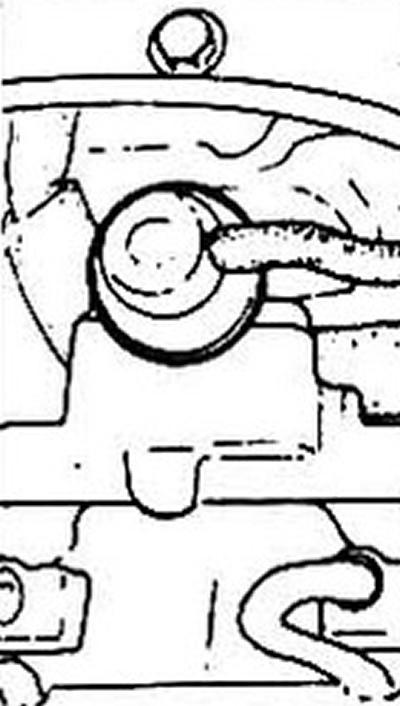
Fig. 3.18a Pressure regulator (multipoint injection system)
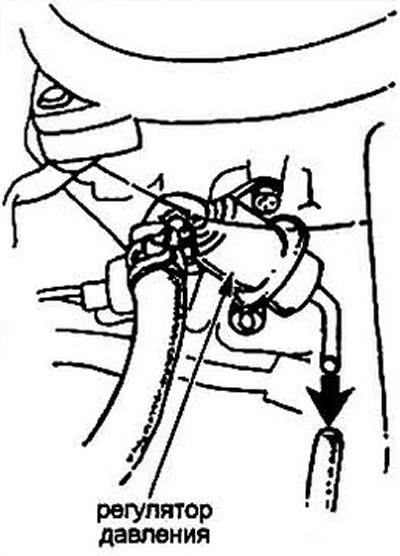
Fig. 3.186 Location of fuel filter and pressure regulator (two-point injection system)
19. If the pressure deviates from the recommended value:
a) if the pressure is higher, check the operation of the regulator (see Section 14) or the presence of kinks and crushes in the return pipes and hoses.
b) if the pressure is lower:
- 1) check the fuel filter;
- 2) inspect the tubes and hoses from the tank to the filter. Bends and crushes are unacceptable.
- 3) check the operation of the regulator (see Section 14);
- 4) Check for fuel leaks.
- 5) Did you remember to remove the vacuum hose?
20. If the above faults are not detected, proceed to check the operation of the fuel pump.
Fuel pump control
21. You will need an assistant. When you turn the ignition key to the second position, you should hear a short buzzing sound from the pump and the pressure should begin to increase. Start the engine. The buzzing sound should be heard constantly.
22. If the pump noise is not heard, perform the following operations:
23. Raise the rear of the vehicle and place it on stands.
24. Remove the left rear wheel.
25. On 1985-1987 models, remove the fuel pump protective cover (see Section 4) and disconnect the black and black/yellow wires (the engine must be stopped and the ignition key in the "O" position). On models from 1988, the fuel pump connector is located on top of the fuel tank, and the disconnection can be done from the passenger compartment after removing the rear seat. The connector should have wires of the same colors (black and black and yellow).
26. Connect the voltmeter terminal to the black and yellow wire, and the terminal to the black wire, turn the ignition key and read the voltmeter readings.
27. If there is voltage, replace the pump (see Section 4).
28. If there is no voltage, check the main relay (see below).
Main relay control
29. Remove the relay from its socket under the fuse panel.
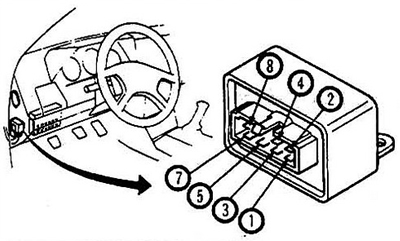
Fig. 3.29 The main relay is located under the dashboard near the fuse panel. The relay legs are indicated by numbers
30. Using wires of sufficient length, connect the positive terminal of the battery to leg #4, ground leg #8 to the body and check the conductivity of the current from leg #5 to leg #7. If there is no conductivity, replace the relay.
31. Connect the battery "plus" to pin #5, ground pin #2 to the body and check the conductivity of the current between pins #1 and #3. If there is no conductivity, replace the relay.
32. Connect the battery "plus" to pin #3 and ground pin #8 to the body. Check for current between pins #5 and #7. If there is no current, replace the relay.
The original text of the article is located on the website HONDABOOK.ru