
HondaBook.ru
Auto companies Volkswagen Auto companies Ford Auto companies Lada Auto companies Skoda Auto companies BMW Auto companies Mazda Auto companies Peugeot
English Русский
Български
Беларускі
Український
Српски
Hrvatski
Română
Polski
Slovenský
Magyar
Bookmark Contacts Sitemap   


Accord Civic Fit / Jazz CR-V HR-V Others Articles
Civic 3 and 4 (1983-1991) Civic 5 and 6 (1991-2000) Civic 6 (1995-2000) Civic 7 (2000-2005) Civic 8 (2005-2011)

Removal, condition check and installation of the camshaft (Honda Civic 6)

  • Main
  • Honda Civic
  • 6 (1995-2000)
  • Power unit
  • Engine in car (Civic)
  • Removal, condition check and installation of the camshaft
0
Contents: Checking axial play and lateral…⇊ Removal ⇊ Examination ⇊ Installation ⇊

Checking axial play and lateral runout


1. Checking the axial clearance is performed as follows:
  • a) Install the camshaft into the engine and secure it with the bearing caps;
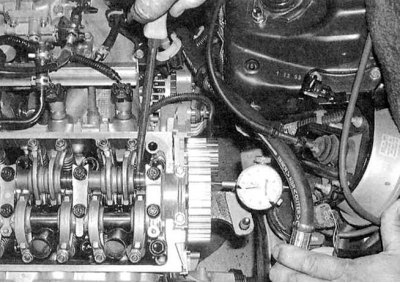
a) Install the camshaft into the engine and…

  • b) Secure the dial gauge to the cylinder head, resting its plunger against the end of the shaft (see accompanying illustration); c) Using a large screwdriver as a lever, pull the shaft back as far as it will go and reset the meter to zero, then push the shaft forward and read the meter reading;
  • d) Compare the measurement result with the requirements Specifications;
  • e) Excessive axial clearance indicates wear of the camshaft or head.

2. To check lateral runout:
  • a) Place the camshaft removed from the engine in two V-shaped prisms, then press the plunger of the dial gauge against the journal of the central bearing and measure the runout value when the shaft rotates;
  • b) Compare the measurement results with the requirements Specifications;
  • c) If the camshaft is excessively loose, it must be replaced.

Removal


1. Remove the cylinder head cover (see Removal and installation the cylinder head cover).


2. Bring the piston of the first cylinder to the TDC position (see Bringing the piston of the first cylinder to the top dead center (TDC) position).

3. Remove the ignition distributor (see Chapter Engine electrical equipment).

4. If necessary, unscrew the camshaft gear mounting bolt in order to remove it from the journal.

Note: To prevent the shaft from turning, insert a screwdriver through one of the holes in the gear.


5. Remove the rocker arm assembly (see Removal, condition check and installation of rocker arm assembly). If the camshaft bearing caps are to be removed from the assembly, they must be marked in the order of installation (place marks asymmetrically to ensure correct orientation of caps).
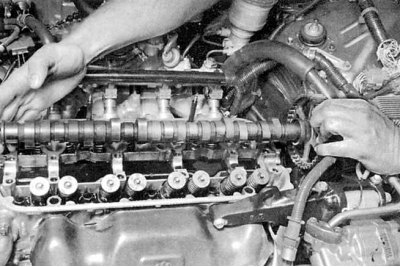
5. Remove the rocker arm assembly (see Removal,…


6. Remove the crankshaft (see accompanying illustration).

Examination


1. Check the bearing shells of the shaft and the inner surfaces of the bearing caps for scratches and scoring. If serious defects are detected, the cylinder head must be replaced with a new or reconditioned one. Using a calibrated plastic wire (plastigauge set) measure the size of the working clearances in the bearings. Compare the measurement results with the requirements Specifications.


Note: Instructions for using the Plastigauge kit are provided in Installing the crankshaft and checking the main bearing clearances and Installation of connecting rod and piston assemblies and checking the size of working clearances in the connecting rod bearings of the crankshaft Parts General and major engine repairs of this Chapter. If the clearance of any of the bearings is outside the permissible range, replace the camshaft.


2. Assess the degree of wear of the camshaft cams:
  • a) Carefully inspect the working surfaces of all cams, checking for scratches, scoring and signs of uneven wear;
  • b) If a defect is detected in at least one of the cams, replace the camshaft. Do not forget about the need to identify the causes of wear - check the engine oil for the presence of abrasive particles. Check the patency of the oil pump and all oil flows (wear of cam lifters is most often associated with oil contamination or a disruption in its supply);
b) If a defect is detected in at least one of the…

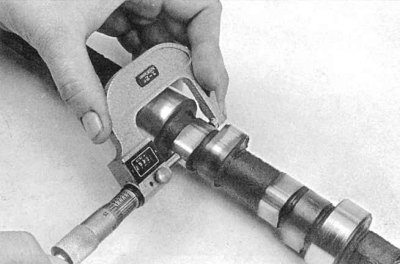
  • c) Using a micrometer, measure the height of the cams (see accompanying illustration). Compare the measurement results, replace the camshaft if necessary. 3. Check the working surfaces of the valve drive rocker arms for signs of wear, abrasions, cavities and other defects.

4. If any of the above defects are detected, the condition of the engine oil and the correctness of its supply to the cylinder head should be checked. Only after identifying and eliminating the cause of the violation, proceed to install replacement components (head, camshaft or rocker arm assembly).


Installation


1. Thoroughly clean the camshaft, its bearing seats in the cylinder head and covers, and the rocker arms of the valve drive. Try to completely remove the slightest traces of sludge and dirt. Use only clean, lint-free cloths to wipe the components.
1. Thoroughly clean the camshaft, its bearing…


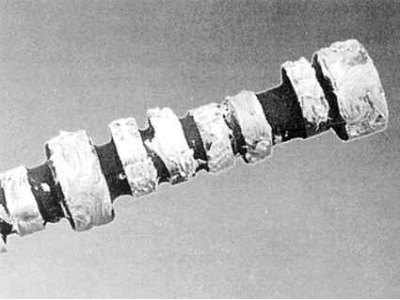
2. Lubricate the camshaft cams and bearing journals with special assembly grease (see accompanying illustration).

Caution: Failure to lubricate the shaft thoroughly before installation can result in severe damage to the bearings and cams in the first seconds after engine start-up before normal oil circulation begins.


3. Carefully lower the camshaft into the cylinder head. Using a socket head of the appropriate size or a piece of pipe of the appropriate diameter as a mandrel, seat the camshaft oil seal in its regular place (open side with a spring installed in the groove inside).

4. Install the rocker arm assembly (see Removal, condition check and installation of rocker arm assembly).

5. After turning the shaft accordingly, place the gear wheel (marked "UP" at 12 o'clock) on its front journal.

6. Install the timing belt and associated components (see Removal, condition check and installation of the timing belt and timing drive gears).


Caution! If the position of the crankshaft was knocked down during servicing the head, take care to align the timing marks of its toothed wheel when installing the belt (see Fig. Removal, condition check and installation of the timing belt and timing drive gears).


7. Remove the spark plugs and turn the crankshaft manually, checking the correct installation of the valve timing. After two turns, the timing marks of the teeth should return to their original position. Otherwise, remove the belt and achieve the required alignment of the marks.

Caution! If resistance occurs during cranking, stop the procedure immediately!


8. Further installation is carried out in the reverse order of dismantling the components.
This article is available at: russian, bulgarian, belarusian, ukrainian, serbian, croatian, romanian, polish, slovak, hungarian
This information has been verified: Timofey Goryachev
Share with friends:
◀ Previous
Civic 6: Engine in car (Civic)
Next ▶

Replacing the front crankshaft oil seal
Removal, condition check and installation of the timing belt and timing drive…
Replacing valve springs with plates and oil deflector caps
Removal, condition check and installation of rocker arm assembly
VTEC Systems — General Information and Component Health Checks
Removal and installation the cylinder head
Removal and installation the engine oil pan
Removal, inspection and installation of the oil pump
Removal and installation the flywheel/drive disc
Replacing the rear crankshaft oil seal
See also other articles from Honda manuals:
Removal, condition check and installation of the camshaft Honda Accord 6 (1997-2002)
Checking tire pressure and condition Honda Fit 1 (2001-2008)
Camshaft — check Honda CR-V 1 (1995-2001, petrol)
Camshaft — Check Honda HR-V 1 (1998-2006, petrol)
Torque Converter Lockup Solenoid Valve and Shift Solenoid Valve Assy… Honda Avancier 1 (1999-2003, petrol)
Link in different formats to this article
Comments and feedback from visitors
No comments yet


How much will 36 + 40 ?


Civic 8 (2005-2011) 
  • General information
  • Technical data
  • Governing bodies
  • Driving and maintenance
  • Power unit
  • Gasoline engines (L13A)
  • Gasoline engines (R18A)
  • Diesel engines (N22A)
  • Cooling and lubrication (L13A)
  • Cooling and lubrication (R18A)
  • Cooling and lubrication (N22A)
  • Injection system (gasoline)
  • Injection system (diesel)
  • Toxicity reduction system
  • Troubleshooting
  • Transmission
  • Clutch and drive shafts
  • Mechanical gearbox
  • Chassis and running gear
  • Suspension and wheels
  • Steering
  • Brake system
  • Body and interior
  • Exterior (external elements)
  • Doors, locks and windows
  • Electrical equipment
  • Equipment and devices
  • Headlights and lighting
  • Power devices
  • Electrical circuits
Civic 7 (2000-2005) 
  • General information
  • User manual
  • Maintenance
  • Power unit
  • Engines D15B and D17A
  • K20A Engines
  • Overhaul engine
  • Cooling system
  • Lubrication system
  • Fuel injection system
  • Toxicity reduction system
  • Engine electrical equipment
  • Transmission
  • Clutch
  • Manual gearbox
  • Automatic gearbox
  • Variator (CVT)
  • Drive shafts
  • Chassis and running gear
  • Car suspension
  • Steering
  • Brake system
  • Body and interior
  • Exterior (external elements)
  • Interior (internal elements)
  • Doors, locks and windows
  • Heater and air conditioner
  • Manual air conditioner
  • Automatic air conditioner
  • Security system
  • Electrical equipment
  • Equipment and devices
  • Headlights and lighting
  • Windscreen wipers
  • Audio system
  • Electrical diagrams
Civic 6 (1995-2000) 
  • General information
  • Introduction to guide
  • User manual
  • Maintenance
  • Power unit
  • Engine in car (Civic)
  • Engine in car (Integra)
  • Engine overhaul
  • Cooling and heating
  • Power and exhaust systems
  • Engine electrical equipment
  • Engine management systems
  • Transmission
  • Manual gearbox
  • Automatic transmission (AT/CVT)
  • Clutch and drive shafts
  • Chassis and running gear
  • Brake system
  • Car suspension
  • Steering
  • Body and interior
  • Exterior (external elements)
  • Interior (internal elements)
  • Doors, locks and windows
  • Electrical equipment
  • Equipment and devices
  • Electrical circuits
Civic 5 and 6 (1991-2000) 
  • Power unit
  • SOHC engines
  • DOHC engines
  • Engine overhaul
  • Cooling and lubrication system
  • Intake and exhaust system
  • Fuel injection system (SOHC)
  • Fuel injection system (DOHC)
  • Carburetor
  • Transmission
  • Clutch
  • Manual gearbox S4C
  • Manual gearbox S40
  • Automatic gearbox
  • Drive shafts
  • Chassis and running gear
  • Car suspension
  • Steering
  • Brake system
  • Body and interior
  • Body elements
  • Heater and air conditioner
  • Electrical equipment
  • Power devices
  • Equipment and instruments
  • Electrical circuits
Civic 3 and 4 (1983-1991) 
  • General information
  • Maintenance
  • Power unit
  • Engine in a car
  • Engine overhaul
  • Cooling system
  • Power and exhaust system
  • Engine electrical equipment
  • Emission control system
  • Transmission
  • Mechanical gearbox
  • Automatic gearbox
  • Clutch and drive shafts
  • Four-wheel drive
  • Chassis and running gear
  • Brake system
  • Car suspension
  • Steering
  • Body and interior
  • Body elements
  • Electrical equipment
  • Equipment and devices
  • Electrical circuits
HondaBook.ru © 2018–2026 • Mobile version • Sitemap: EN BG BY UA RS HR RO PL SK HU • Feedback • Driver Information • Search system • Bookmark
Accord 3 (1985-1989) • Accord 6 (1997-2002) • Civic 3 and 4 (1983-1991) • Civic 5 and 6 (1991-2000) • Civic 6 (1995-2000) • Civic 7 (2000-2005) • Civic 8 (2005-2011) • Fit 1 (2001-2008) • CR-V 1 (1995-2001) • CR-V 2 (2002-2006) • HR-V 1 (1998-2006) • Avancier 1 (1999-2003) •
 
This website uses cookies to ensure proper functioning. By clicking "OK," you agree.