
When you press the brake pedal, you may feel a slight vibration. This is normal and indicates that the ABS system is working. Continue to press the brake pedal firmly.
At low speeds (below 10 km/h), the ABS system does not work and the brakes operate normally.
This system does not serve to reduce the braking distance. Just like in cars without ABS, the more slippery the road, the longer the braking distance. In addition, even with ABS, the improvement of the wheel grip and vehicle control is limited, so you need to be careful when driving at high speed on a slippery road.
On poor, sandy roads and deep fresh snow, a car with ABS may have a longer braking distance than a car without ABS. In the above road conditions, it is necessary to monitor the distance between cars and drive at a moderate speed.
Note: The tires on all four wheels must be the same size. If the tire sizes (outer diameter) are different, the ABS system will not work properly.
ABS warning light
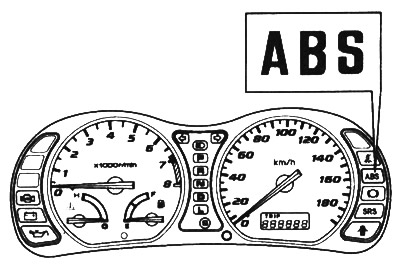
This lamp is located on the dashboard and lights up when there is a malfunction in the ABS system.
When you turn the ignition key to position "II", the lamp lights up for a few seconds and then goes out. This is a normal condition. It is also normal if the lamp lights up while driving for a few seconds and then goes out.
The system malfunction can be indicated by the following behavior of the indicator lamp. In such cases, immediately go to the Honda service for diagnostics.
- The lamp lights up while driving.
- The lamp does not light when the ignition key is turned to position "II" or does not go out after several seconds.
In all the above cases, the brakes operate normally (without ABS).
If the ABS warning light comes on at the same time as the brake warning light, the brake force distribution may not occur and the vehicle may become uncontrollable during sudden braking. In this case, avoid high-speed driving and sudden braking, and contact a Honda service station.