
Contents: Concerns ⇊ Disable the undisableable ⇊ How to brake? ⇊ Surprises of coverage ⇊ Don't be afraid to turn the steering…⇊
The purpose of ABS is simple to formulate - it prevents the wheels from locking during braking. Is the brake pedal pressed too hard? No problem - the electronics, comparing the signals from the speed sensors on each wheel, determine the moment of sudden wheel stop and, opening the electromagnetic valve, releases excess pressure from the brake line into a special hydraulic accumulator. The brake pads are released, the wheel rotation is restored, and the valve reconnects the line to the pressure created by the driver's right foot using the brake booster. And if this pressure is still too great, then the cycle repeats itself again and again. In the cabin, the activation of the ABS is manifested by a crackling sound when the actuator unit operates and jolts on the brake pedal, more or less noticeable depending on the design of the system. In fact, ABS imitates the actions of an experienced driver who, on a slippery road, avoids wheel locking by using intermittent braking. But ABS does this with a frequency and accuracy that is inaccessible to humans - up to 15 times per second. As a result, the ABS should not only provide the car with a minimum braking distance, but also make it obey the steering wheel - after all, the wheels roll and absorb lateral force as much as the tires' grip on the surface allows. And this is the main advantage of ABS. After all, if the wheels lock, the car slides uncontrollably straight, even when the steering wheel is turned all the way.
Concerns
It would seem that everything is already clear. Anti-lock braking systems are recognized by the entire civilized automotive world and have already become standard equipment on cars, starting from the middle class. But often there are also voices of dissatisfaction.
"No electronics can compare with an experienced driver, some say. - Give me the same car without ABS, and I will stop sooner!"
Others do not like the fact that ABS, by interfering with the braking process, completely excludes human participation. No matter how hard you press the pedal, it will be pushed back with an unpleasant vibration. The car brakes itself, there is no way to influence the deceleration process, and with ABS it is very difficult to calculate the braking distance and predict where the car will stop. All that remains is to wait... Unbearable for a driver accustomed to being in control of the situation!
The wheel speed sensor is located in the hub.
And others point to rally drivers. Like, it's not for nothing that they fear ABS like the plague! And they, the athletes, know better...
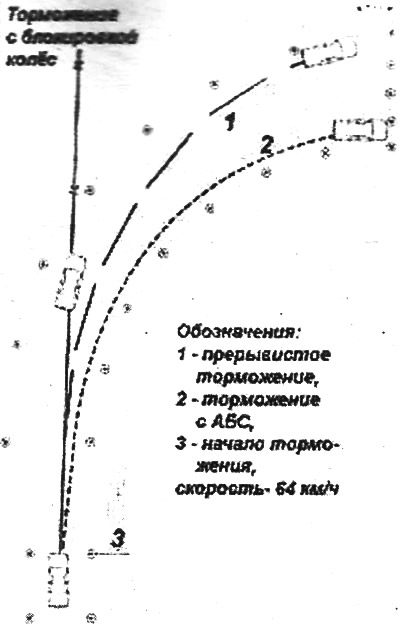
Disable the undisableable
In order to put everything in its place, we committed a technological crime. We found a plug under the hood that fits the ABS actuator unit and pulled it out of its socket, causing the yellow ABS indicator light to come on and the red brake light in the instrument cluster to flash alarmingly. This is how we deactivated the non-disconnectable anti-lock braking system. The tests were conducted according to the following scheme. We have chosen four main exercises: braking on a straight line - on a homogeneous and mixed surface (mixed), in a turn and while going around an obstacle (that is, when performing the maneuver of re-arrangement). The Passat is equipped with recording equipment that accurately measures speed and braking distance. And our test experts were behind the wheel. However, some of the exercises were also offered to ordinary drivers of various qualifications - from novice car enthusiasts to experienced professionals. Everyone was able to practice before the test runs, get used to the car and "zero in" for the next maneuver.
Each exercise was performed in two series. First, they made more than ten runs with the ABS working, then they turned off the system, and the car again hurried to the track of the Next Maneuver, marked with bright markers.
How to brake?
With the anti-lock braking system, everything is simple: if you want to get the maximum possible deceleration, then, without thinking twice, press the pedal to the floor. How to brake without ABS?
At first we tried to do everything "according to theory" - braking on the verge of wheel locking. It doesn't work! The Volkswagen pedal is too sensitive and doesn't allow us to accurately dose the braking force - and we make mistakes, both in one direction and the other. And this is in a calm environment. But try to do this in an extreme situation when there is a threat of an accident!
Then we used a tried and tested method - intermittent braking.
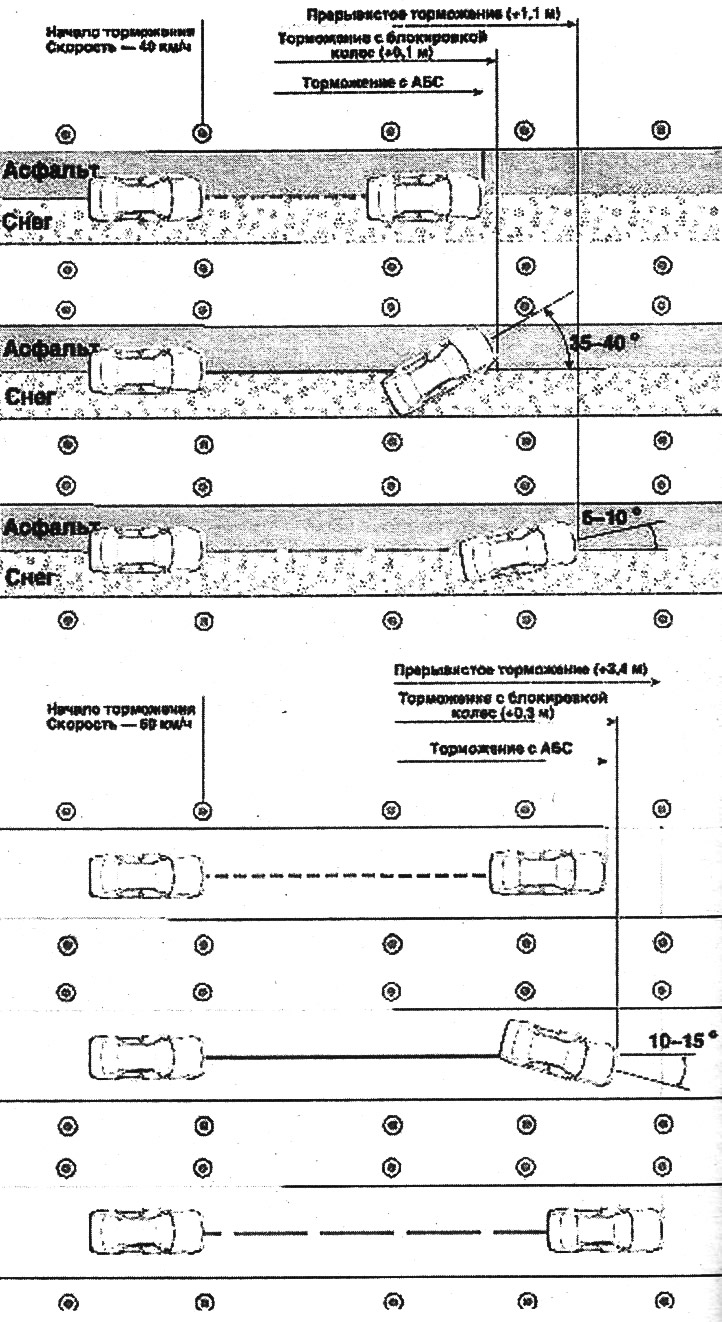
And for comparison, we tried, without further ado, braking "to the floor", with the wheels locked. What's the difference? On a straight line, the main difference is in directional stability. This was especially evident when braking on mixed tracks. There was wet asphalt under the left wheels, and a snowy shoulder under the right ones.
With the ABS on, the car initially starts to pull towards the road surface with better grip, but the electronics work properly: the Passat instantly levels out and then brakes in a straight line, practically without requiring steering corrections. During intermittent braking without ABS, the driver had to steer a little, and the braking distance was longer.
But with the wheels fully locked, the car braked almost as effectively as with ABS. But at the same time, it turned sharply to the left at a dangerous angle - up to 40°! The advantage of ABS here is obvious.
Surprises of coverage
Ice can be as smooth as a mirror or as rough as sandpaper. Snow can be dense, compacted, loose, stuck together, frozen...
What are we getting at? Because each surface has its own specifics, and after our tests we cannot give a clear answer to the question that interests everyone - under what conditions will the braking distance with ABS be shorter than without it!
There are a lot of options. For example, when, after repeated stops on the same straight line, the wheels of our car rolled out a track of rough ice crushed by spikes, the braking distance with and without ABS with locked wheels turned out to be almost the same. It is not for nothing that our athletes say that the most "sticky" surface is not asphalt, but an icy track covered with "nails". And on the snow - what a surprise! - the car with ABS stopped a little later. The whole point is that on snow cover the coefficient of adhesion turned out to be lower than on rough ice - the studs do not work as effectively here. For ABS, apparently, this turned out to be unprofitable. But with "normal" intermittent braking (pressed-released-pressed) during the period of wheel locking, a snow roller forms in front of the wheels, which helps the car slow down more intensively. The ABS operation prevents the wheel from locking, and the roller does not work.
Don't be afraid to turn the steering wheel!
Imagine a very real situation: a truck in front of you suddenly skids on a slippery turn and turns across the road. Or another: a car jumps out from a side drive onto a narrow street right in front of your nose and blocks your lane, leaving only the oncoming lane free.
On a wave of adrenaline rushing into the blood, the driver will panic, reflexively, and press the brake with all his might. The wheels will lock. And with locked wheels, the car will fly out of the turn in the first situation, and in the second, it will crash into an obstacle. Because without ABS, only intermittent braking will help avoid an accident, and this requires the driver to have not only outstanding composure and endurance, but also extraordinary skill.
And here is our example. The experienced expert had to call upon all his skills to repeat and even slightly surpass the results of the same maneuvers with ABS, alternating strictly dosed pushes on the brake pedal and precise steering wheel work.
But so what? After all, even the tester needed to make more than ten sighting runs for this, and in a real situation there will be only one chance! And the electronics will work reliably and for the good.
When braking on a turn, the driver's task was generally very simple: press the brake, turn the steering wheel - and the car, clearly tracking the given trajectory, slows down intensively. This is available to anyone. It is only important to remember that when braking with ABS, the car can and should be controlled. Don't grip the steering wheel numbly, but use it boldly!
When going around an obstacle (we braked while performing a rearrangement maneuver familiar to our readers) the situation was like this. When the speed of the maneuver approached the maximum, after going around the obstacle, the rear axle began to skid. This was both with and without ABS. But using ABS, it was possible to reduce the speed so much that the skid was not so sharp and deep. And the braking distance after the detour was 15 meters shorter. Essential!
True, in order to stay on the road, when correcting a skid, it was necessary to release the brake pedal even with the anti-lock system working. Why? We don't argue, ABS leaves the ability to change the trajectory during emergency braking, rather than sliding in a straight line with locked wheels. But when combating skidding, the operation of the ABS reduces the effectiveness of corrective steering actions too much. And even those drivers whose cars are equipped with ABS, in such situations need to be prepared to release the brake pedal for a moment, consciously refusing the services of electronics.
You will find the original on the portal: www.hondabook.ru