
Contents: Test on a fully braked car (Stall…⇊ Pressure check ⇊ Road test ⇊ Table. Pressure in the main line. ⇊ Table. Gear shift points. 2WD models…⇊ Table. Gear shifting moments…⇊
Test on a fully braked car (Stall test)
1. Preparation:
a) Apply the parking brake and place chocks under the wheels.
b) Check the following parameters:
- engine coolant level;
- engine oil level;
- automatic transmission fluid level;
- ignition timing angle;
- idle speed.
2. Start the engine and wait until the engine warms up.
3. Move the selector to position "2".
4. Press the brake pedal all the way down. Press the accelerator pedal all the way down.
Note: The duration of each check should not exceed 6-8 seconds.
5. Quickly read the tachometer reading when the engine speed reaches its maximum value and compare it with the specified values.
6. Move the selector to the "N" position and let the engine run at idle speed to cool the automatic transmission fluid.
Table: Troubleshooting based on test results on a fully braked vehicle.
| State | Possible malfunction | |
| The rotation speed is greater than specified | In all ranges (low pressure) | Pump wear Clogged working fluid filter Low working fluid level Pressure regulator malfunction |
| In position "R" | Fourth gear clutch failure | |
| In position "2" | Second gear clutch failure | |
| Rotation speed less than specified | Engine does not develop full power Torque converter freewheel clutch malfunction | |
7. Repeat the test with the selector in the "D" and "R" ranges.
Rotation speed with the vehicle fully braked:
models with D15B engine:
- nominal value - 2650 rpm
- acceptable range of values is 2500 - 2800 rpm
models with D17A engine:
- nominal value - 2800 rpm
- acceptable range of values is 2650 - 2950 rpm
If the rotation speed with the vehicle fully braked does not correspond to the established standards, determine the malfunction using the table "Troubleshooting based on the results of the test with the vehicle fully braked".
Pressure check
1. Preparation:
a) (2WD models) Apply the parking brake and chock the rear wheels. Jack up the front of the car and support it on stands. Make sure the front wheels turn freely.
(4WD models) Jack up the car and place it on stands. Make sure all wheels rotate freely.
b) Check the following parameters:
- engine coolant level;
- engine oil level;
- automatic transmission fluid level;
- ignition timing angle;
- idle speed.
2. Unscrew the plug and connect the pressure gauge in its place.
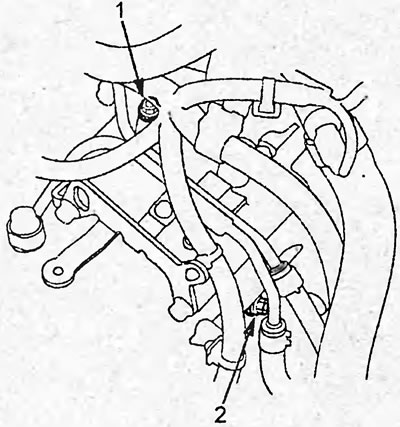
1 - nipple for checking the pressure in the main line, 2 - nipple for checking the pressure in the coupling circuit 2.
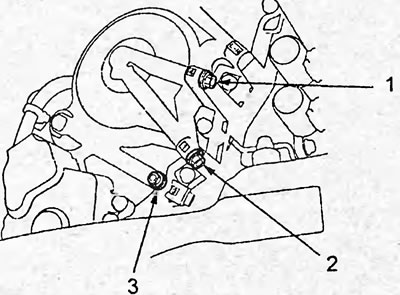
1 - nipple for checking the pressure in the circuit of coupling 4, 2 - nipple for checking the pressure in the circuit of coupling 1, 3 - nipple for checking the pressure in the circuit of coupling 3.
3. Warm up the engine and automatic transmission.
4. Set the engine crankshaft speed to 2000 rpm.
5. Move the selector to position "P" or "N" and measure the pressure.
6. Move the selector to position "D" and measure the pressure in the clutch 1 circuit.
7. Move the selector to position "2" and measure the pressure in the clutch 2 circuit.
8. Move the selector to the "D ₃ " position and measure the pressure in the clutch circuit 3.
9. Move the selector to position "D" and measure the pressure in the clutch circuit 4.
10. Move the selector to the "R" position and measure the pressure in the clutch circuit 4.
11. Remove the pressure gauge.
12. Screw in the new plug.
Tightening torque - 18 Nm
13. Compare the measured values with those given in the table "Pressure in the main line". If the pressure does not correspond to the given one, then use the table to determine the location of the fault.
Road test
1. Remove the glove box (see the chapter "Body").
2. Connect the positive probe of the voltmeter to terminal #15 and the negative probe to terminal #23 or #24.
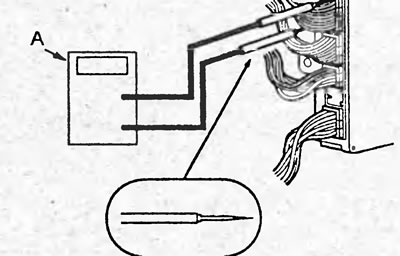
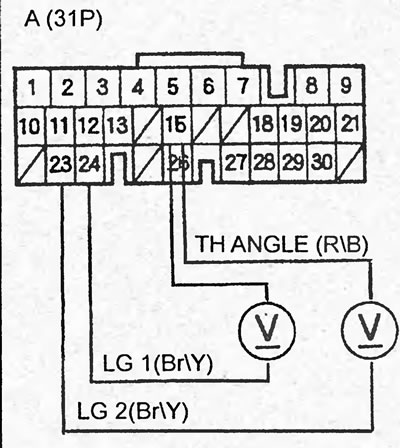
3. Drive the vehicle and make sure that the gear shifting and torque converter lock-up moments correspond to those given in the "Gear shifting moments" table.
4. Repeat the tests in ranges "2" and "D3".
5. Position the vehicle on a slope, move the selector lever to the "P" position and release the parking brake. The output shaft locking mechanism lock should hold the vehicle in place.
Table. Pressure in the main line.
| Pressure test location | Automatic transmission selector position | Pressure, kPa | Possible location of the malfunction | |
| Nominal value | Maximum permissible value | |||
| Main highway | "N" or "P" | 880 - 930 | 830 | Torque converter; Pressure regulator; Pump wear; The working fluid level is not normal; Clogged working fluid filter. |
| Coupling contour 1 | "D" | Leaks in clutch circuit 1; Coupling 1. | ||
| Coupling circuit 2 | "2" | 850 - 900 | 800 | Leaks in clutch circuit 2; Coupling 2. |
| Coupling contour 3 | "D3" | Leaks in clutch circuit 3; Coupling 3. | ||
| Coupling contour 4 | "D" | Leaks in clutch circuit 4;Coupling 4. | ||
| "R" | Leaks in clutch circuit 4; Servo valve;Coupling 4. | |||
Table. Gear shift points. 2WD models with D15B (SOHC) engine.
Upshifts
| Voltage at the terminals of the throttle position sensor (throttle opening degree) | Vehicle speed, km/h | |||
| Switching 1→2 | Switching 2→3 | Switching 3→4 | Activating the torque converter lockup | |
| 0.75 V (the damper is open at 0.5/8) | 15-19 | 30-35 | 43-50 | 23-28 |
| 2.25 V (the damper is open at 3.5/8) | 39-45 | 67-75 | 94-103 | 120-129 |
| 4.5 V (the damper is fully open) | 56-64 | 111 -124 | 169-186 | 169-186 |
Table. Gear shifting moments (continuation).
2WD models with D15B (SOHC) engine.
Downshifts
| Voltage at the terminals of the throttle position sensor (throttle opening degree) | Vehicle speed, km/h | |||
| Turning off the torque converter lockup | Switching 4→3 | Switching 3→2 | Switching 2→1 | |
| 0.5 V (the damper is completely closed) | 21 -26 | 27-32 | 10-15 (switching 3→1) | |
| 4.5 V (the damper is fully open) | 150-166 | 140-156 | 95-106 | 43-51 |
4WD models with D15B (SOHC) engine.
Upshifts
| Voltage at the terminals of the throttle position sensor (throttle opening degree) | Vehicle speed, km/h | |||
| Switching 1→2 | Switching 2→3 | Switching 3→4 | Activating the torque converter lockup | |
| 0.75 V (the damper is open at 0.5/8) | 15-19 | 30-35 | 43-50 | 22-27 |
| 2.25 V (the damper is open at 3.5/8) | 34-40 | 65-73 | 93-102 | 120-129 |
| 4.5 V (the damper is fully open) | 52-60 | 103-116 | 158-175 | 158-175 |
Downshifts
| Voltage at the terminals of the throttle position sensor (throttle opening degree) | Vehicle speed, km/h | |||
| Turning off the torque converter lockup | Switching 4→3 | Switching 3→2 | Switching 2→1 | |
| 0.5 V (the damper is completely closed) | 20-25 | 27-32 | 10-15 (switching 3→1) | |
| 4.5 V (the damper is fully open) | 150-166 | 137-153 | 89-100 | 40-48 |
2WD models with D15B engine (VTEC).
Upshifts
| Voltage at the terminals of the throttle position sensor (throttle opening degree) | Vehicle speed, km/h | |||
| Switching 1→2 | Switching 2→3 | Switching 3→4 | Activating the torque converter lockup | |
| 0.75 V (the damper is open at 0.5/8) | 15-19 | 30-35 | 43-50 | 22-27 |
| 2.25 V (the damper is open at 3.5/8) | 39-45 | 67-75 | 94-103 | 120-129 |
| 4.5 V (the damper is fully open) | 60-68 | 116-129 | 178-195 | 178-195 |
Downshifts
| Voltage at the terminals of the throttle position sensor (throttle opening degree) | Vehicle speed, km/h | |||
| Turning off the torque converter lockup | Switching 4→3 | Switching 3→2 | Switching 2→1 | |
| 0.5 V (the damper is completely closed) | 20-25 | 27-32 | 10-15 (switching 3→1) | |
| 4.5 V (the damper is fully open) | 150-166 | 140-156 | 95-106 | 43-51 |
4WD models with D15B (VTEC) engine and models with D17A (VTEC) engine.
Upshifts
| Voltage at the terminals of the throttle position sensor (throttle opening degree) | Vehicle speed, km/h | |||
| Switching 1→2 | Switching 2→3 | Switching 3→4 | Activating the torque converter lockup | |
| 0.75 V (the damper is open at 0.5/8) | 15-19 | 30-35 | 43-50 | 22-27 |
| 2.25 V (the damper is open at 3.5/8) | 34-40 | 65-73 | 93-102 | 120-129 |
| 4.5 V (the damper is fully open) | 55-63 | 108-121 | 166-183 | 166-183 |
Downshifts
| Voltage at the terminals of the throttle position sensor (throttle opening degree) | Vehicle speed, km/h | |||
| Turning off the torque converter lockup | Switching 4→3 | Switching 3→2 | Switching 2→1 | |
| 0.5 V (the damper is completely closed) | 20-25 | 27-32 | 10-15 (switching 3→1) | |
| 4.5 V (the damper is fully open) | 150-166 | 137-153 | 89-100 | 40-48 |
Refer to the original source on the website www.hondabook.ru