
Note: Depending on the equipment, vehicles are equipped with either iridium spark plugs or conventional spark plugs.
1. Disconnect the connectors from the spark plugs.
2. Using a spark plug wrench, remove the spark plugs.
3. Check the spark plug electrodes.
4. Visually inspect the spark plugs for damage to the threads, insulator and electrodes. If there are any deviations, replace the spark plugs.
Recommended spark plugs:
D15B:
- DENSO — KJ16CR-L11
- NGK — ZFR5J-11
D15B (lean mixture):
- DENSO — SKJ16CR-L11
- NGK — IZFR5F-11
D17A:
- DENSO — KJ20CR-L11
- NGK — ZFR6J-11
K20A:
- DENSO — SK22PR-M11
- NGK — IFR7G-11K
5. Check the spark plug gap.
Nominal clearance - 1.0-1.1 mm
If the gap is greater than the maximum allowable, replace the spark plug.
(Regular candles) The gap adjustment for a new spark plug should be done by bending only the side electrode at the base. Do not touch the central electrode.
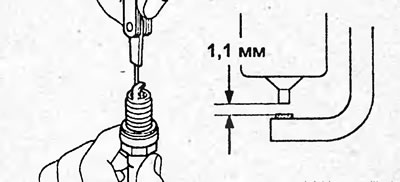
Note: When adjusting the gap, do not rest the tool on the center electrode or insulator.
6. Clean the spark plugs.
If the electrodes have traces of wet carbon deposits, dry them and then remove them with a suitable solvent. If the electrodes have traces of oil, remove them first with gasoline.
Then clean the spark plugs using a spark plug cleaner, applying air at a pressure of no more than 588 kPa (6 kg/cm²) for no more than 20 seconds.
7. Screw in the spark plugs.
Tightening torque - 18 Nm
8. Connect the connectors to the ignition coils.