
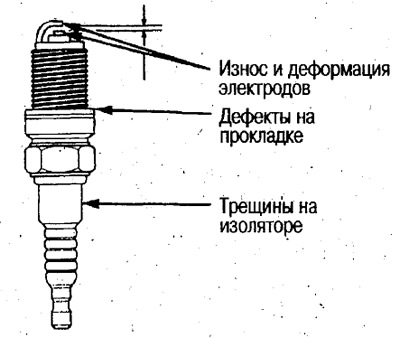
1. Perform the following check of the spark plugs and adjust or replace them if necessary:
- Check spark gaps
- Check the electrodes for contamination
- Check for carbon deposits
- Check the central electrode insulator for cracks.
2. If the electrodes are badly burnt, the following reasons can be assumed:
- The spark plugs were running on a lean fuel-air mixture
- Ignition advance angle too high
- Low spark plug heat range
- Cooling system malfunction
- Insufficient tightening of spark plugs
3. If the spark plugs are completely black from carbon deposits, the following reasons can be assumed:
- Long-term operation at idle speed.
- The spark plugs were running on too rich a fuel/air mixture
- Late ignition
- Ignition coil fault, noise suppression capacitor fault or high voltage wires fault
- Wear of piston rings and valve guides
- Abnormal spark gap
- Spark plug heat range too high
4. If there is carbon deposits on the electrodes, clean them with a sandblasting machine.
Caution: Remove sand completely after sandblasting.
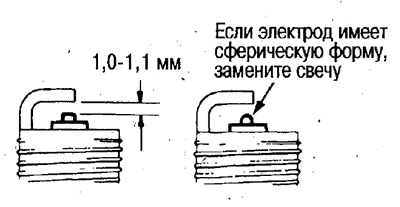
5. If the central electrode has taken on a spherical shape, replace the spark plug.
Use spark plugs that comply with the ISO (International Standard) marking
 .
.
Types of spark plugs
- NGK: ZFR5F11*
- DENSO: KJ16CR-L11*
*: Uses spark plugs for fuel injected engines.
There is marking on the packaging
 .
.
Spark gap:
- Standard spark gap: 1.0-1.1 mm
6. When installing the spark plug, insert it into the spark plug wrench, tighten it by hand until it touches the installation place, and then tighten it to the required force.
 : 18 N·m (1.8 kg·m)
[Article source on the website: HondaBook.ru]