
HondaBook.ru
Auto companies Volkswagen Auto companies Ford Auto companies Lada Auto companies Skoda Auto companies BMW Auto companies Mazda Auto companies Peugeot
English Русский
Български
Беларускі
Український
Српски
Hrvatski
Română
Polski
Slovenský
Magyar
Bookmark Contacts Sitemap   


Accord Civic Fit / Jazz CR-V HR-V Others Articles
Civic 3 and 4 (1983-1991) Civic 5 and 6 (1991-2000) Civic 6 (1995-2000) Civic 7 (2000-2005) Civic 8 (2005-2011)

Manual transmission (Honda Civic 8)

  • Main
  • Honda Civic
  • 8 (2005-2011)
  • General information
  • Driving and maintenance
  • Manual transmission
0
Contents: For some vehicle versions ⇊ Gear Shifting Recommendations ⇊ Maximum vehicle speeds in different…⇊ Reverse gear lock ⇊
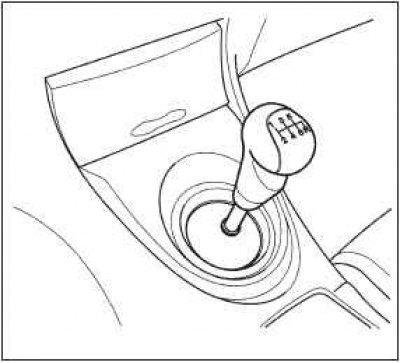
To ensure smooth shifting, all forward gears are…


To ensure smooth shifting, all forward gears are synchronized. A locking device prevents direct shifting from any forward gear to reverse gear if the vehicle is moving faster than a certain predetermined speed.

When changing gears, fully disengage the clutch. After moving the gearshift lever to the next gear, smoothly release the clutch pedal. Do not keep your foot on the clutch pedal while driving in any gear. This can lead to rapid wear of the clutch components.

Engage reverse gear only after the vehicle has come to a complete stop. Trying to engage reverse gear on a moving vehicle may cause transmission failure. Before engaging reverse gear, fully disengage the clutch and pause briefly for a few seconds. Instead of a short pause, you can engage and disengage one of the forward gears and then immediately move the lever to the reverse gear position. The described techniques for engaging reverse gear prevent shock engagement of the gear due to residual rotation of the gears.


To slow down the car, you can use engine braking by shifting the gearbox to one of the lower gears. Engine braking allows you to maintain the speed of the car at a safe level and prevents the brakes from overheating when driving on long descents with a significant slope. After engaging a lower gear, monitor the engine speed using the tachometer. The tachometer needle should not go into the red zone of the scale. In all cases, you should focus on the values of the maximum permissible speed of the car in various gears.

Warning: When driving on a slippery road surface, sudden deceleration or excessive acceleration may result in loss of control of the vehicle and an accident, which may result in injury to you.


Caution! Be especially careful if the condition of the road surface does not provide reliable adhesion to the vehicle wheels.


Caution! Do not keep your hand on the gearshift lever while driving. Hand pressure on the lever may cause premature wear of the gearshift mechanism.


For some vehicle versions


If the car is equipped with an aluminum alloy gearshift lever, it may become very hot after the car has been parked for a long time on a sunny summer day. Be careful. On the contrary, in low temperatures, the lever cools down noticeably.

Gear Shifting Recommendations


Drive in the highest gear that allows the engine to run smoothly at a steady speed and allows the vehicle to accelerate smoothly. Following this recommendation will ensure high fuel economy and efficient operation of the exhaust gas aftertreatment system. When shifting gears, use the vehicle speed values listed below as a guide.


Engine 1.4 l and 1.8 l
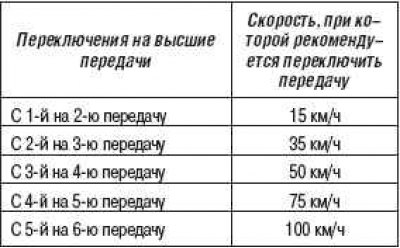


Engine 1.4 l and 1.8 l

Vehicles equipped with a diesel engine
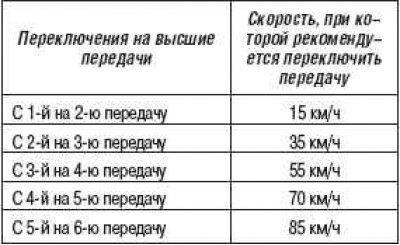


Vehicles equipped with a diesel engine

The car is equipped with an RPM indicator, which allows you to immediately notice when the tachometer needle approaches the unacceptable red zone while driving.

Maximum vehicle speeds in different gears


The tables below show the maximum permissible speeds of the vehicle in various gears. If you exceed the specified speed values, the tachometer needle will move into the red zone of the scale, indicating an unacceptably high engine crankshaft speed. At the same time, the electronic unit that controls the operation of the engine systems begins to limit the crankshaft speed, reducing the fuel supply. You can feel this by changing the engine operating mode. As soon as the tachometer needle leaves the red zone of the scale, the engine operation returns to normal.


To avoid engine damage, before shifting from a higher to a lower gear, make sure that the vehicle speed does not exceed the maximum permitted speed in the lower gear.
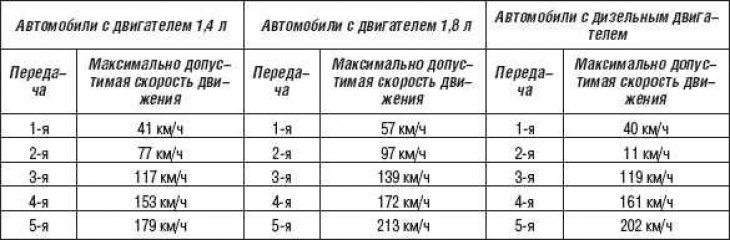
The car is equipped with an RPM indicator, which…

Reverse gear lock


Reverse gear lock


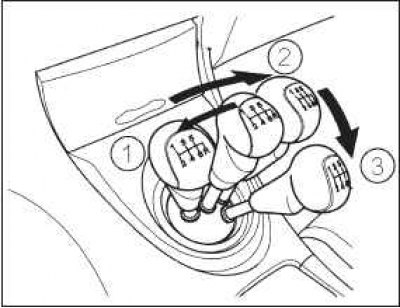
The lock is designed to prevent accidental shifting from any forward gear to reverse gear when the vehicle is moving at a certain predetermined speed. If you cannot engage reverse gear when the vehicle is stationary, follow the steps below.

1. Press the clutch pedal, move the lever towards first/second gear (in this case the lever is not moved out of the neutral position), then engage reverse gear.

2. If reverse gear still does not engage, set the parking brake and turn the ignition key to the "ACCESSORY" (I) or "LOCK" (0) position.


3. Press the clutch pedal and engage reverse gear.

4. Without releasing the clutch pedal, start the engine.

If you had to use this procedure, the car may be faulty. Contact your dealer's service center.
This article is available at: russian, bulgarian, belarusian, ukrainian, serbian, croatian, romanian, polish, slovak, hungarian
This information has been verified: Yaroslav Shiryaev
Share with friends:
◀ Previous
Civic 8: Driving and maintenance
Next ▶

Engine stop
Starting a diesel engine
Starting a gasoline engine
Running in a new car
Checking the battery
Towing a trailer
Wheels and tires — general information
Tire pressure
Monitoring the technical condition of tires
Wheel installation parameters and their balancing
See also other articles from Honda manuals:
Manual transmission Honda Accord 3 (1985-1989)
Driving a car with a manual transmission Honda Fit 1 (2001-2008)
Manual transmission oil Honda CR-V 1 (1995-2001, petrol)
Gear shift lever (models with manual transmission) Honda HR-V 1 (1998-2006, petrol)
Selector lever, automatic transmission Honda Avancier 1 (1999-2003, petrol)
Link in different formats to this article
Comments and feedback from visitors
No comments yet


How much will 29 + 36 ?


Civic 8 (2005-2011) 
  • General information
  • Technical data
  • Governing bodies
  • Driving and maintenance
  • Power unit
  • Gasoline engines (L13A)
  • Gasoline engines (R18A)
  • Diesel engines (N22A)
  • Cooling and lubrication (L13A)
  • Cooling and lubrication (R18A)
  • Cooling and lubrication (N22A)
  • Injection system (gasoline)
  • Injection system (diesel)
  • Toxicity reduction system
  • Troubleshooting
  • Transmission
  • Clutch and drive shafts
  • Mechanical gearbox
  • Chassis and running gear
  • Suspension and wheels
  • Steering
  • Brake system
  • Body and interior
  • Exterior (external elements)
  • Doors, locks and windows
  • Electrical equipment
  • Equipment and devices
  • Headlights and lighting
  • Power devices
  • Electrical circuits
Civic 7 (2000-2005) 
  • General information
  • User manual
  • Maintenance
  • Power unit
  • Engines D15B and D17A
  • K20A Engines
  • Overhaul engine
  • Cooling system
  • Lubrication system
  • Fuel injection system
  • Toxicity reduction system
  • Engine electrical equipment
  • Transmission
  • Clutch
  • Manual gearbox
  • Automatic gearbox
  • Variator (CVT)
  • Drive shafts
  • Chassis and running gear
  • Car suspension
  • Steering
  • Brake system
  • Body and interior
  • Exterior (external elements)
  • Interior (internal elements)
  • Doors, locks and windows
  • Heater and air conditioner
  • Manual air conditioner
  • Automatic air conditioner
  • Security system
  • Electrical equipment
  • Equipment and devices
  • Headlights and lighting
  • Windscreen wipers
  • Audio system
  • Electrical diagrams
Civic 6 (1995-2000) 
  • General information
  • Introduction to guide
  • User manual
  • Maintenance
  • Power unit
  • Engine in car (Civic)
  • Engine in car (Integra)
  • Engine overhaul
  • Cooling and heating
  • Power and exhaust systems
  • Engine electrical equipment
  • Engine management systems
  • Transmission
  • Manual gearbox
  • Automatic transmission (AT/CVT)
  • Clutch and drive shafts
  • Chassis and running gear
  • Brake system
  • Car suspension
  • Steering
  • Body and interior
  • Exterior (external elements)
  • Interior (internal elements)
  • Doors, locks and windows
  • Electrical equipment
  • Equipment and devices
  • Electrical circuits
Civic 5 and 6 (1991-2000) 
  • Power unit
  • SOHC engines
  • DOHC engines
  • Engine overhaul
  • Cooling and lubrication system
  • Intake and exhaust system
  • Fuel injection system (SOHC)
  • Fuel injection system (DOHC)
  • Carburetor
  • Transmission
  • Clutch
  • Manual gearbox S4C
  • Manual gearbox S40
  • Automatic gearbox
  • Drive shafts
  • Chassis and running gear
  • Car suspension
  • Steering
  • Brake system
  • Body and interior
  • Body elements
  • Heater and air conditioner
  • Electrical equipment
  • Power devices
  • Equipment and instruments
  • Electrical circuits
Civic 3 and 4 (1983-1991) 
  • General information
  • Maintenance
  • Power unit
  • Engine in a car
  • Engine overhaul
  • Cooling system
  • Power and exhaust system
  • Engine electrical equipment
  • Emission control system
  • Transmission
  • Mechanical gearbox
  • Automatic gearbox
  • Clutch and drive shafts
  • Four-wheel drive
  • Chassis and running gear
  • Brake system
  • Car suspension
  • Steering
  • Body and interior
  • Body elements
  • Electrical equipment
  • Equipment and devices
  • Electrical circuits
HondaBook.ru © 2018–2026 • Mobile version • Sitemap: EN BG BY UA RS HR RO PL SK HU • Feedback • Driver Information • Search system • Bookmark
Accord 3 (1985-1989) • Accord 6 (1997-2002) • Civic 3 and 4 (1983-1991) • Civic 5 and 6 (1991-2000) • Civic 6 (1995-2000) • Civic 7 (2000-2005) • Civic 8 (2005-2011) • Fit 1 (2001-2008) • CR-V 1 (1995-2001) • CR-V 2 (2002-2006) • HR-V 1 (1998-2006) • Avancier 1 (1999-2003) •
 
This website uses cookies to ensure proper functioning. By clicking "OK," you agree.