
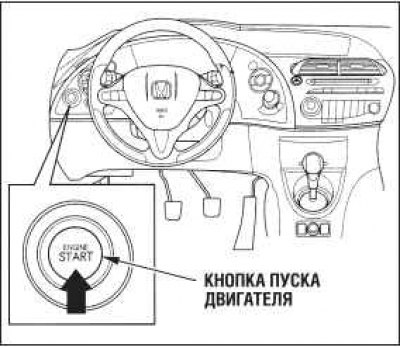
1. Apply the parking brake.
2. When the ambient temperature is low, turn off all auxiliary electrical consumers to reduce the load on the battery.
3. Press the clutch pedal all the way down and shift the gear lever to neutral position.
4. Turn the ignition key to the "ON" (II) position.
5. Without pressing the accelerator pedal, press the button "ENGINE START" ("Start Engine") to engage the starter. If the engine does not start immediately, continue to crank the crankshaft with the starter, but not longer than 15 seconds. Before attempting to start the engine again, pause for at least 10 seconds to allow the electric starter to cool down.
Attention! The car has an immobilizer that prevents thieves from starting the engine. If you try to use a key with the wrong code or another device to start the engine, the engine fuel system stops working.
6. If the engine fails to start after continuously operating the starter for 15 seconds, or if the engine starts and then stops immediately, try to start the engine again (see operation 5), by pressing the accelerator pedal to half of its full travel. After the engine has started successfully, release the accelerator pedal to avoid a sharp increase in engine speed at idle.
7. If the engine still fails to start, fully depress the accelerator pedal and hold it down while the starter operates. This will help flush out any excess fuel that has entered the intake manifold and engine cylinders. If the engine still fails to start, try again by partially depressing the accelerator pedal (see operation 6).
Attention! At low ambient temperatures, starting the engine is difficult. In high altitude conditions (at an altitude above sea level of more than 2400 m), where the air is very thin, starting the engine becomes even more difficult.
If the outside temperature is below freezing or if the vehicle has not been used for several days, allow the engine to warm up for a few minutes before driving.