
Contents: Checking the weight of the vehicle…⇊ Trailer towing equipment ⇊ Towing hitch ⇊ Safety chains ⇊ Trailer braking system ⇊ Trailer exterior lighting and…⇊ Additional trailer equipment ⇊ Preparing to tow a trailer ⇊ Towing a trailer ⇊ Safety precautions when towing a…⇊ Driving speed and gear shifting ⇊ Turning and braking ⇊ Cross-country driving ⇊
Checking the weight of the vehicle and trailer
The most reliable way to check whether the weights of the vehicle and trailer meet the requirements is to weigh them.
Load the vehicle and trailer as they are normally used in a road train and weigh them on a truck scale. Determine the values of the total mass of the vehicle and trailer, as well as the masses per axle of the vehicle and trailer and per coupling. Then compare the obtained values with the maximum permitted masses for the vehicle.
Trailer towing equipment
To transport a trailer, special equipment is required, which must correspond to the design of the vehicle and trailer, the towing conditions and the characteristics of the cargo being transported.
Obtain information about the trailer and the necessary equipment from the dealer where you purchased or rented the trailer. Follow all the trailer manufacturer's recommendations for its installation and operation, as well as the recommendations given in this section of the Manual. Strictly comply with the requirements of the Road Traffic Regulations and other regulations regarding the use of trailers and equipment for towing them.
Towing hitch
The towing hitch must be securely attached to the supporting structure of the vehicle body.
Safety chains
When connecting a trailer to a vehicle, be sure to use safety chains. The ends of the safety chains must be securely fastened to the appropriate places on the trailer and the vehicle's towing hitch. Make sure that the chains cross under the trailer's drawbar. This will prevent the front end of the drawbar from falling onto the road if the trailer and vehicle become uncoupled. The chains must be long enough not to interfere with the vehicle's ability to turn around with minimal radii. However, the safety chains must not be allowed to drag along the ground.
Trailer braking system
If you are going to buy a trailer equipped with brakes, make sure that they have an electric control drive. The design of the hydraulic drive of the vehicle's service brake system does not provide for the possibility of connecting the trailer's brake system to it. Any method of connecting the trailer's brake system to the vehicle's hydraulic brake drive, no matter how attractive it may seem, will lead to a deterioration in the vehicle's braking efficiency and a decrease in traffic safety.
For questions regarding the installation of the trailer's electrical brake control system, refer to the trailer manufacturer's documentation.
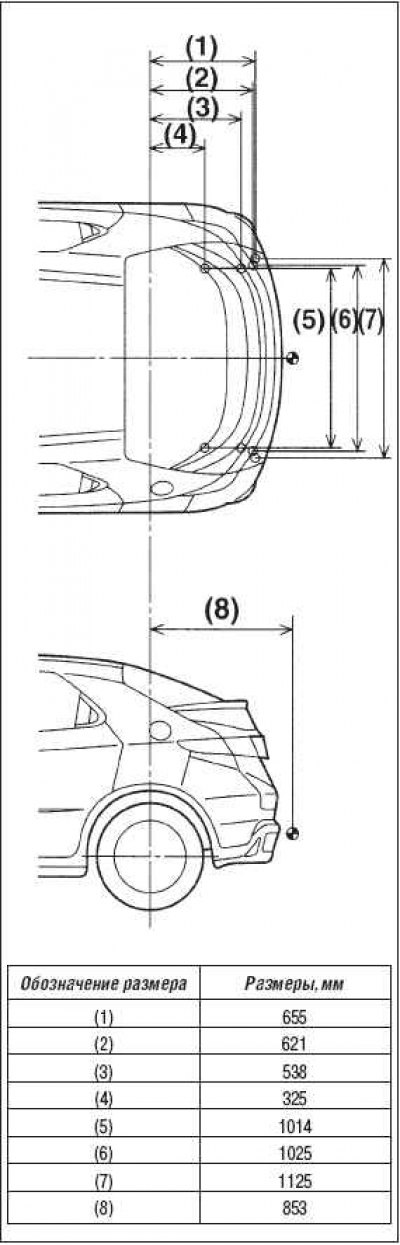
Location of attachment points and rear overhang of the towing hitch
Note: 1. With iconsthe attachment points for the towing hitch are indicated.
Note 2. With the iconthe position of the center of the hinge of the towing hitch is indicated.
Trailer exterior lighting and signaling devices
Trailer exterior lighting system (as is the rest of his equipment), must comply with the capabilities of the vehicle and the legal requirements of the country in which it is operated.
The vehicle may be equipped with an electrical connector for connecting external trailer lighting devices.
Trailer wiring varies among brands. Contact an electrical specialist to check and, if necessary, install the trailer electrical equipment required to connect the trailer lighting system. Incorrect connection of the trailer electrical equipment to the vehicle electrical system may result in a malfunction of the vehicle electrical system.
Before connecting the trailer lighting system to the vehicle's electrical system, be sure to consult your Honda dealer.
Additional trailer equipment
Towing a trailer may require the installation of special rear-view mirrors on your vehicle. Check local laws and traffic regulations regarding towing trailers by cars. You may want to install such mirrors on your vehicle even if their presence is not required by current regulations. Attach a trailer to your vehicle and assess the degree to which the view behind the vehicle is impaired through the standard rear-view mirrors. If the view is poor, special rear-view mirrors should be installed on your vehicle for safety reasons.
Check with the trailer dealer or rental agency to see if it is recommended to install additional equipment on your trailer.
Preparing to tow a trailer
Before starting a trip with a car and trailer, it is necessary to perform a control inspection and check of the car and trailer:
perform daily inspection and maintenance of the vehicle. Check the condition of the tires and their pressure, as well as the serviceability of the brake system, suspension and engine cooling system;
make sure the trailer is ready for travel and in good condition;
make sure that all trailer load capacity specifications do not exceed maximum permissible values;
check the reliability of the trailer drawbar, safety chains and other elements connecting the trailer to the vehicle;
securely fasten all items transported on the trailer so that they cannot shift during movement.
Towing a trailer
Make sure that all external lighting devices and brake mechanisms of both the trailer and the vehicle are in good working order.
Check the technical condition of the tires. Measure the air pressure in the tires of the car and trailer (including spare tire). The trailer tyre pressure must correspond to the value recommended by the trailer manufacturer.
Check the current "Road Traffic Regulations" restrictions on the maximum speed of a passenger car with a trailer. If you are planning to travel to several countries, find out in advance the specifics of local requirements and restrictions regarding towing a trailer with a passenger car, as each country may have its own specifics.
The speed limit for a road train consisting of a passenger car and a trailer is set at 100 km/h.
Safety precautions when towing a trailer
The additional weight and increased dimensions of the road train formed by the car and trailer significantly affect the controllability and traction capabilities of the car. Therefore, when transporting a trailer, it is necessary to have some special skills and driving techniques.
Driving speed and gear shifting
When transporting a trailer, the speed must be lower in any driving conditions than in the same conditions for a car without a trailer. Observe the speed limits established by the Road Traffic Regulations. At high speeds, the trailer may "swerve", which will make it difficult to control the car.
Turning and braking
Remember that the length of a road train is significantly greater than the length of a single car. When turning, move more slowly than you are used to. Keep in mind that when turning a road train, the trailer moves along an arc of a smaller radius than the car and may run into or collide with an obstacle that the car easily passed. It should be taken into account that the braking distance of a car towing a trailer increases. Therefore, when moving with a trailer, you should maintain an increased distance from the car in front. Braking should begin earlier than for a car without a trailer. Try to avoid sudden braking and turns. This can lead to the road train folding or the trailer tipping over.
Cross-country driving
When driving up long hills, carefully monitor the engine temperature using the pointer gauge on the instrument panel. If the pointer is close to the engine overheating zone (red zone of the scale), then turn off the air conditioner and reduce your speed. If necessary, stop on the side of the road and let the engine cool down.
When driving down long descents, reduce speed and shift into a lower gear to use engine braking. On steep descents, engage 1st gear.