
Warning! Remember that gasoline is a highly flammable liquid - when working with fuel system components, observe all accepted fire safety measures. Do not smoke or approach the work area with an open flame or unprotected portable lamp. Do not service the system in a room equipped with heating devices operating on natural gas and equipped with a pilot flame (such as water heaters and clothes dryers). Remember that gasoline is a carcinogen that can cause cancer - try to avoid contact with exposed areas of the body, use protective rubber gloves, and wash your hands thoroughly with warm water and soap if you accidentally come into contact with fuel. Immediately collect any spilled fuel and do not store fuel-soaked rags near open flames. Remember that the fuel system of fuel-injected models is constantly under pressure. Before disconnecting the fuel lines, release any residual pressure in the system (for more information, see Chapter Power and exhaust systems). Wear safety glasses when servicing fuel system components. Always keep a class B fire extinguisher on hand!
1. You should start the procedure only after it has completely cooled down (at least three hours after the engine has stopped).
2. The fuel filter is located in the engine compartment on its rear bulkhead.
3. Release the pressure in the fuel system (see Chapter Power and exhaust systems).
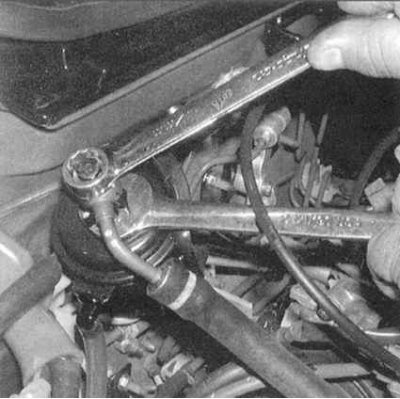
4a. Place paper towels under the filter to collect any spilled fuel. Loosen the hollow bolt of the union connection.
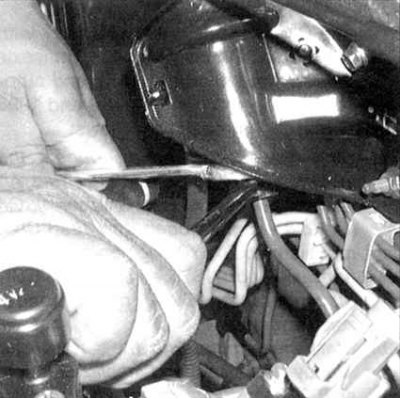
4b. Unscrew the threaded fitting.
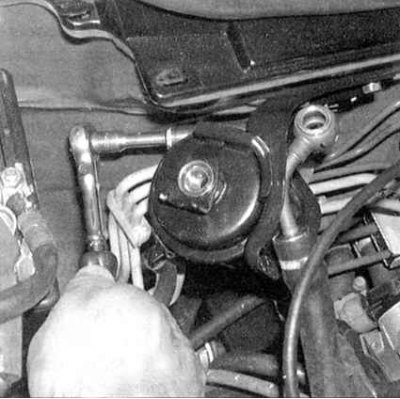
4c. Loosen the clamp bolt and remove the filter from the engine compartment (see accompanying illustrations).
Note: If possible, use a socket wrench to disconnect the fuel line.
5. Installation is carried out in the reverse order. Do not forget to replace the sealing washers on both sides of the hollow union bolt, which should then be tightened to the required force. Make sure that the threaded union is tightened securely. Start the engine and carefully inspect the filter for signs of leaks.