
Honda also recommends that all rubber fuel elements be replaced every 100,000 km. This prevents aging and wear of the rubber.
CAUTION: Fuel injected systems operate at high fuel pressures and retain pressure in the fuel lines when the engine is OFF. Pressure must be relieved before any work is performed on the fuel lines or fuel system components. Carbureted vehicles may also retain residual pressure in the tank and lines. Always remove the filler cap before performing any work on the fuel lines or fuel system components. Slowly relieve pressure and contain leaks. Always have fire sand and a fire extinguisher on hand.
Reducing fuel pressure
Fuel Injected Cars
1. Disconnect the negative battery terminal.
2. Remove the fuel filler cap.
3. The fuel hose on top of the fuel filter is held in place by a large bolt (banjo bolt). On top of this bolt is a smaller bolt which is the service bolt. Use an open-end wrench to hold the banjo bolt and a 6mm socket wrench for the service bolt.
4. Place a cloth over the service bolt. Slowly loosen it one turn. The pressure in the system will decrease as the fuel flows out, and the fuel will be absorbed by the cloth. Now be careful with the cloth - it has become flammable.
5. Even though the system pressure is now lower than normal, always wrap the fuel line with rags before disconnecting it; some pressure drop may remain in the system.
Removal and installation - carburetor engines
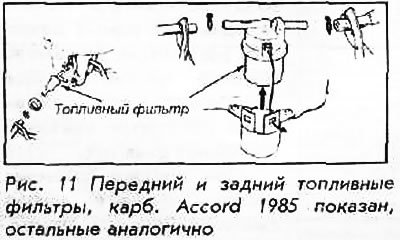
These cars use 2 replaceable fuel filters. The small one is in the fuel line under the hood; the large one is located at the back, next to the left wheel.
Whenever replacing filters, be careful to avoid introducing dirt into the line. Also, pay attention to the correct installation position.
You can - and quite likely - install the filter backwards.
In front
1. Press the tail and unhook the filter.
2. Loosen the fuel line clamps and slide them back.
3. Using a twisting motion, disconnect the fuel line from the filter.
4. To install, use a new fuel filter and reverse the removal procedures. Start the engine and check for leaks.
Behind
1. Raise and securely support the rear of the vehicle. Remove the left rear wheel.
2 Press the tab on the fuel filter retainer and remove the retainer from the holder.
3. Release the two fuel line retaining clips. Be careful not to damage the lines.
4. Loosen the fuel line clamps and slide them back.
5. Using a twisting motion, pull the fuel line away from the fuel filter; remove the filter.
6. For installation, use a new fuel filter and reverse the removal procedures.
Removal and installation - fuel injected engines
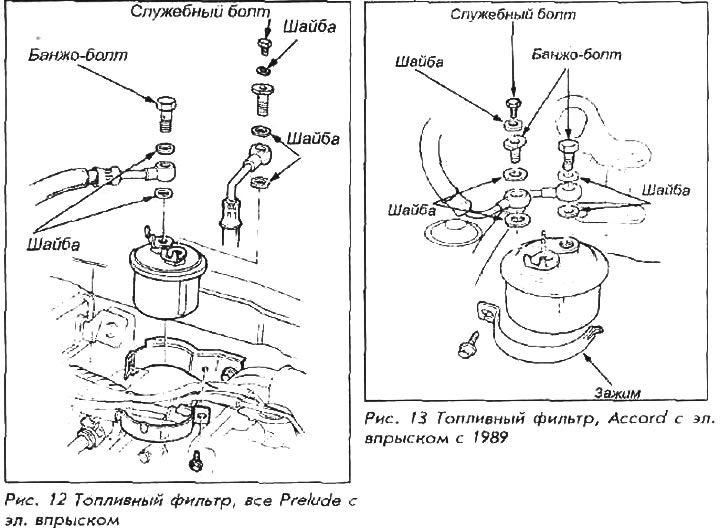
The fuel filter in the tank is located in the engine compartment. When purchasing a new filter, buy new washers and gaskets for the banjo and service bolts. Careless replacement of these gaskets will result in fuel leaks at high pressure. Replacement of gaskets is mandatory.
1. Disconnect the negative battery terminal.
2. The fuel system is under pressure. Slowly release the pressure and contain the leak. Take precautions - do not smoke. Always have fire sand and a fire extinguisher on hand.
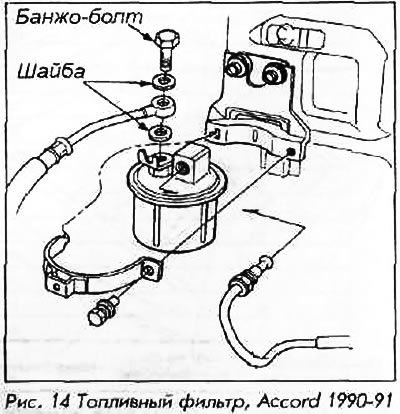
3. Remove the banjo bolts and gaskets from the fuel filter. For Accord (1990-91), disconnect 1 banjo bolt and loosen the fuel line hose flare.
4. Remove the fuel filter clamp bolt and the filter itself.
5. Install the new filter and screw in the bolts.
6. The upper and lower washers for each banjo bolt and the washers for the service bolt MUST be replaced whenever the bolts have become loose. Install the washers and banjo bolts. Tighten the banjo bolts to 22 Nm. For 1990-91 Accord, tighten the hose to 38 Nm.
7. Tightening torque of the service bolt - 9 Nm.
8. Start the engine and check for leaks. The engine may run rough for a while until the full fuel pressure returns to normal.