
Contents: Examination ⇊ Adjustment ⇊
Examination
1. The need to adjust valve clearances arises only after replacing or repairing valve mechanism components.
2. The simplest way to check the valves is to listen to the engine with the hood open. The need for adjustment is indicated by increased noise levels emitted by the valve mechanism.
Adjustment
Checking and adjusting valve clearances is performed when the engine is cold.
1. Remove the cylinder head cover (see the relevant Section of the Chapter Engine).
2. Turn the crankshaft and bring the piston of the first cylinder to the TDC position at the end of the compression stroke (see Chapter Engine). The shaft rotates in the direction of normal rotation (clockwise) until the TDC mark on its pulley aligns with the pointer on the lower timing belt cover and the UP mark on the camshaft gear is at the 12 o'clock position.
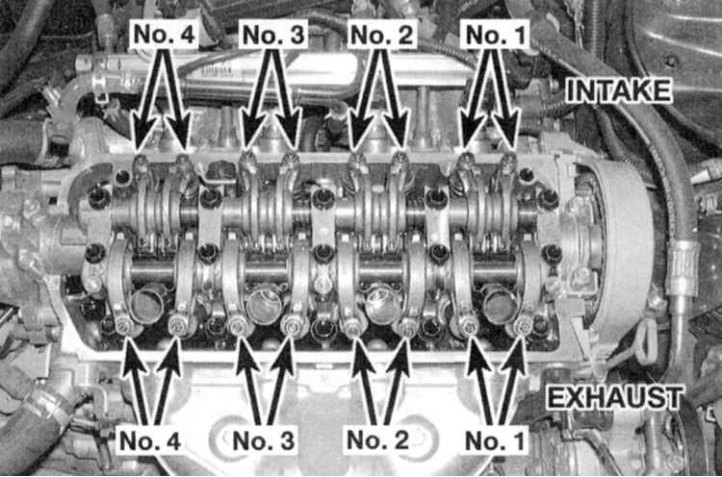
3. Having brought the engine to this position, you can begin checking and adjusting the valves of the first cylinder (see accompanying illustration).
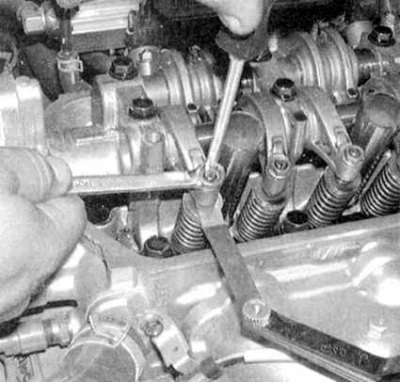
4a. Start with the inlet valve. Insert the feeler gauge blade to the required thickness (see Specifications) into the gap between the end of the valve stem and the valve drive rocker arm (civic models), or the working protrusion of the corresponding cam of the intake camshaft and the valve drive lever (integra models) (see accompanying illustrations).
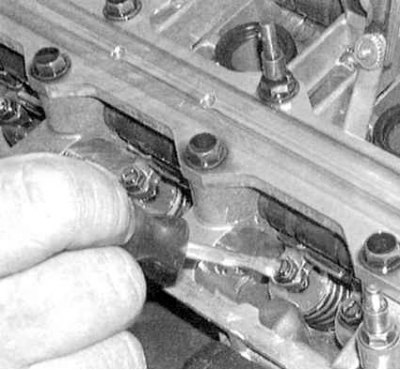
4b. The feeler gauge should slide through the gap with little resistance. If necessary, loosen the lock nut and loosen the adjusting screw, then begin tightening the screw until the desired effect is achieved on the feeler gauge blade.
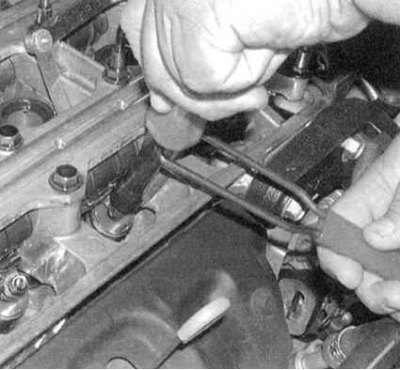
5. Using a screwdriver, secure the adjusting screw from turning and tighten the lock nut (see accompanying illustration). Make sure that the clearance has not changed during tightening of the nut, then, acting in a similar manner, adjust the clearances of the second intake valve and two exhaust valves one by one. 6. Having turned the crankshaft 180° counterclockwise (the camshaft pulley should turn 90°), bring the piston of the third cylinder to the TDC position of the end of the compression stroke. In this case, the UP mark on the camshaft gear should move to the 9 o'clock position. Check and adjust the valves of the third cylinder.
7. Turn the crankshaft another 180° counterclockwise (the UP mark will move down to 6 o'clock) and adjust the valves of the fourth cylinder.
8. Turn the crankshaft 180° again (the UP mark should move to the 3 o'clock position). And repeat the procedure for the valves of the second cylinder.
9. After completing the valve adjustment, reinstall the cylinder head cover (see the relevant Section of the Chapter Engine).