
Checking disc runout
1. Loosen the wheel nuts slightly, then raise the car and secure it on safe stands. Remove the front wheels.
2. Remove the brake pads.
3. Inspect the disc surface for damage and cracks. Clean the disc thoroughly and remove rust.
4. Use the wheel nuts and suitable plain washers to clamp the disc securely to the hub, then attach the digital indicator as shown and measure the runout 10mm from the outer edge of the disc.
Disc runout:
Operational value: 0.10 mm
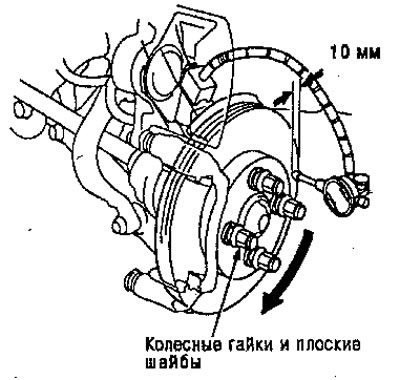
5. If the disc runout exceeds the operating value, grind the disc.
Maximum size after processing: 19 mm
Note: A new disc should be ground if its runout is higher than 0.10 mm.
Checking the thickness of the disc and parallelism of the planes
1. Slightly loosen the front wheel nuts, then raise the car and secure it on safe stands. Remove the front wheels.
2. Remove the brake pads.
3. Using a micrometer, measure the disc thickness at eight points (approximately 45° apart) 10 mm deep from the outer edge of the disc.
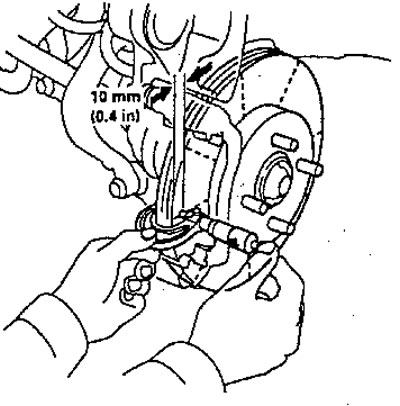
Brake disc thickness:
Standard: 20.9-21-8 mm
Limit value after processing: 19.0 mm
Note: Replace the brake disc if the smaller dimension is less than the thickness limit.
Deviation of parallelism of planes: 0.015 mm.
Note: This is the maximum allowable difference between thickness measurements.
4. If the disc parallelism deviation exceeds the operating value, regrind the disc.