
HondaBook.ru
Auto companies Volkswagen Auto companies Ford Auto companies Lada Auto companies Skoda Auto companies BMW Auto companies Mazda Auto companies Peugeot
English Русский
Български
Беларускі
Український
Српски
Hrvatski
Română
Polski
Slovenský
Magyar
Bookmark Contacts Sitemap   


Accord Civic Fit / Jazz CR-V HR-V Others Articles
Accord 3 (1985-1989) Accord 6 (1997-2002)

Front Disc Brake Pads — Inspection (Honda Accord 3)

  • Main
  • Honda Accord
  • 3 (1985-1989)
  • Chassis and running gear
  • Brake system
  • Front Disc Brake Pads — Inspection
0
Contents: Wear indicators ⇊ Inspection ⇊

Wear indicators


The front brake pads have a metal loop that contacts the disc when the friction surface is worn down to a minimum. Wear indicators make a constant, distinct metallic sound that is easily audible. The sound can be described as being like fingernails scraping a chalkboard or crickets in a field. A clue that it is a wear indicator and not some other brake noise is that the sound is audible when the vehicle is moving WITHOUT using the brakes. (There may be no sound when braking.)

It should be noted that due to the nature of the design, no disc brake system can ever be quiet. Each system includes various pads, plates, and hangers to suppress brake noise, but it is not possible to completely eliminate all noise. Some brake noise - high or low frequency - can be controlled and possibly reduced, but cannot be completely eliminated.

Inspection


The front brake pads can be inspected without removing them. With the front of the vehicle raised and securely supported, remove the wheel(s). Unlock the steering column lock and turn the wheel until the brake caliper comes out from under the fender.

Inspect the pads - inner and outer - through the window in the center of the caliper. Look at the thickness of the pad friction surface (the part that actually squeezes the disc), which is more important than the thickness of the backing plate, which does not change with wear. Replace the brake pads if the thickness is less than 2.4 mm.
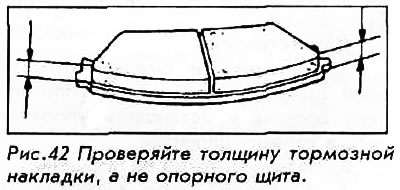


Inspect the pads - inner and outer - through the…


Keep in mind that you are looking at the profile of the pad, not the entire pad. Brake pads can wear to a cone that may not be visible. It is also impossible to check the contact surface for splits or cracks from this position. This quick check is only useful to a limited extent; a detailed inspection requires removal.

(The text of the article is available on the website: www.HondaBook.ru)
This article is available at: russian, bulgarian, belarusian, ukrainian, serbian, croatian, romanian, polish, slovak, hungarian
This information has been verified: Yaroslav Shiryaev
Share with friends:
◀ Previous
Accord 3: Brake system
Next ▶

Bleeding the brake system
Brake system pipes and hoses
Distribution valve — removal and installation
Brake booster — repair
Brake booster — removal and installation
Front Disc Brake Pads — Removal and Installation
Front Brake Caliper — Removal and Installation
Front Brake Caliper — Repair
Front brake disc — removal and installation
Front brake disc — inspection and regrinding
See also other articles from Honda manuals:
Replacement of brake pads of disc brake mechanisms Honda Civic 6 (1995-2000)
Replacing the front brake pads Honda Fit 1 (2001-2008)
Front disc brake pads Honda CR-V 1 (1995-2001, petrol)
Front Brake Pads — Checking and Replacing Honda HR-V 1 (1998-2006, petrol)
Front Brake Discs — Brake Disc Grinding Honda Avancier 1 (1999-2003, petrol)
Link in different formats to this article
Comments and feedback from visitors
No comments yet


How much will 32 + 45 ?


Accord 6 (1997-2002) 
  • General information
  • Introduction to the guide
  • User manual
  • Maintenance
  • Power unit
  • Four-cylinder engines
  • Six-cylinder engines
  • Engine overhaul
  • Cooling system
  • Heater and air conditioner
  • Power and exhaust systems
  • Engine electrical equipment
  • Engine management
  • Transmission
  • Mechanical gearbox
  • Automatic gearbox
  • Clutch and drive shafts
  • Chassis and running gear
  • Brake system
  • Car suspension
  • Steering
  • Body and interior
  • Exterior (external elements)
  • Interior (internal elements)
  • Electrical equipment
  • Equipment and devices
  • Electrical circuits
Accord 3 (1985-1989) 
  • General information
  • Maintenance
  • Power unit
  • Engine adjustment
  • Engine repair
  • Engine electrics
  • Emission management
  • Engine management (carburetor)
  • Electronic injection
  • Programmable injection
  • Schematic of emission system
  • Fuel system
  • Feedback management
  • Transmission
  • Manual gearbox
  • Automatic gearbox
  • Clutch
  • Chassis and running gear
  • Front suspension
  • Rear suspension
  • Steering
  • Brake system
  • Electrical equipment
  • Ventilation and heating
  • Air conditioner
  • Cruise control system
  • Equipment and devices
HondaBook.ru © 2018–2026 • Mobile version • Sitemap: EN BG BY UA RS HR RO PL SK HU • Feedback • Driver Information • Search system • Bookmark
Accord 3 (1985-1989) • Accord 6 (1997-2002) • Civic 3 and 4 (1983-1991) • Civic 5 and 6 (1991-2000) • Civic 6 (1995-2000) • Civic 7 (2000-2005) • Civic 8 (2005-2011) • Fit 1 (2001-2008) • CR-V 1 (1995-2001) • CR-V 2 (2002-2006) • HR-V 1 (1998-2006) • Avancier 1 (1999-2003) •
 
This website uses cookies to ensure proper functioning. By clicking "OK," you agree.